HVAC Postcard Marketing: The 2026 Guide for HVAC Companies
HVAC postcard marketing in 2026. Why shared 9x12 mailers beat solo HVAC postcards, real ROI numbers, and the seasonal plan that fills your service calendar.
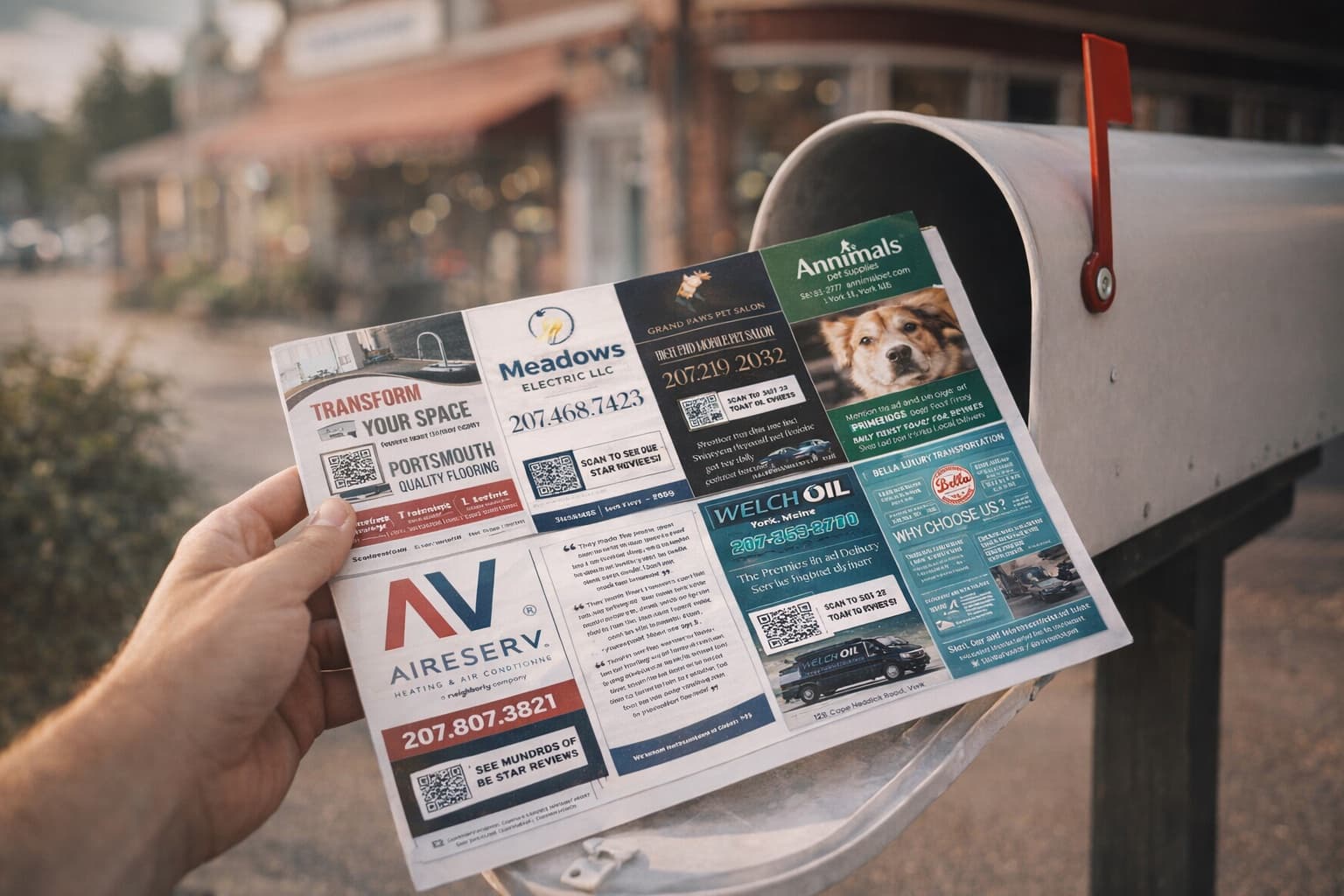
If you run an HVAC company in 2026 and you're spending most of your marketing dollars on Google Ads, Facebook Ads, or Yelp, you're competing in the most crowded, most expensive marketing channels in your industry. Cost per click on "HVAC near me" type keywords is brutal — easily $20–$50 in most metros. HVAC postcard marketing, on the other hand, is quietly producing the best ROI of any HVAC marketing channel in 2026 for the companies who've moved to the right format. That format? A shared 9x12 oversized postcard where you're the only HVAC contractor on a card going to 5,000 homes in a specific neighborhood. Same direct mail concept your competitors did 10 years ago — totally different economics. Let me show you exactly why this works.
If you sell HVAC service, replacement systems, or maintenance plans, this is the marketing math that pays attention.
HVAC happens to match every single criteria for a winning direct mail industry. Here's why HVAC postcards work so well.
1. Strong average job value with seasonal urgency. A typical HVAC service call is $200–$500. A repair averages $500–$2,000. A full system replacement runs $5,000–$15,000+. And HVAC has a unique trigger pattern — your AC breaks in July or your furnace dies in December and the customer needs a contractor RIGHT NOW. A postcard sitting on the kitchen counter at the moment of need wins.
2. Geographic service area. HVAC companies serve specific service radiuses. EDDM mailing routes target specific neighborhoods. The match is perfect — you're not paying to reach prospects you can't serve.
3. Recurring revenue model. One closed customer doesn't just produce a one-time job. HVAC customers convert into maintenance plan members ($150–$300/year) and become "your" HVAC company for the next 10–15 years. Customer LTV is enormous compared to the marketing cost per acquired customer.
4. Trust + safety dynamics. Homeowners care a LOT about who works on their HVAC system because of safety concerns (carbon monoxide, electrical, refrigerant). A neighborhood mailer with your ad next to other trusted local businesses provides exactly the trust signal homeowners need.
5. Already-paying competitors. Most HVAC companies in your service area are already spending on Google, Facebook, or radio. Direct mail is where the smart ones quietly win because most competitors haven't figured out the new shared 9x12 format yet.
One closed HVAC customer is worth $5,000–$15,000 immediately and tens of thousands over their lifetime. The marketing cost per closed customer needs to come from this math, not from CPC averages.
Most HVAC companies are stuck in a frustrating loop with their current marketing channels.
Google Ads: "HVAC repair" keywords cost $20–$50 per click in major metros. At 3% conversion to lead, that's $700–$1,700 per lead. At 30% close rate, that's $2,300–$5,700 per closed customer. Profitable, but not great — and the cost is rising every year.
Facebook Ads: Cheaper per impression than Google, but qualifying HVAC homeowners on Facebook is harder. You're paying for impressions that may or may not be homeowners or in your service area. Cost per qualified lead typically lands at $100–$200, cost per closed customer at $400–$800.
Yelp / Angie's List: Lead-gen platforms bill you $50–$150+ per "exclusive" lead, often shared with multiple competitors despite the marketing pitch. Quality varies wildly. Many HVAC owners express frustration with these platforms.
Door-to-door canvassing: Effective for storm or weather-triggered urgency, but doesn't scale and burns out reps.
Solo HVAC postcards (the old way):
Cost line
Amount
Mailing list (5,000 homeowner addresses)
$200–$500
Printing (4x6 or 6x9, full color, 5,000 pieces)
$1,000–$1,500
First-class postage (~73¢/piece)
$3,650
Design + project management
$300–$500
Total per send
$5,150–$6,150
That's $5K–$6K per send for a smaller postcard format that gets buried in mail piles. Most HVAC companies that try solo postcards run them once, see modest results, and conclude "direct mail doesn't work."
It's not direct mail that doesn't work. It's the format.
Here's the format winning quietly in 2026. A 9x12 oversized postcard mailed via USPS EDDM, where ~16 local businesses (including ONE HVAC company — you) split the cost. You buy a single slot for $500. Your ad goes to 5,000 homes in a specific neighborhood you select.
Metric
Solo HVAC postcard
9x12 shared mailer slot
Card size
4x6 or 6x9 (small)
9x12 (dominant)
Cost per mailing
$5,000–$6,000
$500
Postage rate
~73¢ first-class
~26¢ EDDM (split 16 ways)
Households reached
5,000
5,000
Visual impact
Buried in mail stack
Sits on top
Frequency feasible
1–2x/year
4–12x/year
HVAC exclusivity on card
None
Yes — only HVAC on the card
For about 8–10% of solo postcard cost, you reach the same 5,000 households with way more visual impact and territorial exclusivity over other HVAC contractors. That's not a small improvement — it's a structural economic shift.
Here's what the actual annual numbers look like for an HVAC company running shared 9x12 mailer slots.
Metric
Value
Cost per slot
$500
Cards per year (quarterly)
4
Annual marketing spend
$2,000
Households reached per year
20,000 (5,000 × 4)
Typical inquiries per slot (60-day window)
25–60
Annual inquiries
100–240
Typical HVAC close rate on inbound calls
25–40%
Estimated annual closed jobs
25–96
Mix: service ($300 avg) + replace ($8K avg)
Roughly 70/30
Annual revenue from postcard marketing
$110,000–$425,000
Even at the conservative end — 25 jobs (let's say 20 service calls at $300 + 5 replacements at $8K) = $46,000 in revenue from $2,000 spent. That's 2,300% ROI. At the higher end, you're producing $425K from $2K. The math isn't subtle.
Most HVAC companies are spending $20K–$50K/year on Google + Facebook + Yelp combined and getting 2–4x return. Switching $5K of that spend to direct mail and producing 50x return is the rebalance every HVAC company should be running.
Strategy: Heavy mailing volume during cold snaps. Furnace failures peak. Same urgency dynamic as summer AC.
Best offers: "Furnace not heating? 24/7 service — same-day," "Emergency furnace replacement — financing available"
The smart HVAC companies time their card mailings to land in mailboxes 1–2 weeks BEFORE seasonal demand peaks. Spring tune-up cards land in late February. AC repair cards land in early June. Furnace cards land in October. Winter emergency cards land in early December.
Find an operator running cards in your service area, pay $500 per slot, provide your ad and tracking, get the leads. Standard path for most HVAC companies.
Run your own card. Your HVAC slot is "free" because the other 15 slots cover the cost and produce profit. Best for HVAC companies with extra capacity in operations and a network of local business contacts.
Full transparency — running cards as the operator is taught inside the 9x12 Method community. Most HVAC companies just buy slots and skip the operator complexity.
Critical for HVAC companies because of the long customer LTV. Here's the tracking stack.
QR code on every slot. Generates a tracked link to your booking page or phone number. Use ScanLab or any QR generator with analytics.
Tracked phone number. Critical for HVAC because most leads call rather than scan. CallRail or Twilio number that forwards to your main line. Every call is logged.
Source tagging in CRM. Tag every postcard-acquired customer with the card date so you can attribute long-term LTV (maintenance plans, future replacements, referrals) back to specific cards.
Math you should run quarterly:
Cost per inquiry from postcard
Cost per closed customer from postcard
Maintenance plan attach rate from postcard customers
12-month LTV per postcard customer
ROI as a percentage
Real example math: Spent $2,000 on 4 quarterly cards. Got 165 inquiries. Closed 60 jobs (mix of service and replacements). Average revenue per closed customer in year 1 (including maintenance plan attachment): $1,200. Total revenue = $72,000. ROI = 3,500%.
Then year 2 of customer LTV adds another $50K+ from those same 60 customers without spending any new marketing. The compounding is why HVAC companies that switch to postcards rarely go back.
Yes — HVAC postcard marketing produces some of the highest ROI of any HVAC marketing channel in 2026, especially in the shared 9x12 mailer format. HVAC companies typically see 2,300%–10,000%+ ROI on shared 9x12 slots because one closed replacement system ($5K–$15K) covers 10–30 cards. The model works because HVAC has strong job value, geographic concentration, urgent demand triggers, and high customer LTV.
A typical effective HVAC postcard marketing budget is $2,000–$6,000/year (4–12 shared 9x12 slots). This produces 100–500 inquiries and 25–125 closed jobs annually depending on close rate. Compare to typical HVAC Google Ads spend of $20K–$50K/year producing fewer total leads. Most HVAC companies should rebalance 20–30% of their digital spend to direct mail for higher overall lead volume.
Time HVAC postcard mailings to land in mailboxes 1–2 weeks BEFORE seasonal demand peaks. Spring tune-up cards = late February. Summer AC repair cards = early June. Fall furnace cards = early October. Winter emergency cards = early December. Saturating mailboxes during peak need windows produces 3–5x normal response rates compared to off-season mailings.
A high-converting HVAC postcard slot includes: a pain-point or specific offer headline (NOT the business name), a clean photo of your branded team or installed equipment, a specific dollar offer with deadline, a big phone number AND QR code, financing language if available ("0% APR for 12 months"), and HVAC-specific trust markers (NATE certified, licensed, insured, BBB rating). Avoid generic "Best HVAC in town!" claims.
Yes — many HVAC companies run their own 9x12 shared mailers where they're the HVAC slot AND they sell the other 15 slots to local businesses. This makes their HVAC advertising effectively free (the other slot sales cover the card cost) AND generates $5,001 profit per card. Best for HVAC companies with extra time and existing local business relationships. The full operator playbook is taught in the 9x12 Method community.
HVAC postcard leads typically close at 25–40% on inbound calls (compared to ~10–15% on Facebook ads or Google clicks). The higher close rate is because postcard inquiries are higher-intent — the homeowner saved the card specifically because they have an HVAC need. Postcard leads also typically convert to maintenance plans at higher rates (40–60% attach rate vs. 20–30% from cold digital channels).
That's HVAC postcard marketing in 2026. Same direct mail playbook, completely different economics from the solo postcards your competitors are still running. Buy slots in your service neighborhoods, time your mailings to peak season demand, design ads that lead with offers, and track every lead in your CRM with long-term LTV in mind.
As always, I'm rooting for you. Peace.
Ready to run your own card?
Get the course, scripts, tools, and weekly coaching inside the 9x12 Method community.

 Mitchell Tebo