Realtor Postcard Marketing: The 2026 Guide for Agents
Realtor postcard marketing in 2026 — why shared 9x12 mailers crush traditional realtor postcards, how much they cost, and how to dominate your farm area.
If you're a realtor in 2026 and you're still doing realtor postcard marketing the old way — sending 4x6 "Just Listed" postcards alone, paying full first-class postage, hoping anyone notices — you're burning money. The traditional realtor postcard model is dying because it's expensive, generic, and gets buried in junk mail. There's a better way that costs less, reaches more, and actually gets noticed: putting your real estate ad on a shared 9x12 postcard alongside other local businesses. Same farm area, way bigger format, fraction of the per-impression cost. Let me show you why this works and exactly how to use it.
This guide is for realtors who want to actually farm a neighborhood — not just check the "I sent some postcards" box.
For 30+ years, the realtor postcard playbook was simple: pick a farm area, mail "Just Listed" or "Just Sold" cards every quarter, hope your face stayed top-of-mind. It worked when mailbox volume was high (everyone got mail) and competition was low (few realtors were doing it). Neither is true anymore.
Mailbox volume dropped. Households get 30% less mail than a decade ago. That sounds like a good thing — less competition for attention — but it actually hurt traditional realtor postcards. When mail volume was high, your 4x6 card was one of many. Now it's one of three pieces, but it still looks tiny next to the bigger pieces in the stack.
Realtor postcard saturation went up. In any given farm area, there are usually 8–15 realtors all sending similar 4x6 "I Just Sold This!" cards every month. They blur together. Recipients can't tell them apart. The whole channel got commoditized.
Per-piece postage costs are punishing. A standard realtor postcard at first-class rate runs ~73¢ per piece. At 5,000 pieces, that's $3,650 in postage alone — before printing, before design, before list buying. The economics for solo realtors are terrible.
Digital crowded out the message. Recipients see a "Just Listed" card and immediately Zillow it. The card doesn't sell them — it just routes them to a website where the realtor information is buried.
The traditional realtor postcard isn't dead. It's just inefficient. The new playbook is bigger format, shared cost, and saturation across multiple touchpoints — not solo cards on repeat.
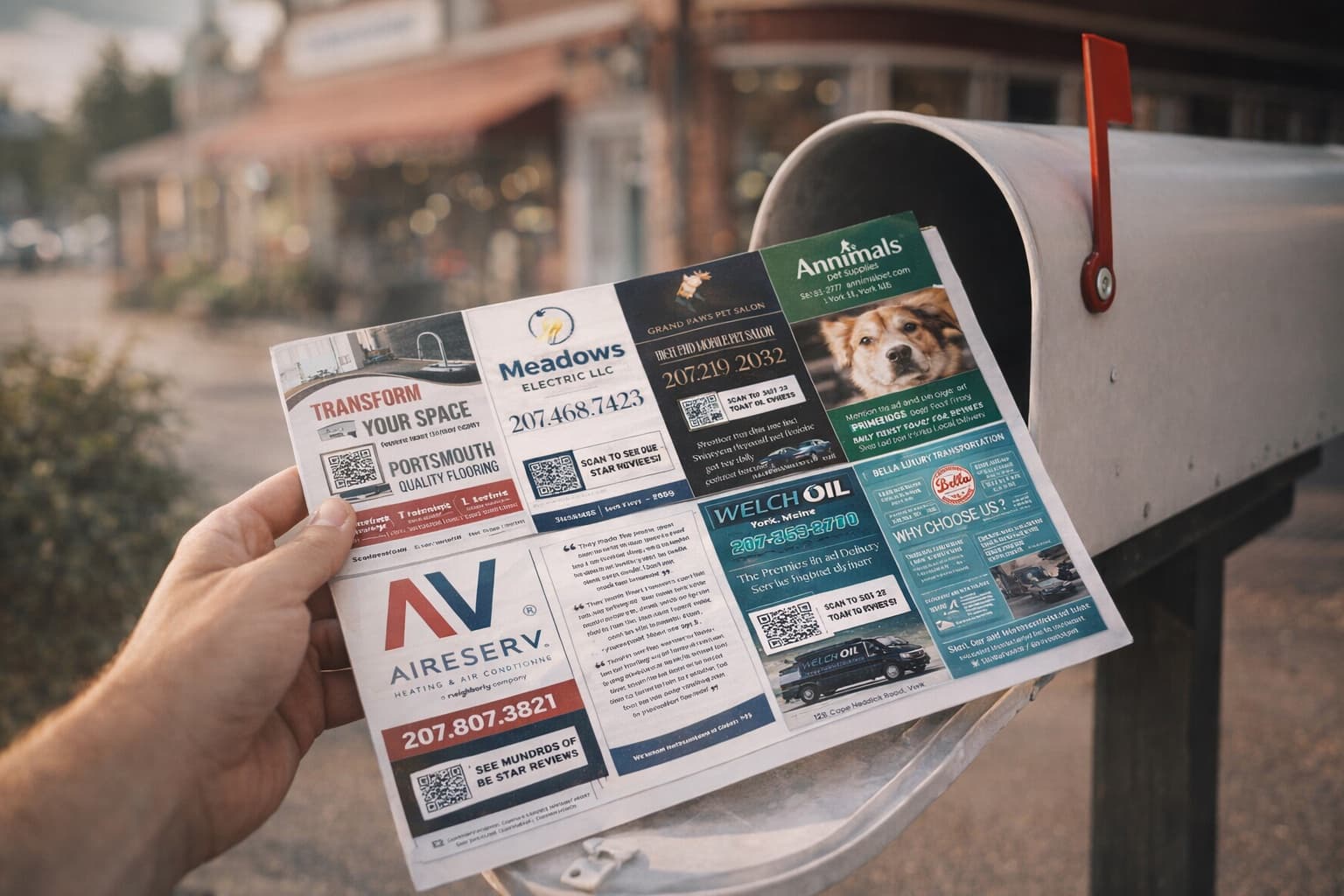
Here's the format that's quietly taken over realtor direct mail in 2026: a 9x12 oversized postcard mailed via USPS EDDM, where ~16 local businesses (including ONE realtor — you) split the cost. Each business gets a slot on the card. The card lands in 5,000 mailboxes in your farm area for the price of one realtor's slot — typically $500.
Metric
Traditional realtor postcard
9x12 shared mailer slot
Card size
4x6 (small)
9x12 (dominant)
Your cost per mailing
$1,800–$3,000+
$500
Postage rate
~73¢ first-class
~26¢ EDDM (split 16 ways)
Households reached
1,000–2,000 typically
5,000
Visual impact
Lost in the junk pile
Sits on top of every stack
Frequency feasible
Quarterly
Monthly or quarterly
Exclusivity
None — every realtor sends one
One realtor per card
For roughly 20–30% of what you'd spend on solo realtor postcards, you reach 2.5x more households, with dramatically more visual impact because of the size, AND you've locked out other realtors from the same card. That last part is the most underrated benefit.
When you're the only realtor on a 9x12 mailer reaching 5,000 homes in your farm area, you're effectively the only realtor in the recipient's mind for that neighborhood. That's the whole point of farming — and the shared 9x12 format does it 5x more efficiently than solo postcards.
Some industries get OK results from shared postcards. Realtors get exceptional results. Here's why.
Real estate is geographic. Your business is literally tied to specific neighborhoods. EDDM mailing routes are geographic. The match is perfect. You're not trying to reach random demographics — you're trying to reach homeowners in a specific 5,000-household block, which is exactly what a 9x12 EDDM card delivers.
Realtors are repeat marketers. A realtor's customer cycle is roughly 7–10 years between transactions. Your job isn't to convert someone who saw your card today into a sale next week. Your job is to be the realtor they remember when they're ready to sell in 3 years. Frequency over time wins, and the 9x12 shared mailer makes consistent frequency affordable.
The card credibility halo helps you. When your real estate ad sits next to a roofer, a dentist, a landscaper, and a financial advisor on the same neighborhood mailer, you're framed as a "trusted local" — not "another realtor sending solo junk mail." That neighbor framing dramatically improves perceived trust.
One commission destroys the ad cost. Average realtor commission on a $400K home sale at 2.5% = $10,000. One closed deal from a single 9x12 postcard slot covers the cost of 20 cards. The math is laughably good.
The non-competing exclusivity is your moat. When you secure the realtor slot on a 9x12 card in your farm neighborhood, no other realtor can be on that card. You've effectively bought territorial exclusivity for the price of one slot — something traditional realtor postcards can't offer.
The slot itself is roughly 3.8" x 2.8" — small but enough space to make a real impression if you design it correctly. Here's the structure that works for realtor slots.
The simpler option. Find an operator running a 9x12 shared mailer in your target farm area. Pay $500 for the realtor slot. Provide your ad. Mail goes out, you get exposure to 5,000 homes, you handle the leads from there.
Pros:
Zero operational work — operator does everything
Quick — slot purchase to mailbox in ~30 days
Predictable cost ($500/card)
Cons:
You don't control the other 15 advertisers (though typically all are quality local businesses)
You're at the mercy of the operator's neighborhood selection
One slot = one ad position, can't expand within the card
Best for: Most realtors. This is the default path.
The more advanced option. Run your own 9x12 shared mailer where YOU'RE the realtor on the card and you sell the other 15 slots to local businesses you know.
Pros:
Free realtor advertising for yourself (you're the operator, so your slot is "free")
Best for: Realtors with extra time, sales appetite, and a network of local business owners. Many top-producing realtors actually love this model because it gives them free farming AND introduces them to every local service business owner in their area — who all become referral sources.
Full transparency — running the operator side is taught inside the 9x12 Method community. Plenty of realtors have crossed over and now run cards as a side business that pays them while it markets them. You don't have to. Many realtors just buy slots and skip the operator complexity entirely.
For shared 9x12 mailers, here's the cadence that works.
Frequency
Cost per year
Best for
Quarterly (4x/year)
$2,000
Most realtors farming 1 neighborhood
Bi-monthly (6x/year)
$3,000
High-density farm areas, premium markets
Monthly (12x/year)
$6,000
Top producers in highly competitive markets
The minimum effective frequency is quarterly. Less than that and you don't build the "always present" brand recognition that real estate farming requires. More than monthly is usually overkill — you hit diminishing returns.
You're a realtor. You need to know what your direct mail dollars produce. Here's how to track it.
QR code → personal landing page. Every card slot should have a unique QR code that goes to your branded landing page. Track scans monthly.
Tracked phone number. Get a CallRail or Twilio number specifically for postcard tracking. When someone calls it, you know they came from the card.
Lead capture form. On your landing page, capture name, email, neighborhood, and "buying/selling/curious." Tag every lead with its source so you can track conversion to closed deals over time.
Long-term LTV tracking. Real estate is long-cycle. Track every postcard-acquired lead in your CRM with a 24-month follow-up cadence. Some leads convert in week 1. Some convert in month 18. Both count.
Math you should be running monthly:
Cost per scan/call/lead from postcard
% of postcard leads that become "active" (responding to follow-up)
% of active leads that become listings/closings
Total commission revenue attributable to postcard, divided by total spend
If you spend $2,000/year on postcards and close ONE $400,000 home from postcard-acquired leads, you've netted ~$10,000 in commission for $2,000 spent = 400% ROI. Most realtors close 2–5 deals/year from a sustained postcard farming campaign once they hit year 2.
Stop sending solo realtor postcards. The economics don't work and the format is inefficient.
Find a 9x12 shared mailer in your target farm area. Or run one yourself.
Buy the realtor slot. $500 covers 5,000 homes with non-competing exclusivity.
Design your slot for hyperlocal expertise with a specific offer + QR code + tracked number.
Mail consistently — quarterly minimum, monthly if you can.
Track every lead in your CRM with a 24-month follow-up cycle.
Renew on the same card every cycle to maintain neighborhood saturation.
That's it. Compare that 7-step plan to what most realtors are doing right now (random "Just Sold" postcards 1–2x per year with no tracking) and you can see why the realtors who adopt this model dominate their farm areas.
Yes — postcards still work for realtor marketing in 2026, but the format has evolved. Solo 4x6 realtor postcards are inefficient and expensive (about $1,800–$3,000 per send). The model that works now is shared 9x12 mailers where one realtor occupies a slot alongside 15 other local businesses, splitting the cost. You reach 5,000 homes for ~$500 instead of $2,000+ for fewer homes via solo postcards.
Solo realtor postcards cost $1,800–$3,000+ per send (1,000–2,000 households). A 9x12 shared mailer slot costs $500 per send and reaches 5,000 households. Annual quarterly campaigns cost $10,000+ for solo realtor postcards vs. $2,000 for shared 9x12 slots. The shared format saves 75–80% while reaching more homes.
A strong realtor postcard slot includes: a hyperlocal expertise headline (NOT your name as the biggest text), a real photo of you in the neighborhood (NOT stock photos), a specific offer like "Free Home Valuation," a tracked phone number AND QR code linking to your landing page, and a trust marker like "Just Sold 14 Homes in [Neighborhood]." Avoid generic "Call me!" copy — specificity and proof close more leads.
Minimum quarterly (4x/year) for effective neighborhood farming. Bi-monthly (6x/year) is stronger for competitive markets. Monthly (12x/year) is reserved for top producers in premium farm areas. The biggest mistake realtors make is sending one or two cards and concluding postcards don't work — real estate is a multi-year relationship business and consistent frequency is what builds top-of-mind recognition.
Yes — modern realtor postcard marketing is fully trackable using QR codes, tracked phone numbers (via CallRail or Twilio), branded landing pages with lead capture forms, and CRM source tagging. Track every lead from postcards on a 24-month follow-up cycle since real estate cycles are long. A typical sustained postcard farming campaign generates 2–5 closed deals per year by year 2, producing ROI of 300–600% on the marketing spend.
No — real estate farming is more effective than ever for realtors who use the right format. The 4x6 solo postcard format is dying because of cost and saturation, but the shared 9x12 mailer format thrives. Geographic real estate farming aligns perfectly with EDDM-routed shared mailers, and the non-competing exclusivity (one realtor per card) gives farming realtors a structural advantage that solo postcards can't match.
There it is. The honest realtor postcard marketing playbook for 2026. The old way (solo 4x6 cards, full first-class postage, hoping for the best) is dying. The new way (shared 9x12 mailers, EDDM rates, neighborhood exclusivity) is quietly producing the realtors who dominate their farm areas year after year.
As always, I'm rooting for you. Keep winning.
Ready to run your own card?
Get the course, scripts, tools, and weekly coaching inside the 9x12 Method community.

 Mitchell Tebo