Real Estate Postcard Marketing: The 2026 Guide for Realtors
Real estate postcard marketing in 2026. Why realtors are the easiest first close, real wins, pitch language by sub-niche, and pricing that holds at $700+.
If you are a realtor in 2026 and you are still spending most of your marketing dollars on Zillow Premier Agent, paid leads, and Facebook ads, here is the thing nobody wants to tell you. The top agents in your market are quietly running real estate postcard marketing in a brand new format that costs 80% less than what you are paying for digital leads and produces face recognition that compounds for years. I happen to know this firsthand. I work for one of the largest real estate brokers in the country. I watch how the best agents farm neighborhoods. And the new shared 9x12 mailer format is the cleanest competitive edge I have seen in real estate marketing in a decade. Let me show you why and exactly how it works.
This is the post for realtors who want to stop overpaying for cold internet leads.
Across the 9x12 community, realtors are the first slot to sell on most cards. Not the hardest. The easiest. Here is why.
1. Realtors live on face recognition. Real estate is a brand-recall business. Sellers list with the agent they "see everywhere." A 9x12 postcard going to 5,000 homes in your farm area, 4 times a year, puts your face in front of every potential listing in that neighborhood 4 times annually for a flat $500 per appearance. Compare that to Zillow Premier Agent at $300 to $1,500 per month for shared leads in the same zip.
2. Realtors understand direct mail. Every realtor has tried postcard marketing at some point. The just-listed and just-sold cards. The "10 reasons to use me" cards. Most of them quietly underperformed because the format was wrong (4x6 postcards that get buried) or the targeting was wrong (random list buys). The 9x12 oversized format and EDDM neighborhood targeting both solve those issues.
3. Realtors refer. Real estate is a referral-driven industry. Realtors do not just buy a slot. They send you other businesses. Jason's realtor friend bought a $500 spot and then referred 2 other businesses to him who are "75% of the way home" on their own slots. Tammy's realtor friend, voted #1 in her area, verbally committed to a slot AND offered to send an email blast on her behalf to help fill the card.
4. One realtor can buy a whole side. Real estate teams have team marketing budgets that solo agents don't. Kevin had his "1st meeting in person with a real estate office, they bought the whole front side." That is 8 slots in one close. A real estate team buying a full side de-risks the entire card and gives you instant social proof for the remaining slots.
Realtors are the warmest, most reciprocal, highest-leverage first close in the entire 9x12 model. If you do not have a realtor on card #1, you are leaving money and momentum on the table.
Zillow Premier Agent: $300 to $1,500 per month for shared leads in mid-tier zip codes. Shared with up to 3 other agents per lead. Lead quality is hit-or-miss. Cost per closed transaction often lands at $1,500 to $5,000.
Facebook lead-form ads: $20 to $80 per "lead" (most of which are content downloaders, not actual sellers). Cost per closed transaction often $2,000+.
Google PPC for "sell my house [city]": Brutal. $15 to $40 per click. Cost per lead $200+ if your landing page is good.
Solo realtor postcards (the old way):
$200 to $500
Mailing list (5,000 farm-area addresses)
$1,000 to $1,500
Printing (4x6 or 6x9, full color, 5,000)
$3,650
First-class postage at ~73 cents
$300 to $500
Design and project management
$5,150 to $6,150
Total per send
That is $5K to $6K per send, for a postcard size that gets buried in mail piles. Most realtors who try solo postcards run one or two and quietly conclude "direct mail doesn't work." It is not direct mail. It is the format.
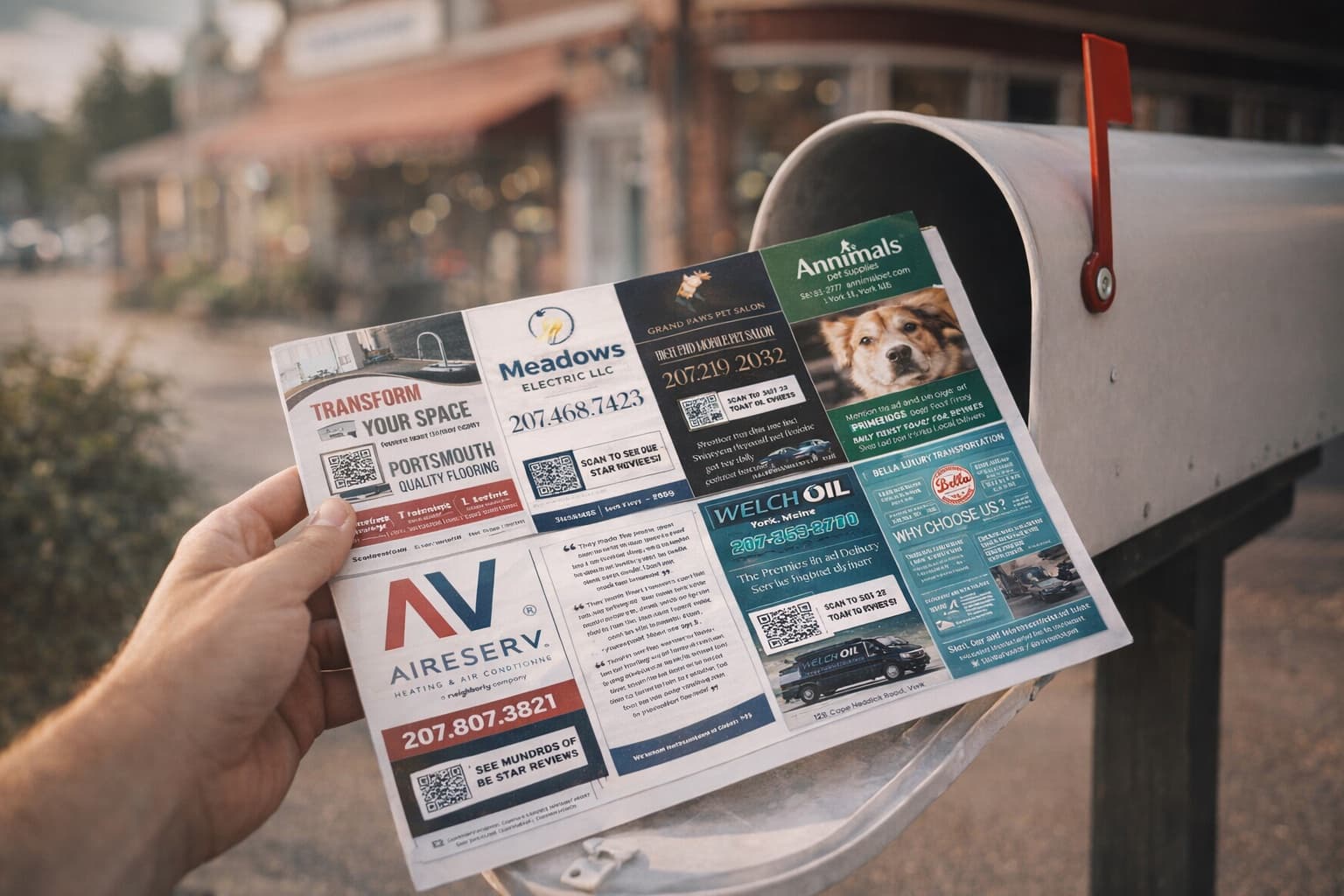
A 9x12 oversized postcard mailed via USPS EDDM, where 16 local businesses (including ONE realtor) split the cost. You buy a single slot for $500. Your face and offer go to 5,000 homes in a farm area of your choosing.
Metric
Solo realtor postcard
9x12 shared slot
Card size
4x6 or 6x9
9x12 (dominates the stack)
Cost per mailing
$5,000 to $6,000
$500
Households reached
5,000
5,000
Visual impact
Buried in mail
Sits on top
Frequency feasible
1 to 2 per year
4 to 12 per year
Realtor exclusivity on card
None
Yes, only realtor on card
For about 8% of solo postcard cost, you reach the same farm area with way more visual dominance and territorial exclusivity over other agents.
Even at the conservative end (1 closed transaction), you have produced $9,000 in commission from $2,000 in marketing spend. That is a 350% ROI. At the higher end, $63,000 from $2,000.
And that ignores the brand-recall compounding effect. By year 3 of quarterly mailings in the same farm area, you are the realtor people associate with that neighborhood by default. Listing calls come in cold from sellers who say "I see your card all the time." That is the long game.
A real estate agent who is "#1 in the area" did not become #1 by hiding. They became #1 by being the agent everyone in the neighborhood sees the most.
Hey [Name], I am putting together a 9x12 community mailer going to 5,000 [farm area] homes. One realtor on the card. No competing agents. Card prints quarterly. Want me to lock in the realtor slot for you?
Notice what is different from a generic pitch:
It names the farm area
It addresses exclusivity (no competing agents) before they ask
It mentions quarterly cadence (real estate thinks in seasons)
If you are pitching the established top agent in the area:
You are already #1 in [town]. The card is how you stay #1, not how you become it. Brand recall is what keeps your phone ringing. 5,000 homes in [farm area] see your face quarterly for $500 a card. It's a no-brainer renewal tool.
If you are pitching a newer agent who can't out-spend the top guys on Zillow:
You can't out-spend the top guys on Zillow. You can out-show them in the mailbox. Print is the off-platform play. 5,000 homes in [farm area], your face on the fridge every quarter, $500 per appearance. While they fight for paid clicks, you build neighborhood brand.
Teams have bigger budgets and longer decision cycles. Pitch the team leader:
Your team needs face recognition in [farm area]. One slot does it for $500 a card. But you could also take a full side of the card (8 slots). One slot per agent, full side coverage, $4,000 quarterly. That is $1,000 per agent per quarter for guaranteed exposure to 5,000 homes. Lower per-agent cost than your current Zillow split.
Kevin closed a real estate office on his first in-person meeting using a version of this pitch. They bought the whole front side.
Different sales motion. Investors do not want listings. They want sellers.
We mail to 5,000 homeowners. Even if 1 in 5,000 wants to sell to an investor instead of dealing with an agent, that is your deal. One $20K+ deal pays for 40 of these cards. The slot is $500.
Rachel ran her real estate investing ad on 4 cards and got 3 leads, with a $100,000 profit deal closing as a direct result.
Then this is the referral catalyst. Your face on the fridge is what makes someone's friend say "I know a great agent, here's her card." Referrals don't happen if people forget who their agent is. The card keeps you top of mind in the neighborhoods that send you referrals.
Then you need to be the only realtor people think of when it picks up. The agents who advertise during slow markets win when markets recover. The top producers in 2009 are the ones who did not pull marketing in 2008.
You only hear this on cold calls. Mitchell Tebo's take on this: "A realtor on the National Do Not Call list is the funniest and most ironic thing I've ever heard." Realtors say it as a script to deflect. The right move is to apologize politely, note their number to not call again, and move on. There are 50 other realtors in your area.
This is the most common deflection from realtors. Send the email immediately, then follow up by text 24 hours later because the email will get buried in their inbox.
Almost everyone in real estate tried 4x6 postcards. They get buried. The 9x12 is the largest size that qualifies for EDDM bulk postage. It sits on top of every other piece of mail. The math is different. Want me to send a sample so you can hold one?
Rare close but huge. Pitch the slot as a recruiting tool, not a buyer-attraction tool. "Top agents want to be at brokerages with marketing infrastructure. The card helps you recruit."
Completely different sales motion. They want sellers, not buyers. Pitch the "1 in 5,000 wants to sell to an investor" math. Premium pricing because one deal is $20K+ profit.
Realtors often pay more than $500 because they understand the long-term ROI of brand recall. $700 to $1,200 for a double slot is common. A 12-month contract is also common because realtors think in seasons (spring market, fall market) and want consistent presence year-round.
The most important window. Mail your card in late January or early February to catch the March-April listing surge. Sellers who saw your name in mid-January are who you list in mid-March.
Best offers: "What is your [town] home worth in this spring market?" "Free CMA for [neighborhood] homeowners thinking of selling."
Run your own card. Your realtor slot is "free" because the other 15 slots cover the cost and produce $5,001 in profit per card. Best for realtors with extra time and existing local business relationships.
Real estate is uniquely suited to operator-mode because realtors already have:
Networks of local businesses (lenders, inspectors, title companies, stagers, contractors)
Comfort with sales conversations
Comfort with the territory framing of farm areas
Reasons to be in the community network anyway
Full transparency, the operator playbook is taught inside the 9x12 Method community. Most realtors just buy slots and skip the operator complexity. Both paths work.
Yes. Real estate postcard marketing in 2026 is one of the highest-ROI marketing channels for realtors who use the new shared 9x12 format. Solo 4x6 postcards still underperform because they get buried in mail piles. But a 9x12 oversized postcard mailed quarterly to a 5,000-household farm area at $500 per slot produces face recognition that compounds across years and consistently delivers 1 to 7 closed transactions per year for participating agents.
A typical effective real estate postcard marketing budget is $2,000 to $6,000 per year (4 to 12 shared 9x12 slots). That produces 4 to 16 seller leads and 8 to 32 buyer leads annually depending on farm-area quality, ad design, and follow-up. At a typical 8 to 15% conversion to closed transactions, that translates to 1 to 7 closed transactions per year (worth $9,000 to $63,000 in commission against $2,000 to $6,000 in spend).
A converting realtor slot includes: a benefit-driven headline ("What is your [town] home worth?"), a professional headshot (not a phone selfie), name in big type, brokerage logo (smaller), license number, phone and email, a QR code to a "What's My Home Worth?" landing page, and one credibility marker like "Top 1% in [town]" or "5-star Zillow rating." Skip laundry lists of designations, generic house stock photos, and any 10-year-old headshot.
Time real estate postcard marketing around natural market cycles. Late January or early February cards catch the spring listing surge in March-April. April or May cards catch summer transitions tied to the school year. August cards catch pre-holiday listing decisions. November cards catch year-end seller motivation. Most successful realtors run quarterly cards (4 per year) in the same farm area to build cumulative brand recall.
Start with one farm area of 5,000 households for at least 4 quarterly cards before adding a second neighborhood. Brand recall takes 3 to 4 repetitions to compound. Spreading across multiple farm areas before any one of them has reached repetition velocity dilutes the effect. Once one farm is producing reliable leads, then expand to a second area.
Yes, and this is one of the most common wins in the 9x12 community. A real estate team can buy a full side of the card (8 slots) at $4,000 quarterly, giving them complete dominance of one face of the postcard going to 5,000 homes. Kevin closed a real estate office on this exact pitch in his first in-person meeting. The per-agent cost on a full-side buy works out lower than typical Zillow Premier Agent splits.
That is real estate postcard marketing in 2026. Same direct mail concept top agents have run for decades. Completely different economics in the shared 9x12 format. Pick your farm area, claim the realtor slot before a competitor does, run quarterly cards for at least a year, and watch the listing calls start coming in from sellers who say "I see your card everywhere."
Keep stacking wins. Let's go.
Ready to run your own card?
Get the course, scripts, tools, and weekly coaching inside the 9x12 Method community.

 Mitchell Tebo