What is a co-op mailer? Local businesses split one mailing. Compare the 3 formats, see how a co-op mailer business makes money, and run the real profit math.
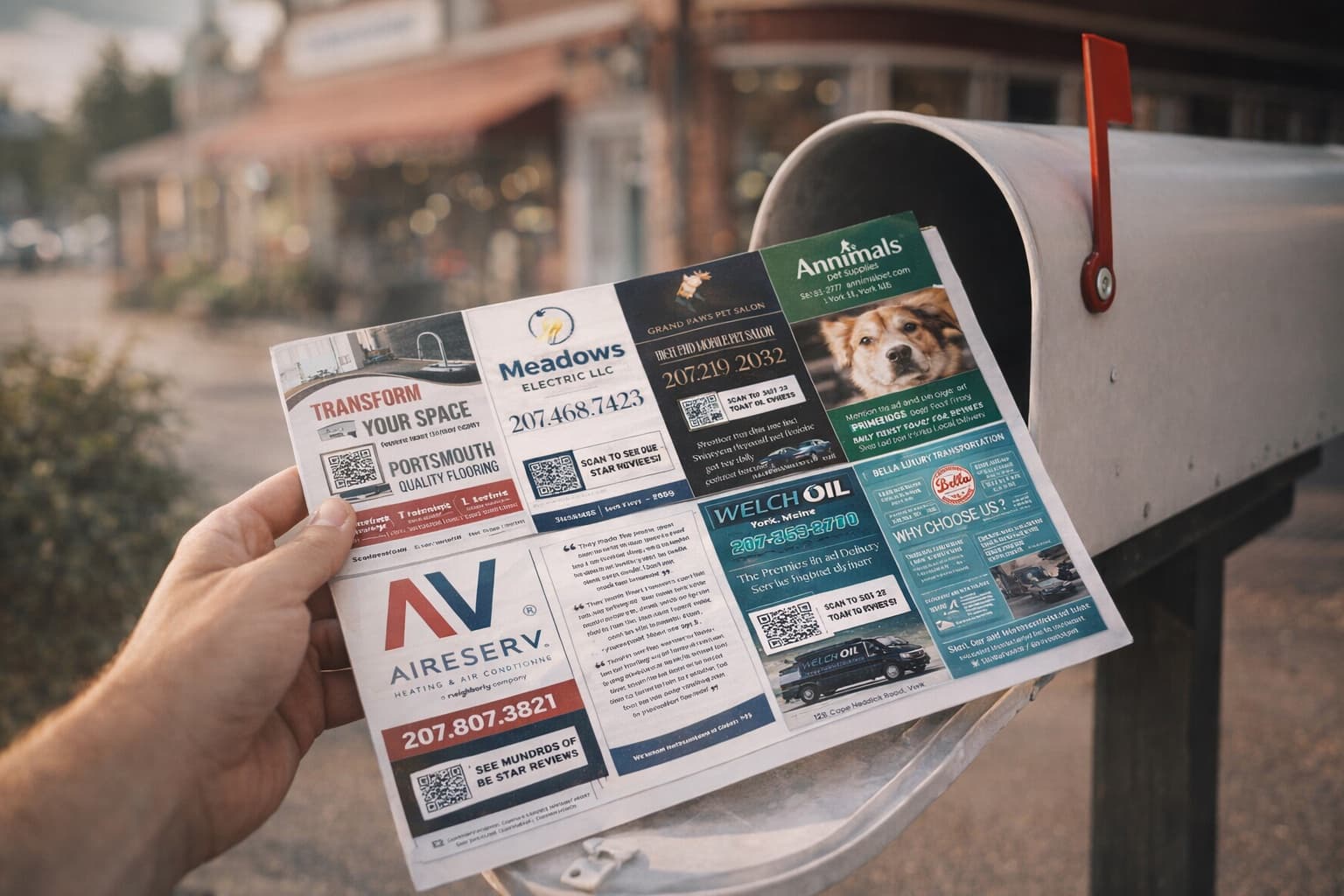
If you've ever pulled a giant postcard out of your mailbox covered in ads for a local roofer, a dentist, a pizza place, and a dozen other businesses, you've already held a co-op mailer. A co-op mailer is one piece of mail that a group of local businesses pay for together, so each of them reaches thousands of homes for a fraction of what mailing alone would cost. It's a simple idea, and honestly, it's the exact business I've built my life around.
Here's the thing though. Search "coop mailer business" and you mostly get pages about grocery store co-ops and an old forum thread. Not super helpful. So let me be the clear answer: what a co-op mailer is, the three formats you've seen, an honest comparison, and how the business works from the operator's side, math included.
A co-op mailer (short for cooperative mailer) is a single mailing that several businesses share. Instead of one roofer paying to print and mail 5,000 postcards by himself, 16 businesses each buy a piece of the same mailer and split the bill. Everybody lands in the same mailboxes. Everybody pays a slice.
That's cooperative direct mail in one sentence: shared cost, shared reach.
Think about it from the business owner's side. Mailing 5,000 homes solo means paying for the whole print run plus postage, and at about 26 cents a piece, postage alone is $1,300. On a shared card, that same business pays $500 for a slot and still lands in all 5,000 mailboxes. That's about a dime per home.
A co-op mailer is just a group of local businesses splitting one postage bill. The person who organizes the group is the one who gets paid.
You know this one. The blue coupon envelope packed with loose inserts. Oil change, carpet cleaning, a pizza deal, a window company, and a pile more. Most of these are run by national coupon mailer franchises, where a local franchise owner sells insert space in their territory.
Every business gets its own separate insert, so every business is paying for its own piece of paper
The homeowner has to open the envelope before a single ad gets seen
Exclusivity isn't always part of the deal, so two carpet cleaners can end up in the same envelope
Be honest... when's the last time you opened one? The envelope has to earn the open before anybody inside gets a shot.
The glossy booklet. Sometimes it's a full-color magazine with a local theme, sometimes a thinner coupon book. Businesses buy a full page, half page, or quarter page.
The cover gets seen. Page 14 might never get seen.
More pages means more paper, more printing, more binding, and more weight
It feels premium, which is real, but it's a heavy lift to produce every single time
Booklets can absolutely work. They're just a publishing operation, and that's a lot to take on when it's only you.
This is what we do. One big card. Ads on both sides. No envelope, no pages, nothing to open. The homeowner pulls it out and every single ad is right there.
There are two versions I teach:
The 9x12 card: 9 by 12 inches, about 16 slots (8 per side), $500 per slot, mailed to 5,000 homes. It's the biggest thing anybody gets in their mail that day.
The community card: 6 by 11 inches, about 16 coupon-style slots at $250 each, mailed to 2,500 homes. Smaller, cheaper for advertisers, and faster to fill.
Here's the deeper breakdown on what a community card is if you want it. Both versions run on the same rule: one business per industry. One roofer. One dentist. One pizza place.
And here's why "nothing to open" matters so much. When Lucy's first community card landed, her Amish butcher advertiser got six phone calls that same day and sold a half beef, a half hog, and 100 pounds of ground beef. Nobody had to tear open an envelope or flip to page 14 to find him. He was just... there.
Here's the honest side-by-side. I'm biased toward the postcard, so I'll tell you where the others have a point too.
Factor
Coupon envelope
Coupon magazine
Oversized shared postcard
Cost to advertiser
Set by each franchise
Priced by page size
One slot price ($500 on a 9x12, $250 on a community card)
Does the homeowner open anything?
Yes, the envelope
Yes, they flip pages
No
Mailbox visibility
Closed envelope
Cover only
Every ad visible right away
Exclusivity
Not always
Varies
One business per industry
How the operator gets paid
Franchise territory, sells inserts
Sells pages, covers a bigger print bill
Sells about 16 slots up front, keeps the difference
Opening is the big one. The envelope and the booklet both need the homeowner to DO something before your ad gets seen. The postcard doesn't. Even the people who toss it see it first on the walk from the mailbox to the kitchen.
Exclusivity closes deals. "You're the only roofer on this card" is the best line I teach, and it's hard to promise in a stuffed envelope. Where the envelope has a point: a household that loves clipping coupons may keep the whole pack. That's real. It's just not most of the mailbox.
The operator side is where co-op postcard advertising really pulls ahead. Most of the envelope brands are franchises, which usually means buying into a territory before you sell a single ad. Booklets mean a bigger print bill and a lot of pages to fill. The postcard is about 16 slots, collected up front, one print run.
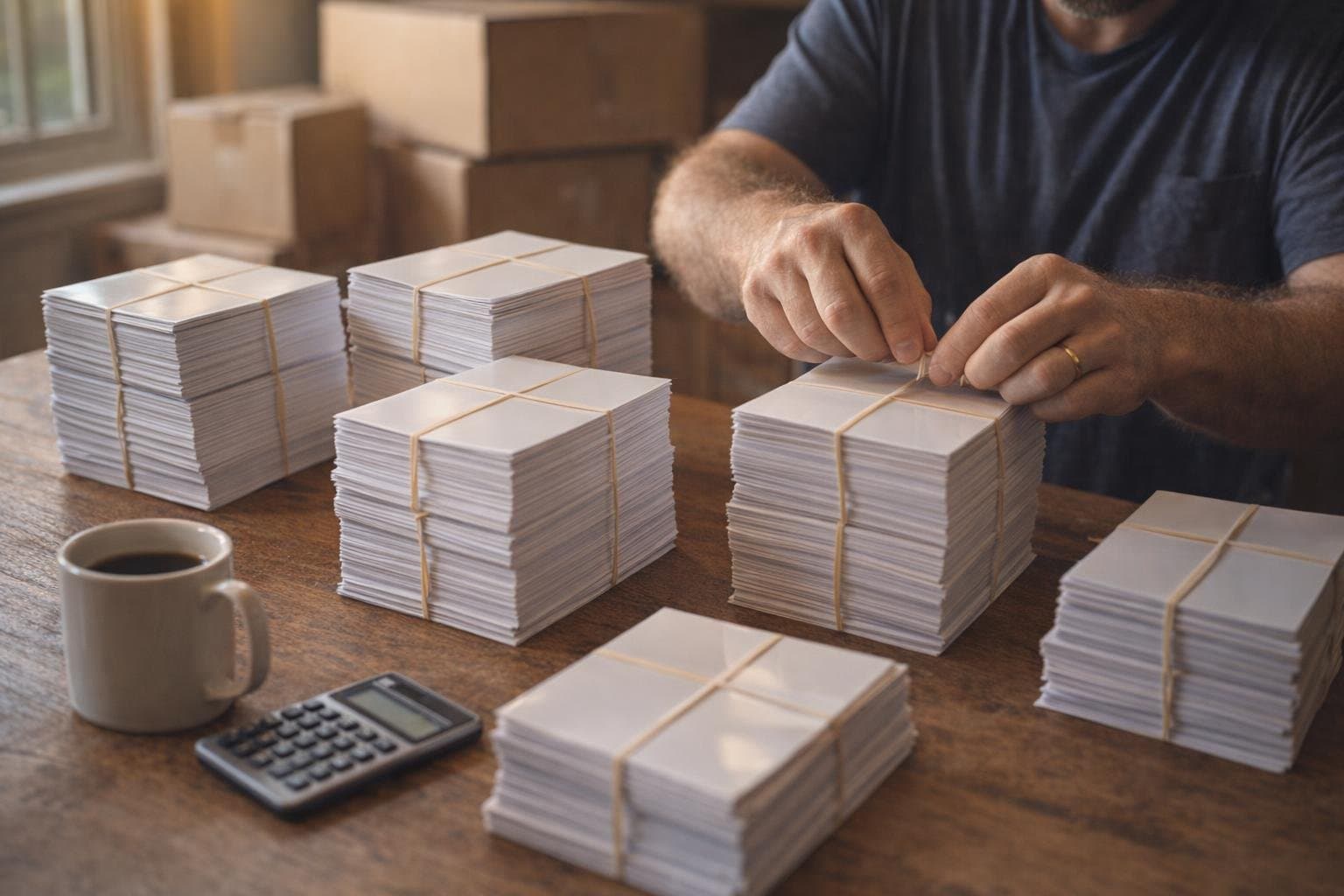
Okay so here's the part the search results never explain. Somebody organizes every co-op mailer. Somebody picks the town, calls the businesses, collects the money, and gets the card in the mail. In a coop mailer business, that somebody is you.
You're not a marketing agency. You're a community connector getting local businesses together to split the cost of a huge mailer. Here's the whole thing, start to finish.
Pick your town and routes. Towns of about 15,000 to 100,000 people work best. Choose carrier routes on the USPS EDDM map, leaning toward higher-income neighborhoods, until you hit about 5,000 homes (or 2,500 for a community card).
Build a list of local businesses. Roofers, HVAC, dentists, landscapers, realtors, auto shops. Anybody already paying for billboards or newspaper ads is a great lead.
Sell the slots. Facebook groups, cold email, cold calls, or walking in with a sample card. One business per industry. I break down exactly how to sell ad space on postcards in another post.
Collect the money up front. ALWAYS. Never chase money, it won't be there by the time you ask for it.
Design, print, and mail. The ads go on the card, the card goes to the printer, and the printer gets it to USPS through Every Door Direct Mail.
Report results. Send every advertiser proof it went out (print photos, mail date, homes reached), then ask what calls they got.
Renew. The advertisers who got customers want back on the next card. Make that an easy yes.
Steps 6 and 7 are where this goes from a side hustle to a real business. Darin is on his third monthly card, and one of his HVAC advertisers traced a full furnace install straight back to the card. Another of his clients went from one ad to a double, then booked doubles in all three of his markets. And Rachel had a roofer prepay 12 monthly mailings, $3,000 up front, off one Facebook group post. That's what advertiser renewals look like when you actually do the reporting part.
Every co-op mailer I teach rides on USPS Every Door Direct Mail. Here's what makes it work for one person, straight from the USPS Every Door Direct Mail page:
No mailing list. Pieces are addressed to "Postal Customer" and go to every address on your routes
Flat postage. EDDM Retail flats are currently $0.26 per piece
No permit. EDDM Retail doesn't need a special mailing permit
Daily limits. EDDM Retail lets you send 200 to 5,000 pieces per day per ZIP Code
On size, EDDM Retail flats max out at 15 inches long, 12 inches high, and 3.3 ounces, per the USPS Quick Service Guide 140. A 9x12 card fits comfortably. A thick booklet has to watch every page. Here's how EDDM works for postcard businesses if you want the full walkthrough.
Here's where a shared mailer business gets fun. Simple equation, real numbers.
The 9x12 card:
16
Slots per card
$500
Price per slot
$8,000
Revenue per card
$2,999
All Inclusive print + postage
$5,001
Profit per card
5,000
Homes reached
The community card:
16
Slots per card
$250
Price per slot
$4,000
Revenue per card
$1,449
All Inclusive print + postage
$2,551
Profit per card
2,500
Homes reached
Here's the kicker. You collect the $8,000 before you pay the $2,999. So the upfront capital is literally zero. The business pays for itself before it exists.
Full transparency, that $2,999 is the All Inclusive price at my own print shop, print.9x12method.com: printing, packing, postage, and USPS fulfillment to 5,000 doors. You don't have to use it, and plenty of operators use a local printer. But it's why the numbers above are exact instead of a fuzzy range.
Two or three 9x12 cards a month is $10,002 to $15,003 in profit. Want to see how different combos shake out? Plug them into the profit calculator.
Here's my honest reasoning, and you can judge it for yourself.
One piece of paper. No inserts to collate, no booklet to bind. One print file, one print run.
Nothing to open. Every advertiser gets seen, which is exactly what brings them back for card #2.
Exclusivity sells itself. "If you don't take the spot, your competitor will" is a real reason to say yes today.
About 16 yeses. Not a magazine's worth of advertisers. Sixteen.
No franchise buy-in, no upfront capital. Money comes in before money goes out, and nobody charges you for permission to start.
Keep it simple. One card, 16 local businesses, 5,000 homes, money collected up front. That's the whole business.
Full transparency: I teach this entire process inside the 9x12 Method community on Skool, with 2,800+ operators, scripts, Canva templates, and weekly coaching calls. You don't need it to get started. You could honestly figure this out from this blog and a lot of phone calls. But if you want people next to you when card #1 gets hard, that's what it's there for.
A co-op mailer is one piece of mail that several local businesses share the cost of, so each one reaches thousands of homes for a fraction of the price. The common formats are coupon envelopes, local coupon magazines, and single oversized shared postcards like the 9x12 card.
Envelope and magazine pricing varies by franchise, market, and ad size. On a 9x12 shared postcard, a standard slot is $500 to reach 5,000 homes. On a community card, it's $250 to reach 2,500 homes. Both work out to about a dime per household.
It can be. A full 9x12 card is $8,000 in revenue against $2,999 All Inclusive print and postage, which leaves $5,001 in profit. A full community card is $4,000 against $1,449, which leaves $2,551. The honest catch is you have to actually fill the card, and the first one takes real work.
No. A lot of the big coupon envelope brands are franchises, but a single shared postcard doesn't need one. You pick a town, sell the slots, collect up front, and mail through USPS Every Door Direct Mail.
Most use USPS Every Door Direct Mail. You choose carrier routes on a map instead of buying a list, and the mailer is addressed to "Postal Customer" so it reaches every home on those routes.
To some people, any mail they didn't ask for is junk. A shared postcard is local businesses with real offers, one per industry, and nothing has to be opened to see it. Even the people who toss it see it first, and the ones who need a roofer that month keep it on the fridge.
A co-op mailer isn't complicated. Local businesses split the cost, somebody organizes it, and everybody gets in front of thousands of homes. The only question is whether that somebody is going to be you.
Keep it simple. Pick a town, make a list, and go get your first yes this week.
As always, I'm rooting for you.
Love you, bye-bye.
Ready to run your own card?
Get the course, scripts, tools, and weekly coaching inside the 9x12 Method community.

 Mitchell Tebo