AI proof business ideas backed by real data, not hype. A 3-part test for work AI can't do, 8 ideas that pass it, and one you can start this month with $0.
Everybody is asking the same question right now. Is AI coming for my job, and if it is, what do I do about it? Most of the answers online are either "start an AI business" (which is the opposite of what you asked) or a list of gig apps somebody threw together in an afternoon. So let me give you AI proof business ideas the honest way: what the actual research says AI can and can't do, a simple test you can run on any idea, and the one I used to make $15,000 in two months when real estate dried up on me.
Full transparency, I run one of these businesses and I teach it. I'll tell you which one, and I'll be straight about where AI still shows up in it.
Watch: Simple $10K/Month Local Side Hustle AI Can’t Touch (Start With $0) · Summary and transcript
Before anybody hands you a list, look at the data. There are two studies I'd actually read, and I haven't seen a single ranking page cite either one.
Microsoft Research looked at real AI usage. In a 2025 paper called "Working with AI," Microsoft researchers analyzed about 200,000 anonymized Bing Copilot conversations and scored every occupation on how much its work overlaps with what people actually use AI for.
Here's what came out on each end:
Most AI overlap:
Media and communication workers
Sales representatives (services)
Information and record clerks
Mathematical science occupations
Least AI overlap:
Grounds maintenance workers
Home health aides and nursing assistants
Helpers in the construction trades
Plant and system operators
Coverage of the paper listed the individual jobs with the least overlap, and it reads like a list of people who work with their hands: dredge operators, bridge and lock tenders, water treatment plant operators, floor sanders and finishers, orderlies.
The World Economic Forum asked employers. The Future of Jobs Report 2025 surveyed more than 1,000 employers. They expect 170 million jobs created and 92 million displaced by 2030, for 78 million net new jobs. The biggest growth in raw numbers? Frontline roles like farmworkers, delivery drivers, construction workers, salespersons, and food processing workers. The fastest-declining roles include postal service clerks, bank tellers, and data entry clerks.
Two honest caveats, because I'm not going to oversell this.
The Microsoft authors say plainly that high overlap does not mean job loss. Plenty of jobs will just change. Nobody actually knows what gets replaced.
Notice "postal service clerks" on the declining list. That's the person behind the counter, not the mailbox. I'll come back to that.
AI is great at anything that lives on a screen. It is useless at anything that has to show up in person, get handed over, or be trusted face to face.
Okay so lists go stale fast. A test doesn't. Run any idea you have through these three questions.
The screen test. Is the finished product just words, images, code, or data on a screen? If yes, AI is already doing a version of it for close to free. That's why media, sales copy, and record-keeping work sit at the top of the overlap list.
The hands test. Does somebody have to physically show up, touch something, or deliver something? Roofs, lawns, floors, furnaces, people who need care. Software can schedule the job. It can't do the job.
The trust test. Does the customer need to trust a real local person they can find, call, and look in the eye? A homeowner letting someone into their house. A business owner handing over a check. That trust is the thing AI can't fake.
Pass the screen test (meaning the work doesn't live on a screen) and at least one of the other two, and you've got something AI is going to have a really hard time touching.
Here are the ones that pass, and the honest catch on each. I'm not going to make up startup costs or income numbers for businesses I don't run. Price them out in your own town.
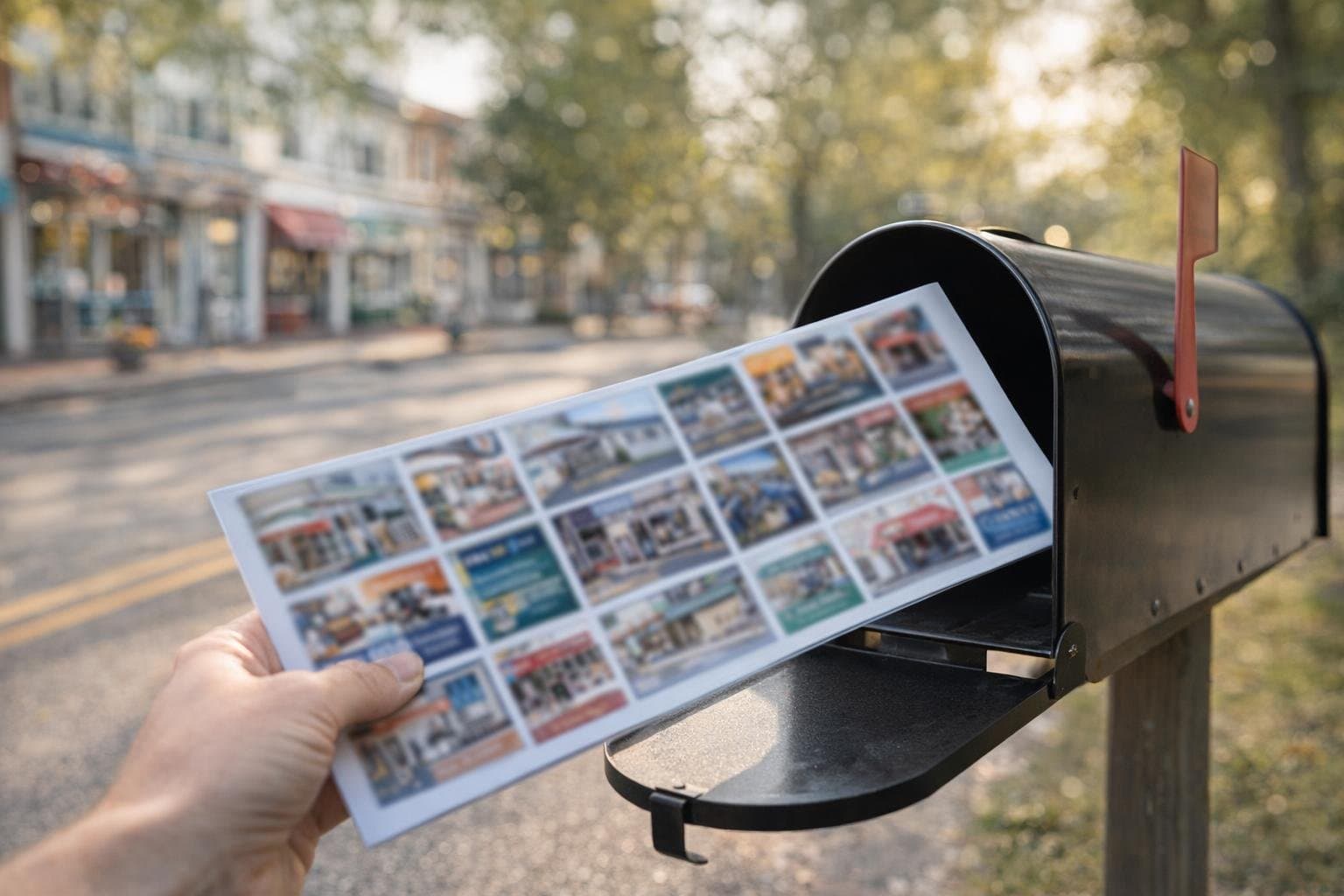
You sell ad spots on one big postcard to local businesses, then mail it to every home in a neighborhood. It passes all three tests. It's paper in a real mailbox, the businesses are down the street, and they hand money to a person they've met or talked to. This is the one I run, so it gets its own section below.
The catch: you have to talk to business owners. That's the whole job.
Electrical, plumbing, HVAC. Pure hands test, plus a big dose of trust, since you're inside someone's home. Construction helpers are on the Microsoft low-overlap side, and construction workers are on the WEF growth list.
The catch: licensing and apprenticeship time. This is a career change, not a side hustle.
Grounds maintenance workers scored among the lowest AI overlap of any group in the Microsoft data. Grass doesn't care how good your chatbot is. The catch: equipment, seasons, and your own body.
Pressure washing, gutter cleaning, window cleaning. Same logic as lawn care. I've written more on these in my post about boring businesses. The catch: weather and ladders, and your income is tied to your hours until you hire.
Home health aides and nursing assistants scored at the bottom for AI overlap. Caring for a person in their home is about as hands-and-trust as work gets.
The catch: training, certification, and background checks, depending on your state. And it's emotionally heavy work.
Dog walking, sitting, grooming. Nobody hands their dog to a chatbot. It passes the hands and trust tests, which is why it shows up on several of the AI-proof lists I found.
Anything where the product is the room: fitness classes, kids' camps, local tours. The catch: people have to know you exist, which (funny enough) is what local advertising is for.
Okay, so here's my story. I was a realtor, and 2024 was a rough year to be a realtor. Winter came, the market got even slower, and I had like $1,000 to my name. I needed money, fast, and I am not a software genius. Starting an AI business sounded stressful and honestly unrealistic for a guy like me.
So I started selling ad spots on a 9x12 postcard. First month, about $5,000 in profit. Second month, two cards (my hometown and the town next door), about $10,000. That's $15,000 in two months, working about an hour a day at first while I was still doing real estate.
The $0 is real. You collect from your advertisers before the card ever goes to print, then pay the print bill out of money you're already holding. There's also a smaller community card: a 6x11 to 2,500 homes, 16 spots at $250, $4,000 in, $1,449 for print and mailing, $2,551 profit. A lot of people start there because the ask is smaller.
That's a real card. Look at who's on it. A landscaper. A gutter cleaner. A butcher. A restaurant. Every single advertiser is a hands-on local business, the exact kind of business from the list above. They're not going anywhere, and they all need customers in that town.
Screen test. The product is a physical card in a physical mailbox. AI can't reach into someone's mailbox, and it can't stick your card on a fridge for a month.
Hands test. Somebody prints it, bundles it, and the mail carrier delivers it to every address on the route. That's physical delivery, and delivery drivers are on the WEF's growth list too.
Trust test. This is the big one. A local business owner hands $500 to a person, not a website. Hunter's very first sale was a plumber who wrote him a check on the spot. Logan closed two advertisers with no website and no social media at all, just a physical sample card in his hand. Pamela sent 200+ emails, sold three spots, then met the owners in person to pick up payment.
And about those postal clerks on the declining list: fair, the counter job is shrinking. But the mail carrier still covers every route, and no app replaces the piece of paper on the kitchen counter. That's the part we use.
It's not AI. It's not drop shipping. It's none of that baloney. It's paper, mailed to houses, paid for by the businesses down the street.
Now here's the twist nobody else will tell you. In that Microsoft data, sales reps score high on AI overlap. A lot of selling is writing and sharing information, and AI is good at that.
So am I telling you sales is doomed? No. I'm telling you to split the job in two.
The parts AI should do for you:
Building your lead list. My free ChatGPT prospecting prompt has ChatGPT find local businesses and draft the first email.
Designing ads. Members get the AI Ad Designer (it's on the member tools page), which builds a print-ready ad in about 30 seconds.
Busywork. Jeffrey makes short AI video ads with Veo 3 and a custom GPT and drops them into Facebook groups and DMs.
The parts AI can't do:
Being the person a local owner trusts with $500.
Holding up a real card and saying "your competitor isn't on here yet."
Printing and mailing paper to 5,000 homes.
That's the whole play. Everybody else is trying to out-AI the AI, which most of us can't. You go the other way. Use AI to save you hours, and build the business on the stuff it can't touch.
If you run a marketing agency and feel your services getting squeezed by AI, this applies to you double. A postcard gets you through the door that cold "I do SEO" calls can't open anymore.
Look, I teach this step by step inside the 9x12 Method community, with the scripts and the templates. You totally don't need it to get started. Everything above is enough to sell your first spot.
You don't need to quit anything. Adam filled his first card, about 95% of it through cold email, while working a full-time job and running his kids around to travel ball. You can keep your day job and do this on the side.
Pick your town, ideally your own or the one next door, so you can show up in person.
Build a list of local service businesses: roofers, landscapers, HVAC, dentists, realtors. Use AI or Google Maps.
Send a short email or post in local Facebook groups: you're putting together a big postcard going to 5,000 homes in town, featuring respected local businesses. Would they want a spot?
When they ask the price, explain it: $500 for the spot, about a dime per home, because they're splitting the cost with non-competing businesses. One business per industry.
Collect payment up front. When the card's full, send the file to 9x12 Method Printing and they print it and get it to the Post Office for you.
Most people take about 30 days to fill their first card. Rachel posted once in a local Facebook group and a roofer bought 12 monthly mailings, $3,000 paid up front. That's not typical, and I won't pretend it is. But it shows you what's possible when the trust part clicks.
Businesses where the work is physical, local, and built on trust. Microsoft's 2025 research found the least AI overlap in hands-on work like grounds maintenance, home health care, and construction helpers. So think roofers, landscapers, plumbers, caregivers, and anything that puts a physical thing in a real place.
The best AI proof side hustles pass three tests: the work doesn't live on a screen, it needs hands or physical delivery, and customers need to trust a local person. Lawn care, exterior cleaning, pet care, and local shared mail advertising all pass. Shared mail is the one you can start with $0, because advertisers pay you before the card prints.
Nobody knows, and anybody who promises you "forever" is guessing. Even the Microsoft researchers say high AI overlap doesn't automatically mean job loss. And I'd add the flip side: low overlap today isn't a guarantee for the next 20 years. The best bet is work that depends on physical delivery and local trust, since those are the hardest things for software to fake.
AI can write the ad and design the card. It can't put the card in a mailbox or stick it on somebody's fridge for a month. The physical piece and the delivery are the parts no chatbot does, which is why mail still works as a channel for local businesses.
You can, but you're competing with every other person and company building the same thing, and the tools change every month. If you're not a developer, that's a hard race to win. A boring local business that uses AI as a tool is a lot more realistic for most people.
Yes. Shared postcard advertising needs $0 upfront because you collect from your advertisers before you pay for printing and mailing. A full 9x12 card brings in $8,000, costs $2,999 to print and mail to 5,000 homes, and leaves $5,001 profit.
While everybody is zigging toward AI, you can be zagging toward the mailbox. As always, I'm rooting for you. Peace.
Ready to run your own card?
Get the course, scripts, tools, and weekly coaching inside the 9x12 Method community.

 Mitchell Tebo