Skip to content
9x12Method
Getting Started

How to Start a Local Business Directory in 2026

How to start a local business directory, online or in print: how directories make money, the chicken-and-egg problem, real costs, and why most of them fail.

Mitchell TeboMitchell Tebo23 min read
How to Start a Local Business Directory in 2026

Every town has somebody with this idea. They scroll a local Facebook group full of "who's a good plumber?" posts, or flip through the chamber's member list, and think: there should be one place to find every good local business in this town, and the businesses should pay to be in it. If that's you, this is the honest version of how to start a local business directory: the two kinds (online and print), how directories actually make money, why most of them quietly die, what it costs, and a step-by-step plan that doesn't depend on luck.

Full transparency before we go any further. I teach a business built on a printed shared mailer, so I'm biased toward print, and I'll tell you exactly where. But I also run a directory myself (more on that later), so I've seen both sides. And I'm going to tell you where a directory website makes total sense too.

He Sold Out His 1st Community Card in 3 Weeks: $1000s in Profit
Watch: He Sold Out His 1st Community Card in 3 Weeks: $1000s in Profit · Summary and transcript

Local Business Directory Website vs Print Business Directory

Here's the thing. "Local business directory" really describes two different businesses. Same idea, different engine.

The online directory website

A local business directory website is a site where people search or browse local businesses by category. Plumbers, dentists, pizza, dog groomers. Each business gets a listing: name, phone, address, hours, photos, a link to their site. Some listings are free, some are paid, and the paid ones get better placement and more stuff.

  • The good - Cheap to start, easy to update, no print bill, and unlimited room.
  • The catch - Nobody finds it unless you bring them, and you're competing with some of the biggest companies on earth for the same local searches.

The printed community directory

A print business directory is the old-school version. A booklet, a guide, a fold-out map, or one big mailer listing local businesses by category. Think of the community guide a new neighbor gets handed, or the booklet that shows up once a year with every local service pro in it.

  • The good - It physically lands in front of people. You can tell an advertiser exactly how many homes it reached. And business owners get it instantly.
  • The catch - A real print and postage bill every edition, and it starts going out of date the day it prints. Every fix waits until next time.

Here's the side-by-side.

Factor Online directory website Printed community directory
Startup cost Low: domain, hosting, a directory tool A real print and postage bill per edition
How people find it Search, social media, your own list It shows up in the mailbox or at pickup spots
How fast it gets used Slow. Traffic takes a long time to build Fast. It lands the week it mails
Updating listings Anytime Next edition
What advertisers can count Clicks and calls, if you track them Homes reached, plus calls and QR scans
Biggest risk Nobody visits Printing before it's paid for

Neither one is "right." They just break in different places. Keep that in mind, because the rest of this post is about those break points.

How Do Business Directories Make Money?

Okay so, money. How do business directories make money? Online or in print, a directory makes its money from businesses, not readers. Readers almost never pay. Here are the usual ways the money comes in:

  • Featured listings A business pays to show up first in its category, with a badge, a bigger photo, or a highlight. This is the bread and butter of most online directories.
  • Paid or annual listings Every business pays just to be listed, usually once a year. Common in print, where every line costs you paper.
  • Display ads Banner ads on the site, or bigger boxed ads in a printed guide. In print, these are usually what cover the printing.
  • Category sponsorships "Home Services, presented by a local roofer." One business owns a whole section.
  • Premium spots The back cover, the inside covers, the top of the homepage. Everybody wants them, so they cost more.
  • Extras Newsletter mentions, a featured business profile, event listings, a landing page for the business.

That's the menu. Now let me give you the two hard truths most "start a directory" guides skip.

Hard truth #1: free listings rarely pay

A lot of directory plans go like this. List every business for free, get a ton of traffic, then sell upgrades. The middle step is where it breaks.

Free listings don't pay your bills. They make the site look full, and that's it. If your plan only works once thousands of locals are visiting every month, you don't have a plan yet. You have a hope.

Hard truth #2: SEO for a new directory is slow

The other hope is Google. "I'll rank for best plumber in my town and the traffic will roll in." Look, that's one of the most crowded searches out there. For a lot of local searches, Google shows its own map results, built from Google Business Profile listings, right at the top. Big platforms with years of reviews fill in plenty of what's left.

And people don't stick to one place anymore. BrightLocal's Local Consumer Review Survey 2026 (1,002 US adults, published February 11, 2026) found that Google was still the top site for reviews at 71%, consumers used an average of six review sites, and use of ChatGPT and other AI tools for local recommendations jumped from 6% to 45% in a year.

So a brand-new directory site isn't just up against the other directory in town. It's up against Google, social media, AI tools, and everybody's group chat. Can you win a small niche? Sure. Will it be fast? Honestly, almost never.

The Chicken-and-Egg Problem (Why Most Directories Fail)

Businesses won't pay to be in a directory nobody uses. People won't use a directory with nothing in it. Every new directory hits this wall on day one.

Most people try to fix it from the listing side. List every business for free so the site looks full. That solves half the problem. The site looks full... and still nobody comes. Then you try to sell a featured listing, and the business owner asks the only question that matters: "How many people are going to see this?" And there's no good answer.

A directory without distribution is just a list.

Here's the real fix: bring your own audience. Don't wait for people to find the directory. Put the directory in front of them. That can be:

  • A local email newsletter that goes out every week
  • A local Facebook group you run
  • Stacks at pickup spots like coffee shops and waiting rooms (with the owner's permission)
  • Mail that lands in every home on the routes you pick

The second you can say "this goes to 5,000 homes" or "this goes out to my whole list every Friday," that business owner's question finally has an answer. Does that make sense? Distribution first, listings second.

How to Start a Local Business Directory in 8 Steps

  1. Pick your town and your niche. One town or a cluster of neighborhoods, plus one clear angle.
  2. Check what already exists. The chamber's member list, local Facebook groups, any printed guide still floating around.
  3. Build your list of businesses by category.
  4. Decide what's free and what's paid.
  5. Pick your format: a website, a printed piece, or both.
  6. Lock in your distribution before you build anything big.
  7. Sell your first paying listings, and collect the money up front.
  8. Launch, keep it accurate, and renew.

Now let me break down the steps that actually trip people up.

Pick a niche or a town (ideally both)

"Every business in the county" is how directories die. Too big to fill, too vague for anyone to care. Go narrow:

  • One town, the essentials Every home service pro in one town is a directory people actually keep.
  • One category, one area Wedding vendors, kids' activities, pet businesses, farm stands.
  • One community New residents, one neighborhood, the shops on one main street.

Then check what's already there. If your chamber of commerce already has a solid member directory, you're not going to out-list them. Partner with them, or pick an angle they don't cover. (Hang on to that chamber idea, because one of our members did exactly that.)

Want to size up your area first? The Census Bureau's County Business Patterns is a free annual count of establishments with paid employees, broken down by industry (the latest data year on the site right now is 2023). It won't count one-person shops, but it'll tell you whether "every HVAC company in my county" means 12 businesses or 120.

Build the list

You don't need fancy software. A spreadsheet works. For every business, grab the name, category, phone, website, address, and the owner's name if you can find it. Here's where to look:

  • Drive the main roads Write down every business with a sign.
  • Search Google Maps by category "Roofer near [your town]," and so on down your category list.
  • The chamber's member directory Doug, one of our members, belongs to his local chamber, and one of the first places he went looking for prospects was its member directory.
  • Yard signs and truck wraps Corey snapped photos of four yard signs on a walk with his dog (a roofer, junk removal, a handyman, and a power washer) and texted each one about what he was doing. In his words: "These are spending time and money."
  • Local Facebook groups Notice which businesses get recommended over and over.

Decide what's free and what's paid

There are three common setups:

  • Free basic, paid featured Common online. The free listings fill the site, and the paid ones get placement and extras. Only works once there's an audience.
  • Paid only Common in print, because every listing costs you paper and postage. Smaller directory, but every entry pays.
  • Hybrid Paying gets you in print, and everybody gets a basic listing online.

One member laid out a version of that hybrid on one of our group calls: a free listing on the directory on their website for any business, and a premium spot on it for every business that buys space on the mailer. The plan was to start with a simple WordPress plugin to avoid spending a bunch of money up front. Smart. Free listings fill the site, and the mailer is what actually pays.

One rule I'd never break: don't charge a business to fix or remove its own listing. That's the fastest way to become the most hated thing in a small town.

Tools for a local business directory website

You don't need a developer. Here's how people usually build one:

  • A website platform with a directory plugin or theme - Listings, categories, search, and paid upgrades, mostly built in.
  • A no-code website builder with a database or collections feature - Great for a small, hand-picked directory.
  • One simple page per business - Honestly, for a few dozen businesses, a clean page for each one plus a page per category IS a directory.
  • A way to get paid - An invoice or payment link, so businesses pay before they go live.

Don't spend weeks on this part. A plain site with 40 accurate listings beats a fancy one with 400 stale ones.

Get your first paying listings before you build the big thing

Sell first, build second. Make a quick mockup of what their featured listing (or their box in the printed guide) would look like, show it to them, and ask. Offer a founding rate to the first business in each category. And make the category exclusive if you can: "You're the only featured roofer" is a real reason to say yes today.

Introduce yourself as a local business owner bringing businesses together, not an ad salesman. And get paid up front. ALWAYS. Never chase money, it won't be there by the time you ask for it.

Keep it accurate

Directories rot. According to the SBA Office of Advocacy's 2025 Small Business Profile (released June 2025), between March 2023 and March 2024, small businesses in the US accounted for 1.1 million establishment openings and 982,940 closings (those counts include temporary closures and reopenings). That's a lot of churn. Phone numbers change, owners sell, and the place you listed in January is closed by June. Check every listing at least once a year, and renewal time is the perfect moment to do it.


What It Costs to Start a Directory

The online version

Cheap to start. You'll pay for a domain, hosting or a website builder plan, and maybe a directory plugin or theme. Prices swing a lot by tool, so price your exact setup before you commit. The real cost is your time: building the list, selling, and doing whatever it takes to get people to actually visit.

The print version

This is where the real bill lives. When I wrote my guide on starting a coupon book business, I priced a 16-page, 8.5 x 11 booklet on 48HourPrint's online booklet calculator on September 28, 2026: $4,285.50 for 5,000 copies, printing only. A printed directory booklet is basically the same object. Mail all 5,000 with USPS Every Door Direct Mail at the EDDM Retail rate of $0.26 per piece (as of July 12, 2026), and that's another $1,300.

$4,285.50
Printing, 16 pages x 5,000
$1,300
EDDM Retail postage x 5,000
$5,585.50
Print + postage per edition
Extra
Design and shipping

So you'd need to sell more than $5,585.50 in listings and ads before you make a dime. A 16-page booklet holds a LOT of listings, which means a lot of selling. It's the same math you hit when you start a local magazine, just without the articles. And if you mail a booklet, ask your printer for the weight per copy, because EDDM Retail flats max out at 3.3 ounces.

Mistakes That Kill Local Directories

I'd be doing you dirty if I skipped this part. Here's what I'd watch for:

  • Building before selling - Weeks on the website, zero conversations with business owners.
  • Free forever - Free listings fill the page. They don't pay the bills.
  • Betting everything on SEO - A brand-new site against Google and every big platform. Bonus, not plan.
  • Going too broad - "Every business in the county" is too much to fill and too vague to care about.
  • No distribution plan - If you can't answer "how many people see this?", you can't sell a featured listing.
  • Printing before it's paid for - The printer gets paid whether you sold 40 listings or 12.
  • Letting it go stale - One dead phone number and people stop trusting the rest.
  • Charging businesses to fix their own info - See above. Just don't.

A Directory That Shows Up in the Mailbox

Okay, here's where my bias comes in, and I'll own it.

Look at everything above. The online directory's problem is distribution: nobody comes. The print directory's problem is the bill: thousands of dollars out before you know if it sells. What if you fixed both at once?

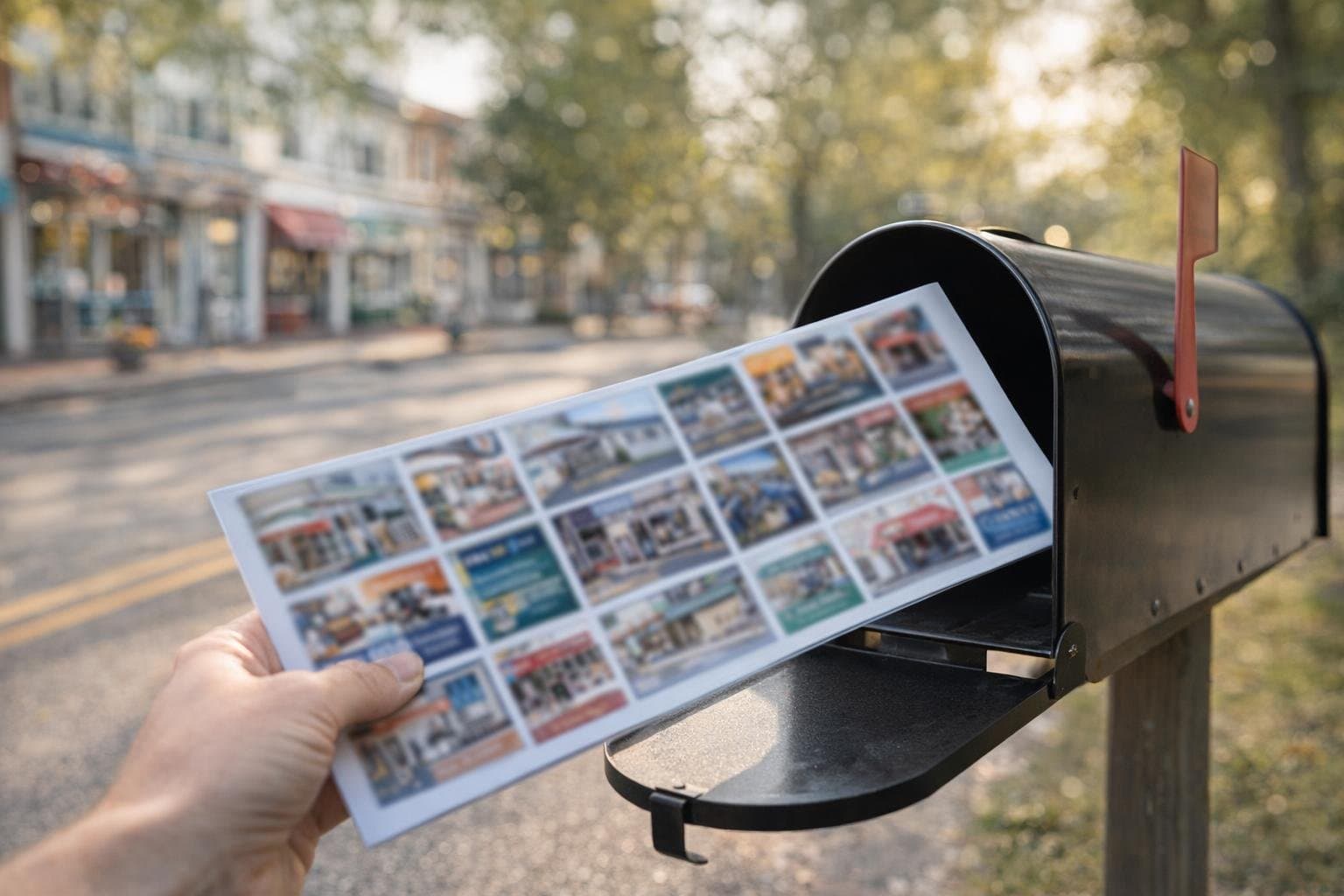
That's basically what a shared 9x12 card is. Think of it as a directory that shows up in the mailbox. One giant 9 x 12 inch piece with about 16 local businesses on it, one per industry, mailed to every home on the USPS carrier routes you pick through EDDM. A roofer, a dentist, an HVAC company, a pizza place, a landscaper. It's like the featured listing for 16 categories, delivered to 5,000 homes, no search ranking required. (If you want to see it from the business owner's side, here's how shared postcard advertising works for advertisers.)

And the chicken-and-egg problem? Gone. You're not asking businesses to pay for traffic that might show up someday. You're selling something they can picture: their ad, in 5,000 mailboxes, mailed on a date you give them.

16
Slots per card
$500
Price per slot
$8,000
Revenue per card
$2,999
All Inclusive print + postage
$5,001
Profit per card
$0
Upfront capital

Here's the beauty of it. Businesses pay before it prints. You collect the $8,000, then you pay the $2,999. The print bill that sinks directory booklets? It's just... not hanging over your head. The first card usually takes around 30 days to fill, and honestly, it's the hardest one you'll ever do.

Full transparency, that $2,999 is the All Inclusive price at my own print shop, 9x12 Method Printing: printing, packing, postage, and USPS fulfillment to 5,000 doors. You don't have to use it. Plenty of people use a local printer.

There's also a smaller version called the community card: 6 x 11 inches, about 16 slots at $250, mailed to 2,500 homes. That's $4,000 in revenue against $1,449 All Inclusive, which leaves $2,551 in profit, and it usually fills in about two weeks. With its simple coupon-style boxes, it honestly looks the most like a printed directory of anything I teach.

If you love the classic directory feel, there's one more variation I've talked about on one of our group calls: a directory card. Lots of tiny one-line listings ("local plumber," "local electrician") at a low price, plus a few bigger ad boxes that cover the print bill. Every sale is way easier than a full slot, but you need a lot more yeses, so it takes a lot more outreach. I haven't run one myself, so go in with your eyes open.

Quick nerd note: in USPS terms, a 9x12 is a "flat," not a postcard, so leave the word "Postcard" off the printed piece. And if you want to see how many homes are in your town before you pick anything, our free EDDM route planner lets you click carrier routes on a map and see the home counts, plus Census numbers like median household income.

Build the Community Business Directory Behind the Card

Here's where it gets fun. The card handles distribution. Now you can add the directory side, and this time it has a reason to exist, because real local businesses already paid to be part of it.

The card is the front door. The recurring revenue lives in the room behind the door.

Here's what that looks like for real members.

William closed a partnership with his local Chamber of Commerce. His words: "Instant credibility, local clout, and access to a powerful network." He gave his mailer a fresh, community-connected name and paired it with a weekly newsletter with business profiles, local deals, and a featured business page for every advertiser. That's a community business directory, built on top of a mailer that already pays.

Jeffrey runs his card under his own brand, Vegas Local Spotlight. He built an email list from people he met at local networking events and sends a free newsletter every Friday morning on Beehiiv. The format is dead simple: one Vegas thing, one Jeff thing, one joke. When he shared it, it was getting a 53% open rate, and he said it was "allowing for warmer conversations when I hit people up to advertise." He also built a web app where residents claim offers from his advertisers.

Corey is a full-time teacher who had been running a hyper-local newsletter for his town for about two years when we sat down for the interview at the top of this post. It grew into a newsletter, a directory, an event calendar, and an app. Then he added community cards. Here's his take on why the card matters even with all that digital stuff: "It's the only physical product I have. If you try to do this just digitally, it is a much much harder sell."

And here's a Corey detail I love. He put a preview of his card on his website, with the other advertisers' names on it. A business owner who'd been in his local business Facebook group for two weeks messaged him "I want in," and paid before 8 a.m. The reason? Seeing the names of other local businesses on the mailer made Corey look legit. That's a directory doing its job.

Ange and her husband set up a local Facebook group for the small and micro businesses in the area they cover, with videos and editorial articles even for businesses that don't advertise on their cards. It hit almost 50 members in just under 48 hours.

Notice what all four have in common. None of them built a directory website and hoped. They started with something that already reached people (a card, a newsletter, a group), then built the directory-style stuff on top.

Funny enough, I run a directory too

Our Local Spotlight is the partner directory for people running this business: 400+ operators on the map, each with a free pin and an optional landing page, so local businesses (and anybody else who's curious) can look up the operator serving their town and see they're part of something real. Here's how Our Local Spotlight works if you want the details.

And it follows every rule in this post. It's narrow (one kind of business). It has one clear job (proving operators are real). And it never had to wait on Google for listings, because the operators come from a community that already existed. Distribution first, listings second.

Speaking of that community. Full transparency: I teach the card side of all this inside the 9x12 Method community on Skool, with 2,800+ members, scripts, templates, and coaching calls. You don't need it to start a directory, and you don't need it to sell your first card either. You could honestly figure it out from this blog and a lot of conversations with business owners. But if you want people next to you while you sell the first one, that's what it's there for.

Where the directory website wins: cheap to start, unlimited room, easy to update, and real long-term value if you stick it out. Where the card wins: distribution on day one, and money in before money out. Honestly? The best version is both, in that order.

Frequently Asked Questions

How do I start a local business directory with no money?

Start narrow and sell before you build. Pick one town and a handful of categories, build your list in a spreadsheet, and sell a few founding listings with a simple mockup before you pay for anything big. If you go the shared mailer route, businesses pay before anything prints, so the money comes in before the print bill does.

How do business directories make money?

From businesses, not readers. The usual ways are featured listings (better placement in a category), paid or annual listings, display ads, category sponsorships, and premium spots like the back cover or the top of the homepage. Free listings can fill a directory, but they rarely pay the bills on their own.

How long does it take a new directory website to get traffic from Google?

There's no set timeline, and for a brand-new site it's usually slow. You're up against Google's own map results and big platforms with years of reviews. BrightLocal's 2026 consumer survey found people used an average of six review sites, with Google on top at 71%. Plan to bring your own audience with a newsletter, a local group, or mail, and treat search as a bonus.

Is a print business directory still worth it?

It can be, because it actually lands in front of people and you can tell advertisers exactly how many homes it reached. The catch is the bill. A 16-page, 8.5 x 11 booklet priced at $4,285.50 for 5,000 copies on 48HourPrint's calculator on September 28, 2026, plus $1,300 in EDDM Retail postage at $0.26 per piece (as of July 12, 2026). Sell the listings and collect the money before you print.

How much should I charge for a directory listing?

Start from your costs. For print, add up printing, postage, and design for one edition, then divide by the listings you can realistically sell. That's your break-even, and your price has to be above it. For online, look at what local businesses already pay for other advertising in your area, and charge more for featured and premium spots.

What's the difference between a local business directory and a shared mailer?

A directory lists a lot of businesses and waits for people to come look. A shared mailer like a 9x12 card puts about 16 local businesses, one per industry, in every mailbox on the routes you pick through EDDM. At $500 a slot, that's $8,000 in revenue against $2,999 All Inclusive print and postage, and businesses pay before it prints.


Look, a local business directory can be a genuinely useful thing for a town, and a real business for you. Just remember the order: distribution first, listings second, and money in before anything prints. Get people looking at it, and selling the listings gets a whole lot easier.

As always, I'm rooting for you.

Ready to run your own card?

Get the course, scripts, tools, and weekly coaching inside the 9x12 Method community.