Honest side hustles for salespeople: real pay, the non-compete traps to check first, and how sales pros turn their skills into a local business they own.
You spend all day closing deals for somebody else's product, at somebody else's price, under somebody else's commission plan. And when the quarter resets, so do you. Most lists of side hustles for salespeople miss that completely. They hand you "start a podcast" and "sell on Etsy" like your best skill doesn't exist. Here's the thing. You already know how to prospect, follow up, and ask for the money. The question is how to point that at something you own, without getting fired over your non-compete. So that's what this is: the honest list, the employer traps to check first, and what happened when a few career salespeople in our community started selling for themselves.
Watch: Never Take A Deposit: 9x12 Postcard Sales Rules From A 40-Year Sales Veteran · Summary and transcript
Most people looking for a side hustle need to learn how to sell. You don't. Your problem is the opposite. You've got the skill, and somebody else owns the upside.
And honestly, the average side hustle doesn't pay much. Bankrate's 2025 side hustle survey found that 27% of U.S. adults have one. The average earns $885 a month, but the median is just $200.
27%
Adults with a side hustle
$885/month
Average side hustle income
$200/month
Median side hustle income
$64,820/year
Median ad sales agent wage
That last number is from the BLS page on advertising sales agents, as of May 2025. BLS also says "most employers pay some combination of salaries, commissions, and bonuses." So even the people who sell ads for a living are mostly earning a paycheck on somebody else's book.
So the bar for a good sales rep side hustle is simple. It should use your skill, pay in real chunks, not compete with your employer, and build customers who come back to you, not to your territory. Most of the usual ideas fail at least one of those.
This is the part nobody else covers, and for a salesperson it's the part that can actually hurt you. You signed paperwork when you took your job. Go read it before you earn a dollar.
Non-compete: limits you from working in your employer's line of business, often for a period after you leave too. The FTC tried to ban most of them, but on September 5, 2025 the FTC voted to drop its appeals and accept the court ruling that threw the rule out. So non-competes are back to being a state-law question.
Non-solicit: stops you from going after your employer's customers. This one bites salespeople hardest, because your best contacts are usually their accounts.
Moonlighting or outside-work policy: some companies just want you to disclose a side business. Some want approval first. Check the handbook.
Duty of loyalty: even without a contract, most states hold that employees owe their employer loyalty while they work there. In general, that means don't compete with them or divert their deals. And as Nolo explains, an employer can typically fire you for starting a competing business on the side.
Look, I'm not trying to scare you. I just don't want you fired over a $500 ad slot. Here's a quick test I'd run before picking anything:
Write down who buys from your employer. Industries, company sizes, the towns in your territory.
Write down who your side hustle would sell to. Same exercise.
Look for overlap. If the lists share buyers, pick something else or get it cleared in writing. If they don't, you're in much safer territory.
The cleanest side hustle sells to different buyers, in a different industry, on your own time. Keep that in mind as you read the list.
Companies pay people to book calls and meetings for their closers. You already know how to work a list, so the learning curve is basically zero.
The catch: I couldn't find a reliable source for typical pay, and the forum numbers are all over the place. More important, it's basically your day job again, just on nights. It's also the side hustle most likely to collide with a non-solicit if you stay in your industry.
Picking up a second product to sell at night. Some reps do it. But it carries every risk of commission only sales jobs (draws, chargebacks, no pay when nothing closes), plus the risk that your boss sees it as competing. And you still don't own the customer.
Local owners are often terrible at selling. You can teach them scripts, how to follow up, and how to keep track of every lead.
The catch: you need proof before anyone pays you for advice, and it's still hours for dollars. Also, stay out of your employer's industry here, because "I advise companies like my employer's customers" is exactly what a non-compete is written for.
These are popular with sales types for good reason. BLS lists the median at $62,280 for insurance sales agents and $52,830 for real estate sales agents as of May 2025, mostly paid in commission.
The catch: both are licensed in every state, so there's schooling, exams, and fees before your first deal. And those medians are full-time incomes, not part-time ones. I was a struggling realtor myself, so I know a license isn't the same as income. Funny enough, my first month running cards made me about $5,000 in profit while I was still in real estate.
Selling scripts and courses is the make-it-once version of consulting, but it's a slow build, and you're now in the content business. Reselling on eBay or Facebook Marketplace rewards your negotiating, but it's mostly sourcing, storage, and shipping. Both can work. Neither uses much of what makes you good.
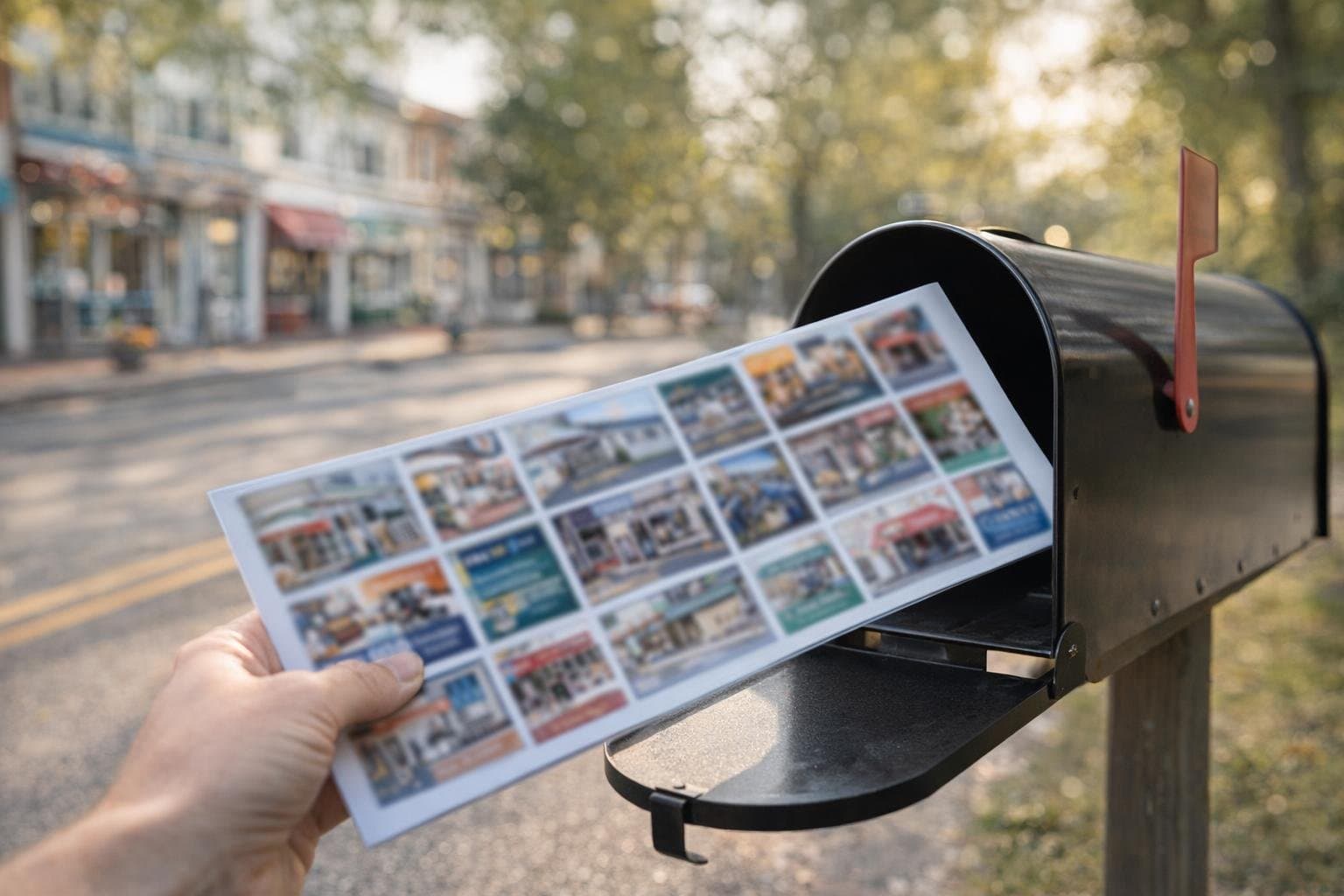
This is the one I run, so I'll go deeper below. Short version: you put together one big postcard, sell ad slots to local businesses (one per industry, so nobody competes), and mail it to every home in a neighborhood. The businesses pay upfront, which covers the printing and mailing. You keep the difference.
The catch: it's still sales. You will hear no. The difference is that it's your product, your price, and your customers.
Here's the whole list in one table. Figures with a source are linked above. Everything else is my honest read.
Side business
Pay
Who owns the customer
Conflict risk with your job
Appointment setting
No reliable data
The client
High if same industry
Commission-only gig
Commission only
The company
High
Sales consulting
You set it
You
Medium
Scripts and courses
Slow build
You
Low to medium
Real estate or insurance
$52,830 to $62,280 median (BLS, full-time)
Shared with the brokerage or agency
Depends on your job
Reselling
Margin per item
Nobody, really
Low
Postcard advertising
$5,001 per full 9x12, $2,551 per community card
You
Low (local businesses, not your accounts)
See the pattern? Most options either put you back on someone else's commission plan or barely use your sales skill. Only a couple let you own the customer and set the price.
Okay so, let me break down the model with real numbers first.
You build one oversized 9x12 postcard with about 16 ad slots. Each slot goes to one local business per category. The card mails to every home on the postal routes you pick through USPS Every Door Direct Mail. Every advertiser pays before anything prints, so you never front the money.
16
Slots per 9x12 card
$500
Price per slot
$8,000
Revenue per card
$2,999
All Inclusive print + mail
$5,001
Profit per card
5,000
Homes reached
That $2,999 is 9x12 Method Printing's flat All Inclusive price to 5,000 homes, postage included. The smaller 6x11 community card is 16 slots at $250, so $4,000 in, $1,449 All Inclusive to 2,500 homes, and $2,551 kept. Sell fewer slots and you keep less. It's math, not magic.
Now here's why salespeople pick this up fast. Look at what the job actually is:
Prospecting: a list of local roofers, dentists, and HVAC companies. You've built worse lists.
Follow-up: deals close on the second, third, or fourth touch. Frank, who you'll meet below, puts it at asking seven to 13 times before you get a yes. You already live there.
Closing on scarcity: one business per industry is real exclusivity, not a fake deadline.
Collecting money: full payment upfront, before printing. No net-30, no chasing.
And here's what's different from your day job. Every slot you sell, you set the price. Every advertiser who renews is your customer, not your territory's. That's the whole difference between a side hustle and a second job.
Lucy has been a professional salesperson since she was 16. She does sales training. She's been through Sandler and NLP. She also owns a plant nursery, and she walks in as exactly that: a fellow business owner splitting the cost of a giant postcard.
On one walk-in, the owner listened to her whole pitch and said, "It sounds to me like you're a postcard salesperson, not a plant nursery owner."
She told our group on a live call that it floored her. Her takeaway was that she sounded "too polished and too rehearsed," and that she was talking too much and not asking enough questions. That's a 40-year pro saying that. Her plan going forward: hand the card over, stop talking, and let the owner ask the questions.
She's doing just fine, by the way. When she shared that story, she was working on her third and fourth cards at the same time, with 9x12s going to 10,000 homes in affluent areas at $777 a spot. And in a different conversation, here's the line she used on a hesitating HVAC owner. I love it, because it sounds like she feels bad for them:
"I have to tell you something truly horrible. I have a list of 7 other HVAC companies that I am seeing door to door today and if one of them gives me a check, I am going to take it. What's really horrible is that your competition is going to be in front of 10,000 doors that should have been yours."
Frank told the same call he has recruited and trained over 10,000 salespeople in his businesses. His rules for this business sound like they came out of an old sales manual, because they did:
No deposits. "You don't have a sale till you got all the money." Some people say yes just to get rid of you.
The either-or close. Mock up two ads before you walk in, a single and a double. Ask which one they prefer. Then stop talking. In his words, "First one that opens her mouth loses."
Sell exposure, not instant results. And offer 3, 6, 9, and 12-month packages, paid upfront.
Another veteran on that call, a Sandler trainer who runs a consulting business, said he knows the owner's name before he walks in nine times out of ten. He carries the card in a folder, pulls it out, and lets the owner react. Then he does the takeaway: he has no idea if this is something they're even looking to do. He also targets businesses with bigger tickets, so that two or three new customers cover the ad.
Joshua worked full-time as an appointment setter while he ran his card. Two weeks of zero sales. Then one more Facebook post, and he closed 5 spaces. Sound familiar? It's the same dry spell you've had in your day job. The difference is what happens when it breaks.
I go through the full call in the video at the top of this post, and the most common pushback (with how members answer it) is in my guide to postcard sales objections.
Being good at sales doesn't make you immune. Here's what I see career reps get wrong:
Pitching like an agency. You're not selling marketing services. You're a local business owner getting businesses together to split the cost of a big mailer. A community connector, not a salesperson.
Overtalking the close. See Lucy and Frank above. Polish can work against you with a small-town owner.
Taking a "yes" without payment. Your day job may run on contracts and invoices. Here, money comes in before the card prints. Always.
Mixing worlds. Don't sell slots to your day-job accounts, don't do it on company time, and don't use the company CRM. Keep a separate system.
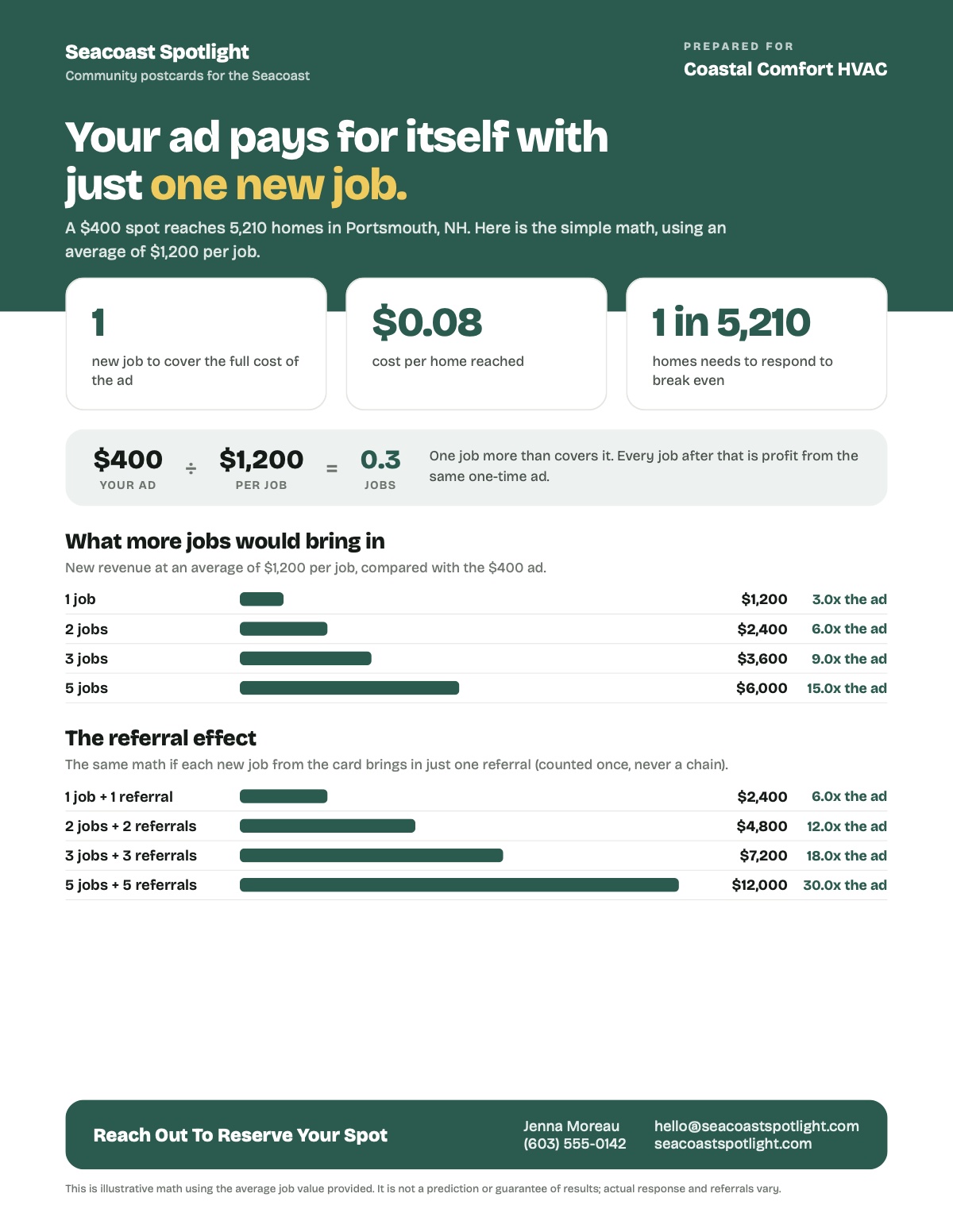
Promising results. Never promise customers. Promise what's true: their ad goes into every mailbox on the routes. A postcard ad payback sheet shows owners the simple math of how many new customers cover the ad, without predicting anything.
If you're already working full time, the schedule matters as much as the pitch. I covered how people fit a side hustle while working full time in a separate guide. Here's the short version for this business:
Read your employment agreement and handbook. Confirm you're clear on non-compete, non-solicit, and outside-work rules.
Pick a town of roughly 15,000 to 100,000 people, away from your sales territory if you can.
Build a list of 50 local businesses in industries with bigger tickets: roofers, HVAC, dentists, chiropractors, painters.
Mock up two ads per prospect, a single and a double, before you reach out.
Reach out after work and on weekends. Email, local Facebook groups, and Saturday walk-ins all work.
Collect full payment upfront, then send the card to print. With All Inclusive, you never touch postage or post office paperwork.
Full transparency, I do teach all of this inside the community, with the scripts, templates, and live calls like the one with Lucy and Frank. You don't need it to get started. If you've been in sales for years, you might honestly need it less than most. It just saves you time.
You've spent years proving you can sell. The only question left is whose name is on the business.
The best one uses your sales skills, sells to different buyers than your employer, and lets you own the customer and set the price. For a lot of reps, that's a local advertising business like a shared postcard. You're selling to local businesses that have nothing to do with your day-job accounts.
Usually, yes, but check four things first: any non-compete, any non-solicit, your company's outside-work policy, and the general duty of loyalty you owe while you work there. Never compete with your employer or pitch their customers. If your agreement is unclear, an hour with an employment attorney is worth it.
No. A federal court set the rule aside in 2024, and on September 5, 2025 the FTC voted to drop its appeals. Non-competes are governed by state law, and some states (California is the best-known example) don't enforce them for most employees.
It depends entirely on the side hustle. Bankrate's 2025 survey put the median side hustle at $200 a month. On a shared postcard, a full 9x12 card is $8,000 in slot sales and $5,001 kept after the $2,999 All Inclusive print and mail, but only if you fill it.
Yes. If you net $400 or more from self-employment, you owe self-employment tax of 15.3% on top of income tax, reported on Schedule C and Schedule SE. The IRS says you may need to pay estimated taxes quarterly, or you can raise your withholding at your day job with a new W-4.
Check your handbook. Some companies require you to disclose outside work, and some require approval. If yours does, disclose it. A side business that sells to completely different customers is a much easier conversation than one that touches your employer's market.
As always, I'm rooting for you.
Ready to run your own card?
Get the course, scripts, tools, and weekly coaching inside the 9x12 Method community.

 Mitchell Tebo