Postcard advertising examples from real shared 9x12 cards, broken down slot by slot: headlines, offers, QR codes, colors, plus 10 ad ideas and common mistakes.
Search for postcard advertising examples and you'll mostly find solo cards. One business, one big photo, one offer, the whole card to themselves. That's great if you're a dentist mailing your own card. But on a shared card, the real question is different: what does one ad look like when it's sitting next to seven others on the same side? So I'm going to show you real cards that mailed in my own towns, York, Dover, and Portsmouth, and break them down slot by slot. What works, what doesn't, and the ad ideas I'd steal for each industry.
Okay so, quick orientation before the shared postcard examples. A 9x12 card has two sides, Side A and Side B. Each side has a row of ads on top, a row on the bottom, and a banner running through the middle.
9" x 12"
Card size
8
Ad slots per side
About 2.8" x 3.8"
Single slot
Two singles side by side
Double slot
5,000
Homes per mailing
Every business gets the same shot at the eye, and only one business per industry gets on the card. Advertisers can also buy more room. A double is two singles side by side, and some buy three. You'll see all of it below.
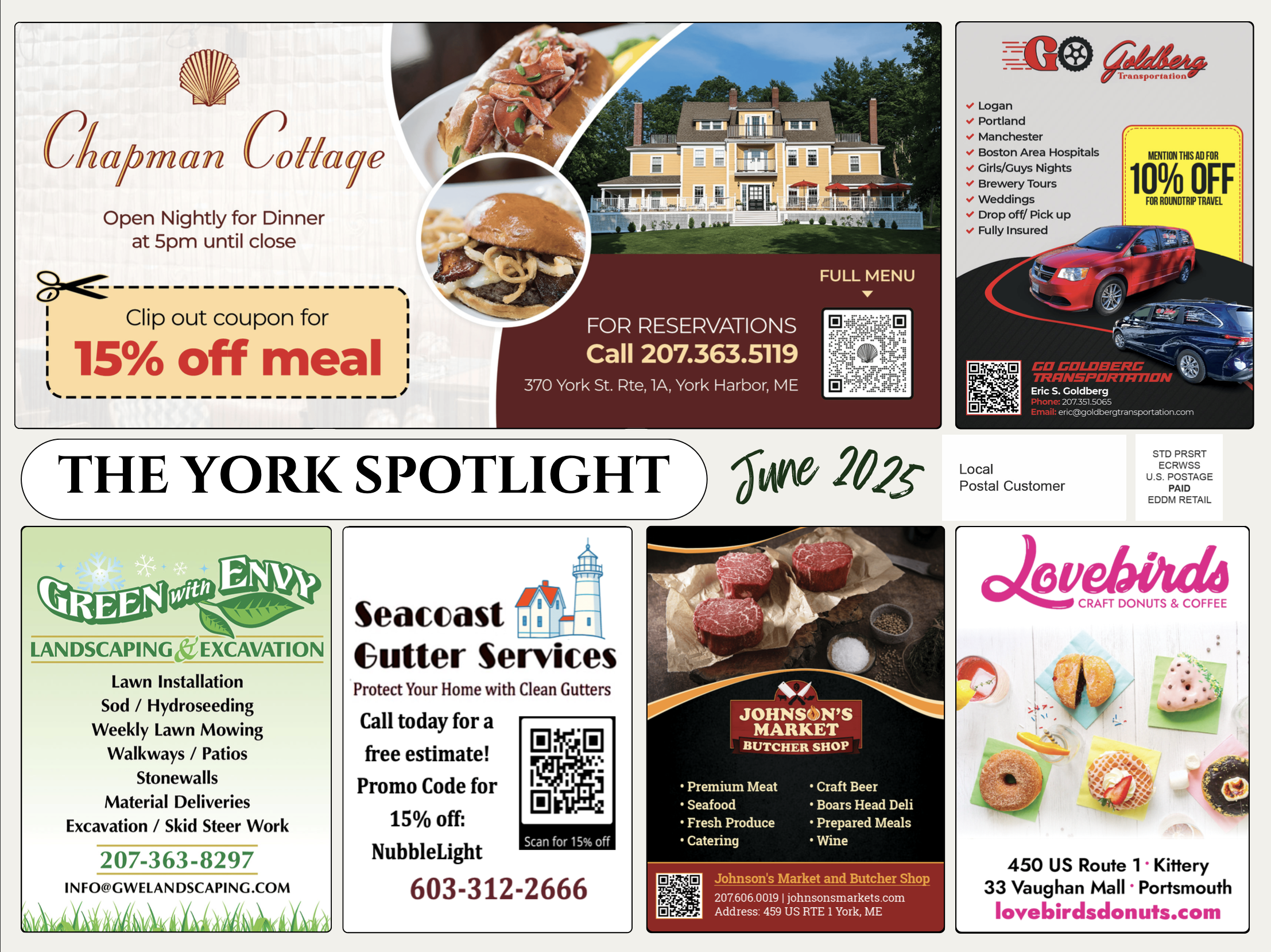
The restaurant across the top. It takes up three slots' worth of room and uses every inch. A dashed coupon box with a scissors icon says "Clip out coupon for 15% off meal." Food photos make you hungry, the reservation number is big, and the QR code is labeled "Full menu," so you know exactly why you'd scan it.
The transportation company (top right). A checklist of trips people actually take, like the airport, hospitals, and weddings, plus a yellow box: "Mention this ad for 10% off." That "mention this ad" line is how the owner knows the card worked. The weak spot is the contact block, which is tiny.
The gutter company. Plain white background, and it still works: "Call today for a free estimate," a promo code for 15% off, and a QR that says "Scan for 15% off." A promo code is the cheapest tracking there is.
The landscaper. Green on green with seven services and a big phone number. You know exactly what they do. But there's no offer, so there's no reason to call this month instead of next.
The butcher shop. Dark background, steaks on butcher paper, a short bullet list, QR and phone at the bottom. The photo does the selling.
The donut shop. A hot-pink logo and a photo you can almost taste. No phone, no offer. That's a brand ad. It works for a shop people walk into, but the owner can't easily tell what the card did.
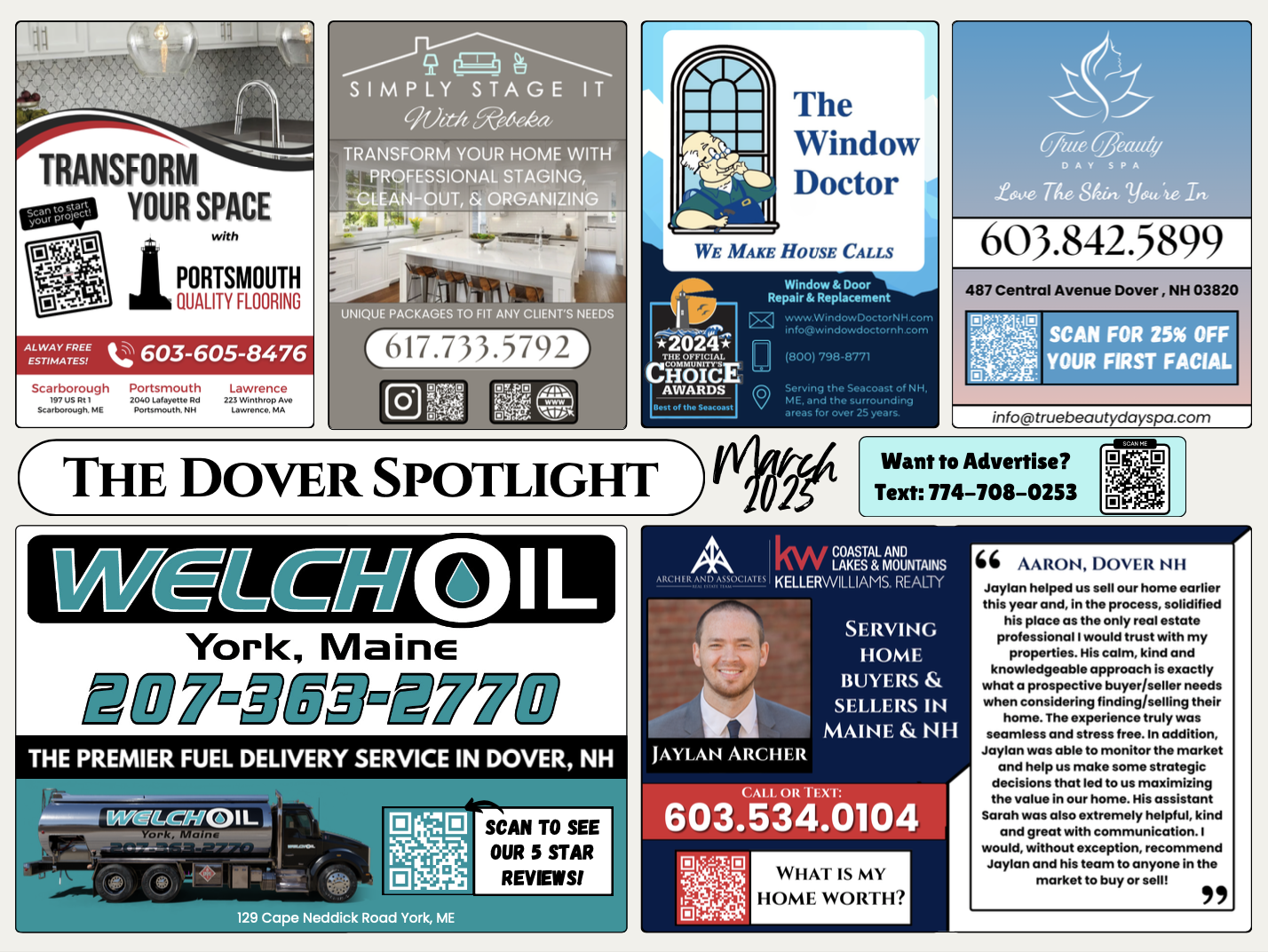
The day spa. "Scan for 25% off your first facial." The QR code has a job, and the offer is aimed at first-time customers, which is exactly who an advertiser wants from a mailer.
The realtor (double, bottom right). A headshot, because people hire people. A QR code that asks "What is my home worth?", which might be the best realtor call to action there is, since every homeowner is curious. Plus a real client review. That's why realtors buy doubles.
The fuel company (double, bottom left). The phone number is the biggest thing on the ad. And the headline names the town: "The premier fuel delivery service in Dover, NH."
The window repair company. A friendly mascot, "We make house calls," and a community choice award badge. Small trust markers like that matter when you're inviting someone into your house.
The banner. "Want to advertise? Text" plus a phone number and a QR code. That's the operator selling the next card. Every home sees it, including the business owners who live on those routes.
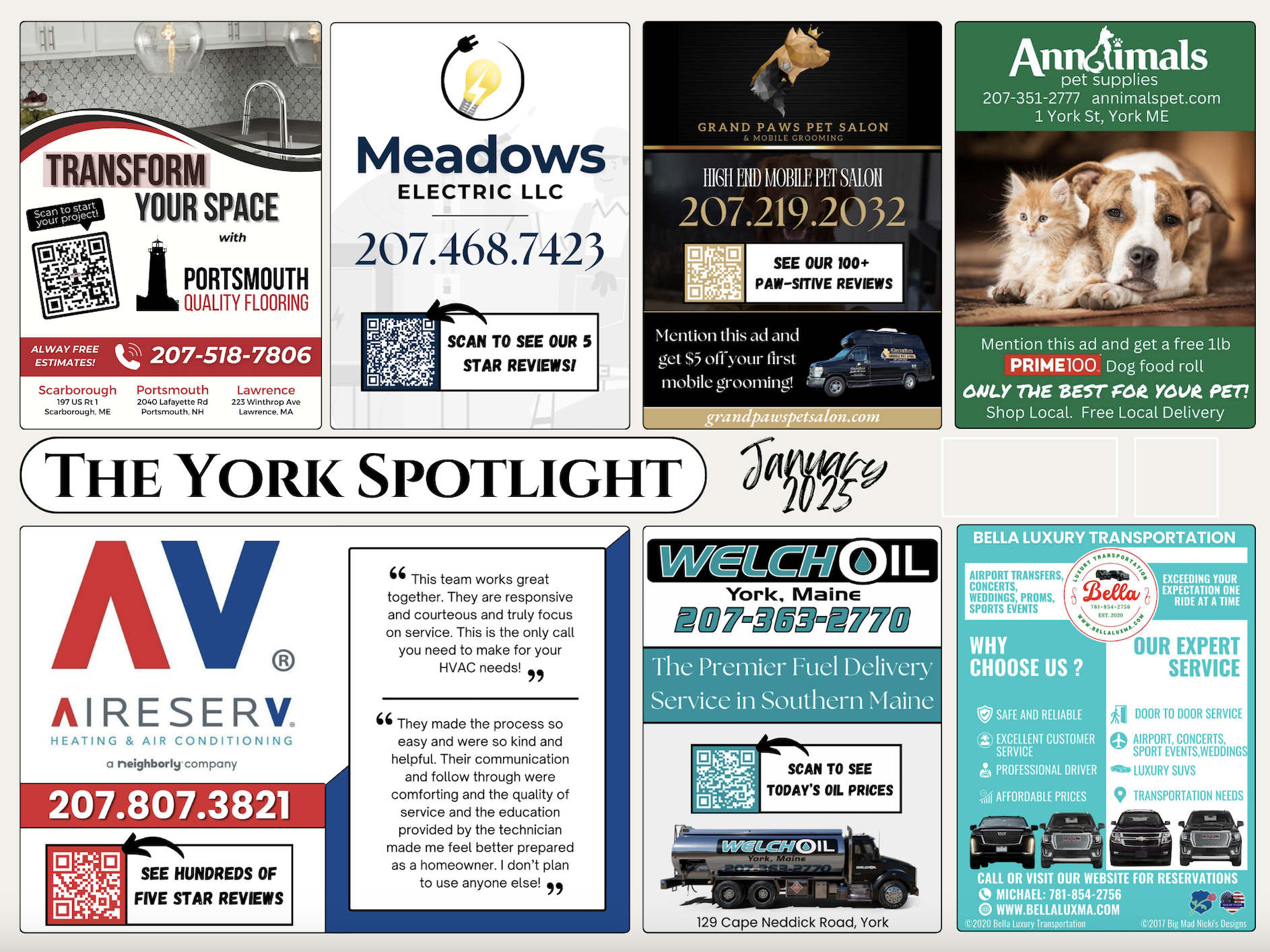
The flooring company is on the York January card and the Dover March card. Same ad, two towns. But look closely: the phone number is different on each card. Whether that's a tracking line or a local number for each state, a different number per card tells the owner exactly which mailing made the phone ring.
The fuel company is on both cards too, with a smarter tweak. On York it's "Southern Maine" with "Scan to see today's oil prices." On Dover it's "Dover, NH" with "Scan to see our 5 star reviews." Same company, headline rewritten for each town.
Two pet businesses, one card, no conflict. The groomer offers "$5 off your first mobile grooming" and the pet store offers a free dog food roll, both with "mention this ad." Grooming and pet supplies are different industries, so exclusivity holds.
The HVAC double (York, bottom left) puts two customer reviews next to a big phone number and a "See hundreds of five star reviews" QR. For a big-ticket service, trust sells.
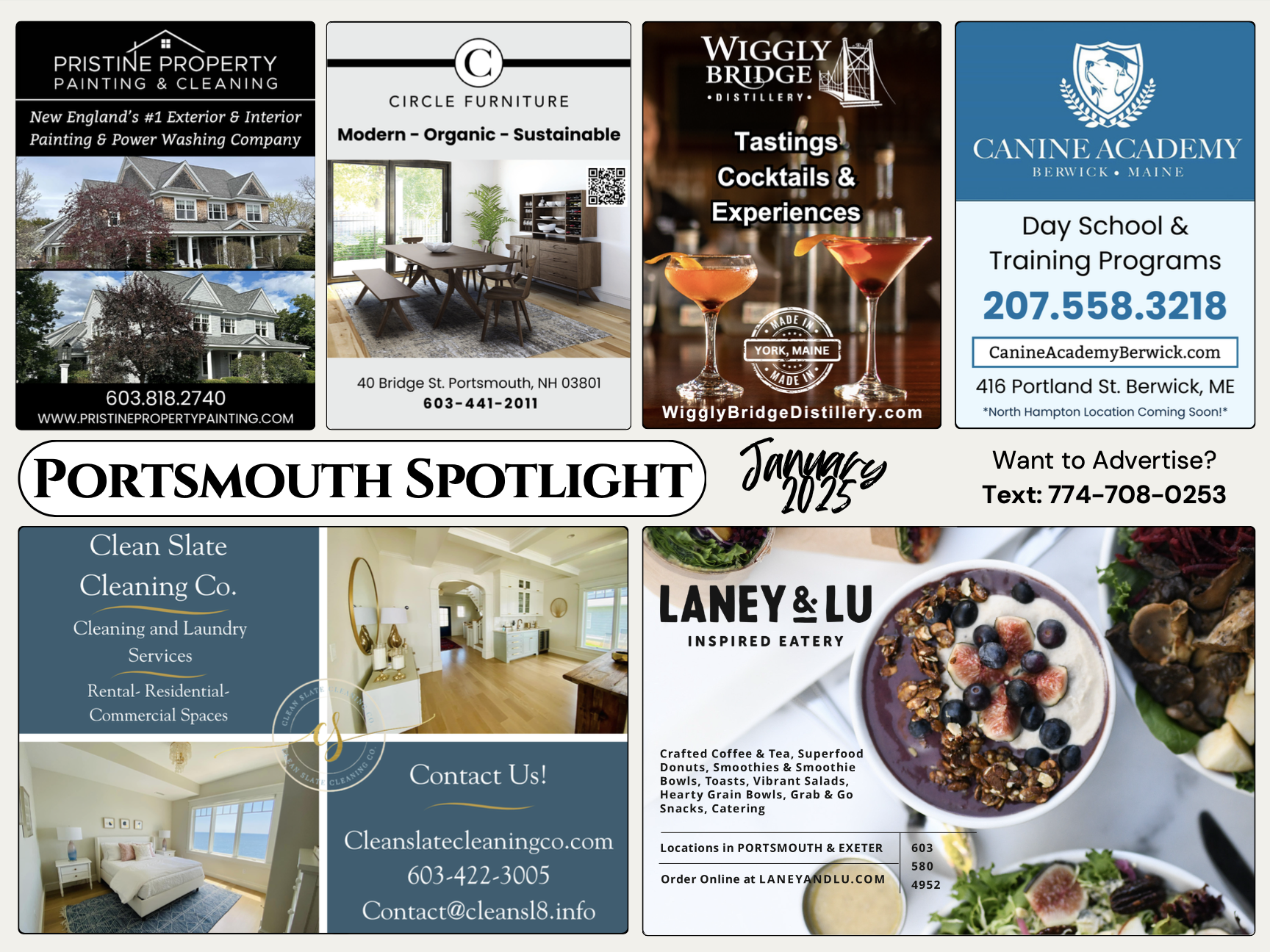
The Portsmouth side is gorgeous, and not a single ad on it has an offer. The furniture store, the distillery, the cleaning company: all brand ads. Beautiful photos, nothing to act on this week, and nothing for the owner to count.
A great ad and a forgettable ad cost exactly the same to print. The only difference is what's inside the box.
Most EDDM postcard examples online skip this part, and it's the part that gets your card mailed.
The banner. Card name plus the month, like "The York Spotlight, June 2025." It makes the card feel like a local publication instead of junk mail, and the month tells people it's current.
Your "Want to advertise?" line. Free advertising for your next card.
The mailing block. On the York June card, look right of the banner: "Local Postal Customer" and the EDDM Retail postage indicia. An EDDM Retail piece needs both. Keep ads and photos out of that space. The USPS Every Door Direct Mail page spells out the rules.
No "postcard" printed on it. In USPS terms a 9x12 is a flat, not a postcard, and the rules say pieces that aren't postcards shouldn't carry that word. Leave it off.
The free 9x12 postcard template has the banner, the slots, and the mailing block already in place, so you just swap in the ads.
Here are the postcard ad ideas I'd steal from these cards, plus a few more. If you're still deciding who to pitch, start with the best industries for postcard advertising.
Roofers: "Free roof inspection," a before-and-after photo, and their license number. Sell them a double. Roofers need the room.
HVAC: a seasonal tune-up offer next to two short customer reviews and a "See our reviews" QR, like the York HVAC ad.
Dentists: a new-patient offer and a friendly face. A new patient is worth a lot to a dentist, so the ad can pay for itself fast.
Restaurants: a clip-out coupon with a dashed border, a food photo, and a QR to the menu. Copy the York restaurant.
Realtors: a headshot, a "What is my home worth?" QR, and one client review. Double slot.
Landscapers: a spring cleanup or free estimate offer with a promo code, mailed when lawns start growing.
Groomers and pet stores: a cute animal photo and a "mention this ad" deal. Pet photos stop the eye every time.
Spas and med spas: a first-visit discount behind a QR, like "Scan for 25% off your first facial."
Auto shops: a dollar-off oil change with an expiration date and the street address. People pick shops by location.
Home services (gutters, windows, cleaning): a free estimate, a promo code, and a trust badge if they have one.
Full transparency. Inside the community, members get the AI Ad Designer and ScanLab for QR tracking. You don't need either one to make a good ad. Everything in this post works in free Canva.
Every one of these shows up on real cards, including good ones.
No offer. Brand ads look nice and are hard to measure. Give people a reason to call this month.
A list of everything. Seven services in a slot under 3 inches wide is a brochure, not an ad. One headline, one offer, one call to action.
A QR code with no reason. "Scan for 25% off" beats a naked QR code. Give every scan a job.
A tiny phone number. For service businesses, the phone number should be one of the two biggest things in the slot.
Thin text over busy photos. Script fonts on a dark photo disappear at arm's length.
No town name. The fuel company proved it: put the town in the headline and it reads like it was made for that neighborhood.
The full design rules (headline, offer, image, call to action, trust marker) are in my guide to postcard ad design. Running a community card instead? Those slots are smaller and coupon-style, so the offer has to be the headline. I cover that in community card design.
One clear headline, one specific offer, one way to respond (a big phone number or a QR code with a reason to scan), and a photo that fits the business. The best ads on real shared cards also include a tracking hook, like "mention this ad" or a promo code, so the owner knows the card worked.
About 16, with 8 slots per side. Each single slot is about 2.8" x 3.8". Advertisers can buy a double (two singles side by side) or more. One business per industry keeps competitors off the same card.
A banner with the card name and month, the words "Local Postal Customer," and the EDDM Retail postage indicia in a clear mailing block. EDDM Retail pieces need both the address line and the indicia. Leave the word "postcard" off a 9x12, since USPS treats it as a flat.
Lead with an offer built for new customers: a free estimate for home services, a first-visit discount for spas and salons, a clip-out coupon for restaurants, or a "What is my home worth?" QR code for realtors. Add a tracking hook like a promo code so the business can count the results.
Not every one, but most should, and every QR code needs a label that says why to scan it, like "Scan for 15% off" or "Full menu." For service businesses where people call, a big phone number matters more than the QR code.
No. Most operators build ads in Canva, and plenty of advertisers send their own. Follow the one headline, one offer, one call to action rule and keep important text away from the edges. If an advertiser sends a cluttered ad, it's worth suggesting a cleaner version before it prints.
Grab one real card, put it next to your next ad, and ask: what's the offer, and how will they know it worked? Answer those two and you're ahead of half the ads in any mailbox.
Love you guys. As always, I'm rooting for you.
Ready to run your own card?
Get the course, scripts, tools, and weekly coaching inside the 9x12 Method community.

 Mitchell Tebo