Build a one-page advertising media kit for your local postcard: reach, slot prices, mail dates, proof, and contacts, plus the payback sheet that closes faster.
Search "advertising media kit template" and almost every result is built for a newsletter, a podcast, or a website. Pageviews. Open rates. CPM. Here's the thing. A roofer deciding whether to buy a slot on your postcard doesn't care about any of that. He wants to know how many homes, which neighborhoods, what it costs, when it mails, and whether it works. That's what an advertising media kit for a local postcard really is: one clean page that answers those questions before he has to ask. So let me break down what goes on it, what the layout looks like, how to send it with your pitch, and why a one-page payback sheet often closes better than the kit itself.
Most local business owners have never bought shared postcard advertising. So right after "okay, what is this?" they want something they can look at.
Estevan figured this out early. He made a simple sales and price sheet, posted it in local small-business Facebook groups, and got his first reach-out within minutes. Nothing fancy. Just the facts, on one page.
Here are the facts your kit is built around on a standard 9x12 card:
Lead with the number of homes and exactly where they are. "5,000 homes across 9 carrier routes in [ZIP Code]" beats "the greater [County] area" every single time. If locals know the neighborhoods by name, use the names.
If your routes lean toward higher-income, single-family homes, say so. That's what most advertisers want. Still picking routes? My route selection guide walks through how I do it.
Put the price on the page. A kit without prices just creates one more email ("so what does it cost?"), and a posted price filters out tire-kickers before they eat your afternoon.
Slot
Size
Price (5,000 homes)
Single
About 2.8" x 3.8"
$500
Double
Two singles side by side
$900
Call it a "double" so they see they're getting twice the space for a slight discount. And label the card Side A and Side B, never front and back. Michael started doing that after hearing "I don't want to be on the back" one too many times, and the objection basically disappeared.
Running a community card? Same idea, smaller numbers: about 16 slots at $250, mailed to 2,500 homes. The reasoning behind both is in my guide to postcard advertising rates. Then finish this section with one line: "One business per industry. First to pay gets the slot."
Tell them how often the card goes out (monthly, quarterly, seasonal) and when the next one mails. Use a window, not a date. "Next card mails in late March" is perfect.
USPS doesn't guarantee a delivery date for Marketing Mail, so a hard date is a promise you can't fully control. I tell advertisers I'm aiming to put the print order in mid to late month. Most don't care exactly when it goes out, as long as you keep them updated. Keep your real print deadline internal, but do list the date you need their logo and offer.
This section sells your second, third, and fourth card. Put a real photo of your last card on the kit, then add one or two lines of proof:
How many advertisers came back. Michael runs quarterly cards, and roughly 75% of his advertisers renew. A line like "[X] of 16 advertisers are back for spring" says the card works without you saying "it works."
One specific result. Calls, jobs, sales. Whatever an advertiser actually told you.
Brand new with no results yet? Borrow them, honestly: "We've got partners doing this all over the country, and this is our first card in [Town]." Then share a real result from another card, like Lucy's Amish butcher, who got six phone calls the day the cards landed. Add your Our Local Spotlight page so they see you're part of a real network.
The full system for collecting this proof is in my guide to advertiser renewals.
Two or three short quotes with a first name, type of business, and town. Ask permission first.
Short beats long. After card #1, one of Michael's painting advertisers wrote back: "We've had great success with the flyers and have had many calls." That one sentence beats a paragraph of your own copy.
Your name, a phone number that takes texts, your email, and one website (your 9x12 Sites landing page or your Our Local Spotlight page). Then one clear line: "Reach out to reserve your spot."
Add how they pay, too: payment up front claims the slot, because it covers printing and postage.
Here's the layout, top to bottom. Seven blocks, one page.
Block
What goes in it
Example line
Header
Card name, town, your logo
"The [Town] Spotlight"
Reach
Homes, routes, ZIP Code, neighborhoods
"5,000 homes across 9 carrier routes"
Slots and prices
Single, double, exclusivity
"Single $500. Double $900. One per industry."
Schedule
How often, next mail window, artwork date
"Next card mails in late March"
Proof
Photo of your last card, renewals, one result
"[X] of 16 advertisers came back"
Testimonials
Two or three short quotes
"We've had great success with the flyers."
Contact
Name, phone, email, website
"Text [Name] to reserve your spot"
That's the whole media kit template. If it spills onto a second page, cut words, not sections. And update it every card, because an old price makes you look sloppy.
The kit is never your first email. Never. Here's the order that works.
Send the first email as a single question. "Hey, do you still serve the [Town] area?" No price, no pitch, no attachment. The two-part cold email is built around exactly this.
When they reply, send the short pitch. "Awesome, the reason I ask is I'm putting together a giant postcard going to 5,000 homes in [Town], one business per industry. Want the [industry] spot?"
When they're interested or say "send me more info," send one page. That's your kit, or better, a payback sheet with their name on it. This is when the price shows up.
Call within 24 to 48 hours. "Just making sure the sheet came through. Any questions I can answer?"
For walk-ins, hold a real card in your hand and bring printed sheets. If the owner isn't in, leave the sheet at the front desk and save your sample card for the owner.
When they say yes, ask for payment. "Happy to have you on board. We do ask for commitment up front to officially claim your slot. It helps pay for the cost of printing and postage."
A media kit is about your card. A payback sheet is about their money. And every business owner is doing the same math in their head the whole time you're talking: will this thing pay for itself?
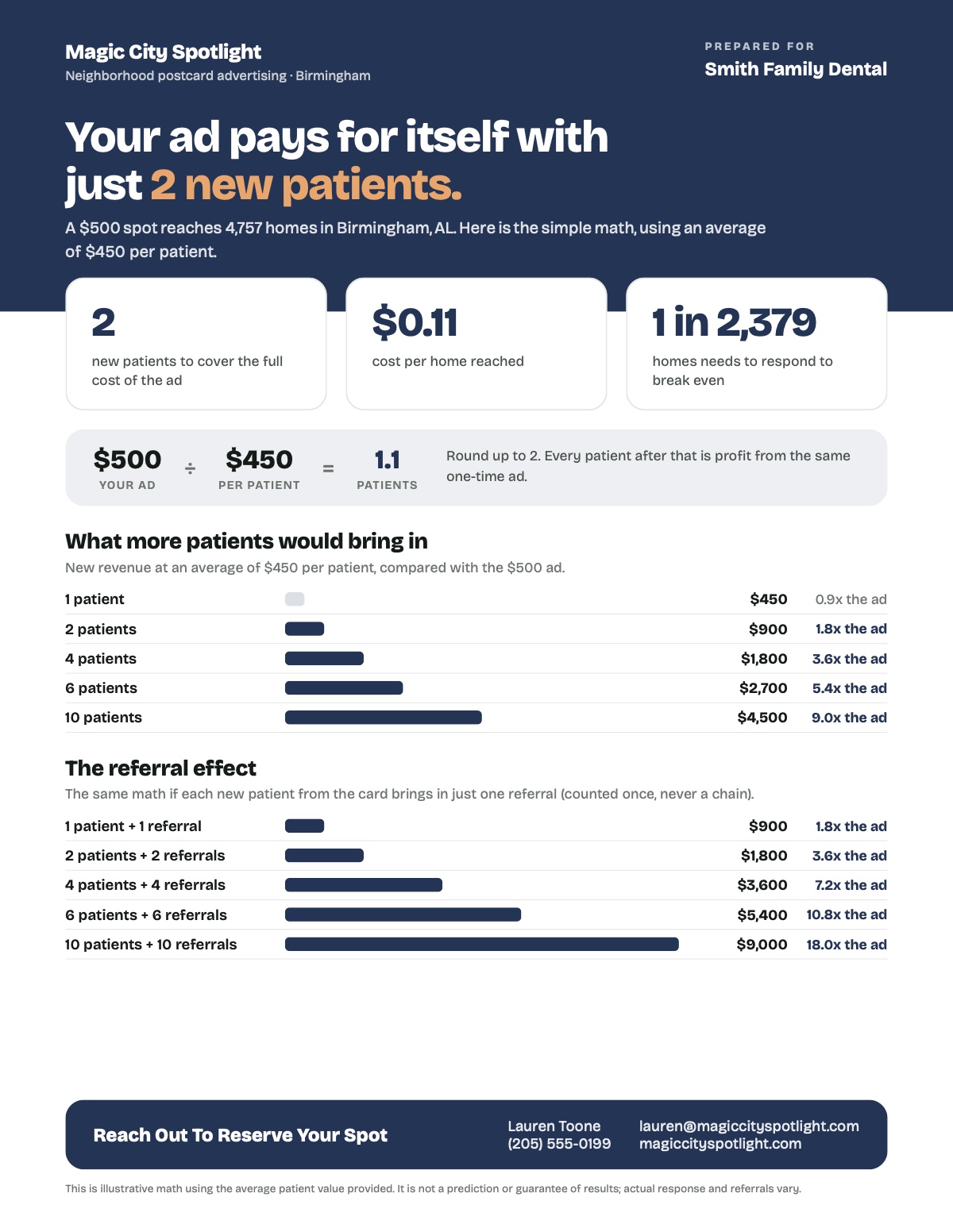
The payback sheet does that math out loud, with their own number. Ask one question on the call: "What's a new customer usually worth to you?" Say a dentist tells you a new patient is worth about $450. Now look:
$500
Their ad
$450
One new patient is worth
2
Patients to cover the ad
10 cents
Cost per home reached
1 in 2,500
Homes that need to respond
Two new patients. Out of 5,000 homes. That's the whole pitch.
Here's why it so often beats the full kit:
It uses their number. You're not claiming anything. They told you what a customer is worth.
It answers "how many customers will I get?" honestly. No predicted response rate. Just how few customers it takes to break even.
It has their name at the top. "Prepared for Smith Family Dental" shows you did your homework.
It sells the outcome, not the card. That's what the best advertising sell sheet does.
A media kit tells them about your card. A payback sheet tells them about their money. Lead with their money.
Keep the kit for people who want the full picture. Send the payback sheet when you want a yes this week. Or send both. It is that simple.
Full transparency. I built a free tool for exactly this: the postcard ad payback calculator. Type in your business name, logo, colors, and contact details, then the advertiser and what one customer is worth to them. You get a live preview of the one-page sheet as you type.
A few things I was strict about:
Your brand only. No 9x12 Method name or logo anywhere on the sheet. Your advertisers see your card, not a training company.
Pure math. It never predicts a response rate, and it says so at the bottom.
Fast after the first one. It asks for your name and email once, the first time you grab the PDF. Your brand saves on your device, so the next sheet only needs the advertiser.
For the reach section, the EDDM route planner turns the routes you pick into a mailing area report with a route map and neighborhood numbers, your name on it, and no prices. Everything else we give away (Canva card templates, the objection handler workbook, the prospecting prompt) lives on the free tools page.
I do teach the whole pitch inside the community, including the scripts we pair these sheets with. But you don't need it to build a sheet. The builder is free either way.
An advertising media kit is a short document that tells a business what they get if they advertise with you. For a local postcard, it's one page covering homes reached, carrier routes, slot sizes and prices, the next mail window, past results, and your contact details.
Six things: reach (homes and routes), slot sizes and prices, the mailing schedule, results and renewal proof, two or three short testimonials, and your contact details with how to reserve. On a standard 9x12 card, that's 5,000 homes, 16 slots, $500 for a single, $900 for a double, and one business per industry.
Yes. Leave the price out of your first cold email, but once someone asks for more information, the kit should have it. A kit without prices just creates another round of emails. Never put your print cost or your profit on it.
One page. Business owners are busy, and nobody reads page two. If yours runs long, cut words, not sections. Each block should be a number and a line of context.
You can copy the seven-block layout in this post. For the page that does the most selling, the free payback calculator on 9x12method.com builds a one-page payback sheet with your own logo, colors, and contact details. It asks for your email once.
A media kit describes your card: reach, sizes, prices, schedule, and proof. An advertising sell sheet is built to close one specific buyer. For postcard ads, the best sell sheet is a payback sheet that shows how many new customers it takes for that business's ad to pay for itself, using their own numbers.
That's the whole kit. One page, real numbers, and their name at the top whenever you can. Build it once, update it every card, and let it do the explaining so you can do the closing.
As always, I'm rooting for you.
Ready to run your own card?
Get the course, scripts, tools, and weekly coaching inside the 9x12 Method community.

 Mitchell Tebo