Med spa postcard marketing that books new clients: the offer to lead with, what you can't print (Botox, GLP-1, before and afters), real costs, and when to mail.
Most med spas fight for attention on Instagram, where every injector in town is posting the same lip filler reel. Meanwhile the woman three streets over who's been thinking about her first facial for six months never sees any of it. Med spa postcard marketing puts your name, your face, and one good offer in her kitchen, where she actually makes that decision. The catch? A med spa card can get you in real trouble if it says the wrong thing about Botox, weight loss shots, or before and after results. So let me show you what goes on the card, what you can't print, what it costs, and when to mail it.
This is for med spa and day spa owners who want new clients, and for operators selling them a spot.
Watch: He Made $5K From One Postcard Using a Plain Brown Envelope · Summary and transcript
Picking a med spa is personal. People want someone close, someone who clearly knows what they're doing, and an easy first step. Mail is good at all three.
Your clients live nearby. The homes around your spa are your market.
It reaches people who aren't searching yet. Digital ads catch the person already shopping. A card on the counter catches the person who hasn't decided to look.
It sticks around. Doug, who sold out his first 9x12 in Connecticut, mixed lifestyle businesses into his card on purpose. His words: "if you throw in a restaurant, you throw in a med spa ... that gives the card stickiness." People he knew told him the card was still sitting on their kitchen table.
The tickets are real. The American Med Spa Association's own industry survey put the average spend per visit at $527 (its 2024 State of the Industry report). That's why med spas sit on my list of the best industries for shared postcards, right next to roofers, dentists, and chiropractors.
If you only fix one thing on your spa postcards, fix the offer. "Luxury aesthetics, experienced team, call today" is wallpaper. A good offer answers two questions: why should I try you, and why now?
Offers that fit a med spa or day spa slot:
A first-visit price on one service ("25% off your first facial" is exactly what a real day spa ran on the card below)
A new client package at a set price (a facial plus a consult, for example)
A free consultation for higher-ticket treatments, so the first step costs nothing
Gift cards before Valentine's Day, Mother's Day, and the holidays
A seasonal hook ("Get summer ready" in April, "Holiday glow" in November)
Every one of those needs a deadline. "This month only" or a real expiration date.
Without a deadline, your card sits on the counter as a someday.
Look, this is the part nobody ranking for med spa postcard marketing talks about. Every page I found is selling something, and not one of them mentions the rules. Here's what the actual sources say. I'm not a lawyer and this isn't legal advice, so run your final card past whoever handles compliance for your practice.
BOTOX® and BOTOX® Cosmetic are registered trademarks of Allergan, now part of AbbVie. Allergan's own notice on counterfeit products uses the ® and names the drug by its established name, onabotulinumtoxinA.
So if you inject Dysport, Xeomin, or Daxxify, don't print "Botox" on the card. That's someone else's brand on a product you don't carry, and it misleads the client who walks in expecting something else. Say "wrinkle relaxer," "neurotoxin," or the actual product name. If you do carry BOTOX® Cosmetic, write it the way the brand writes it.
Here's what the FDA actually did. In March 2026 it sent warning letters to 30 telehealth companies for marketing compounded GLP-1s as if they were the same as FDA-approved drugs. Its guidance on promoting compounded drugs flags calling a compounded drug a "generic version" of an approved drug, saying it's "the same as" one, or saying it's FDA-approved. Compounded drugs are not FDA-approved.
That guidance is aimed at telehealth companies, not spas. But the lesson for a postcard is the same. If your program uses compounded semaglutide or tirzepatide, don't print "generic Ozempic," "same as Wegovy," or "FDA approved." Lead with the consult: "Medical weight loss consultation with our provider."
My rule for med spa slots is simple: no before and after photos on the card. Two reasons. A 3.8" x 2.8" slot is too small to show results honestly, and the rules are strict.
California is a good example. Business and Professions Code section 651 says a licensed provider's ad can't use an altered image or one that doesn't accurately show the results. Before and after photos have to be comparable, without flattering poses or lighting, must name the procedure, and must say the same results may not happen for every patient. Models have to be labeled as models. Texas's physician advertising rule, 22 TAC 164.3, doesn't address before and afters directly, but it does require ads to identify models or actors instead of passing them off as patients. Try fitting all that into a postcard slot. Use a clean photo of your provider or your treatment room instead.
The FTC says a health claim needs competent and reliable scientific evidence, and a testimonial being honest isn't enough on its own (Health Products Compliance Guidance). Its endorsement guides say a client's story suggests that's what most people will get, and a little "results not typical" line doesn't fix that (16 CFR 255.2). Since October 21, 2024, the FTC's reviews and testimonials rule also bans fake or bought reviews, with civil penalties.
Honestly, the easy move is to leave testimonials off the card. If you use one, keep it about the experience, not results, and get the client's written permission first. Texas goes further for physician ads: testimonials need a disclaimer and a disclosure of any compensation.
On credentials: California's section 651 says a physician who advertises "board certified" has to name the full certifying board, and Texas bans "board eligible" and "board qualified" in physician ads. Write credentials exactly as they are.
A standard slot on a shared 9x12 is roughly 3.8" x 2.8". Every inch has to earn its spot.
Element
What to put there
Why
Headline
The offer with a deadline: "Free Consultation, This Month Only"
She knows the deal in two seconds
Photo
Your provider, or a bright, clean treatment room
A real face builds trust; no before and afters
Provider line
Name and credentials, written accurately
People want to know who's treating them
Services
Two or three, max
A menu of 20 treatments in tiny type gets skipped
Contact
QR code to online booking, a big phone number, the address
Lots of spa clients want to book online
Fine print
Expiration date and "see provider for details"
Keeps the offer honest
For colors, think black, white, gold, soft pink, or soft blue, with lots of white space. Blurry phone photos don't cut it. My postcard ad design tips go deeper on layout.
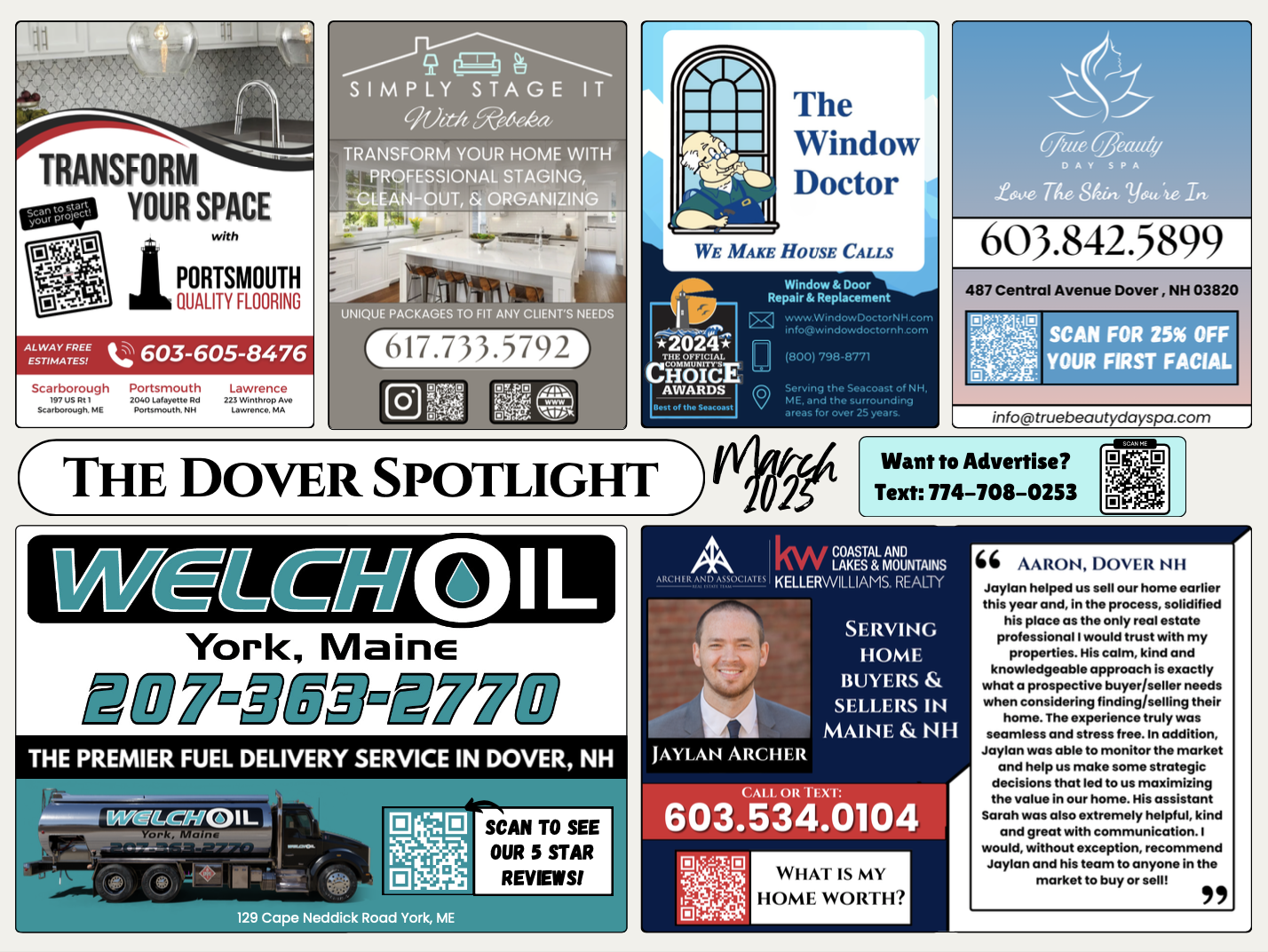
Here's what a spa slot looks like on a real card. Top right on this Dover card is a day spa: logo, a short tagline, a big phone number, the address, and a QR code that says "Scan for 25% off your first facial." One offer. One action. Swap in a provider photo and a free consult, and you've got a med spa slot.
$2,999 to print and mail your own 9x12 to 5,000 homes with 9x12 Method Printing, or $3,250 in stamps alone if you mail 5,000 small cards at the $0.65 retail postcard rate (July 2026)
$500
Homes reached
5,000
5,000
Other med spas on it
None
None, if the operator gives you category exclusivity (ask)
Why stamps for small cards? EDDM Retail takes flats only, so a regular postcard can't go out that way. A shared slot reaches the same 5,000 homes for about a sixth of the cost of your own 9x12, at about 10 cents a home.
So here's the test. If a new client's first few visits add up to more than $500, the slot paid for itself. Results vary, so plug your own numbers into the free postcard ad payback calculator and track every card.
Lower-ticket spas, like a nail studio or a massage place, can also look at a community card: a smaller 6x11 card to 2,500 homes, built around local deals, which fits a gift card or first-visit offer. My guide to community card advertising covers whether it's a fit.
If you'd rather mail your own card, it goes out through USPS EDDM: no mailing list, you pick carrier routes, and every home on them gets the card. EDDM Retail postage is $0.26 per piece as of July 12, 2026, and the 200-piece minimum is per mailing, not per route. If you want it done for you, we print and mail EDDM postcards for local businesses too.
Some vendors push mailing lists filtered by age and income instead of EDDM. You can get a lot of the way there with EDDM by picking routes on purpose:
Injectables, laser, body contouring: higher-income routes with higher home values, within a short drive.
Day spas and facials: routes close to the spa. Convenience matters more than income.
The free EDDM route planner shows the carrier routes in any ZIP Code or city with median household income, median home value, owner-occupied share, and median age, so you can pick routes instead of guessing.
Med spa demand moves with the calendar, so mail about two weeks before each big moment:
Months
Hook
Offer angle
January
New year reset
Skincare and wellness consults
Early February
Valentine's Day
Gift cards, couples treatments
April and May
Pre-summer, plus Mother's Day
Laser hair removal, body treatments, gift cards
October and November
Holiday photos and parties
Facials, injectables, holiday gift cards
My mailing calendar lays out every industry month by month. The bigger rule: be on the card every round, not once. The card that's there every month is the one she remembers when she's ready.
Med spas are not automatic closes. One member on a live call said, "I've called med spas. I've tried to get nail salons and I just I've not had any luck yet." Another member has a med spa and a plastic surgeon on her 9x12, and she thinks higher-ticket businesses like those are an easier sell than the small shops she chased for her community card. Same industry, different towns, different owners. It's a numbers game.
The objections you'll hear, and what to say:
"We're referral-driven." Great. The card backs up referrals. When a friend recommends the spa, she's already seen the name on the counter.
"We're too high-end for mail." Then design it like a luxury piece. Black and gold, one elegant offer, lots of white space. Direct mail can look high-end.
Keep the pitch to one line: "We're mailing 5,000 homes around your spa, and there's only one med spa spot." Skip national chain locations, since their marketing gets decided far away from your town, and never put two med spas on one card. When the artwork comes in, run it past the rules above. My guide to chiropractor postcard marketing covers that industry's version of these rules.
Full transparency, I teach the operator side of this (building the card, selling the slots, the scripts) inside the 9x12 Method community. You don't need it to buy a slot or to try this yourself.
It can, when it's local, has a real offer with a deadline, and shows up more than once. A shared 9x12 card puts one med spa in front of 5,000 nearby homes for a $500 slot, about 10 cents a home. Results vary, so track every card with a QR code and a promo code.
One offer with a deadline, a photo of your provider or your space, the provider's name and accurate credentials, two or three services, a QR code to booking, a big phone number, the address, and an expiration date. Skip long treatment menus and before and after photos.
Only if you actually use BOTOX® Cosmetic, a registered trademark of Allergan (AbbVie). If you inject Dysport, Xeomin, or Daxxify, use that product's name or a generic term like "wrinkle relaxer."
Some states allow them with strict conditions. California requires comparable photos, the procedure named, and a statement that results may vary. That's hard to do honestly in a postcard slot, so use a provider photo instead.
Be careful. The FDA says compounded drugs are not FDA-approved and flags calling them a "generic version" of, or "the same as," a brand name drug. Advertise a medical weight loss consultation instead.
EDDM needs no list. You pick carrier routes and every home on them gets the card, so choose routes by income, home value, and distance. A mailing list lets you target by age and income, but you pay for the list on top of printing and postage.
As always, I'm rooting for you. Peace.
Ready to run your own card?
Get the course, scripts, tools, and weekly coaching inside the 9x12 Method community.

 Mitchell Tebo