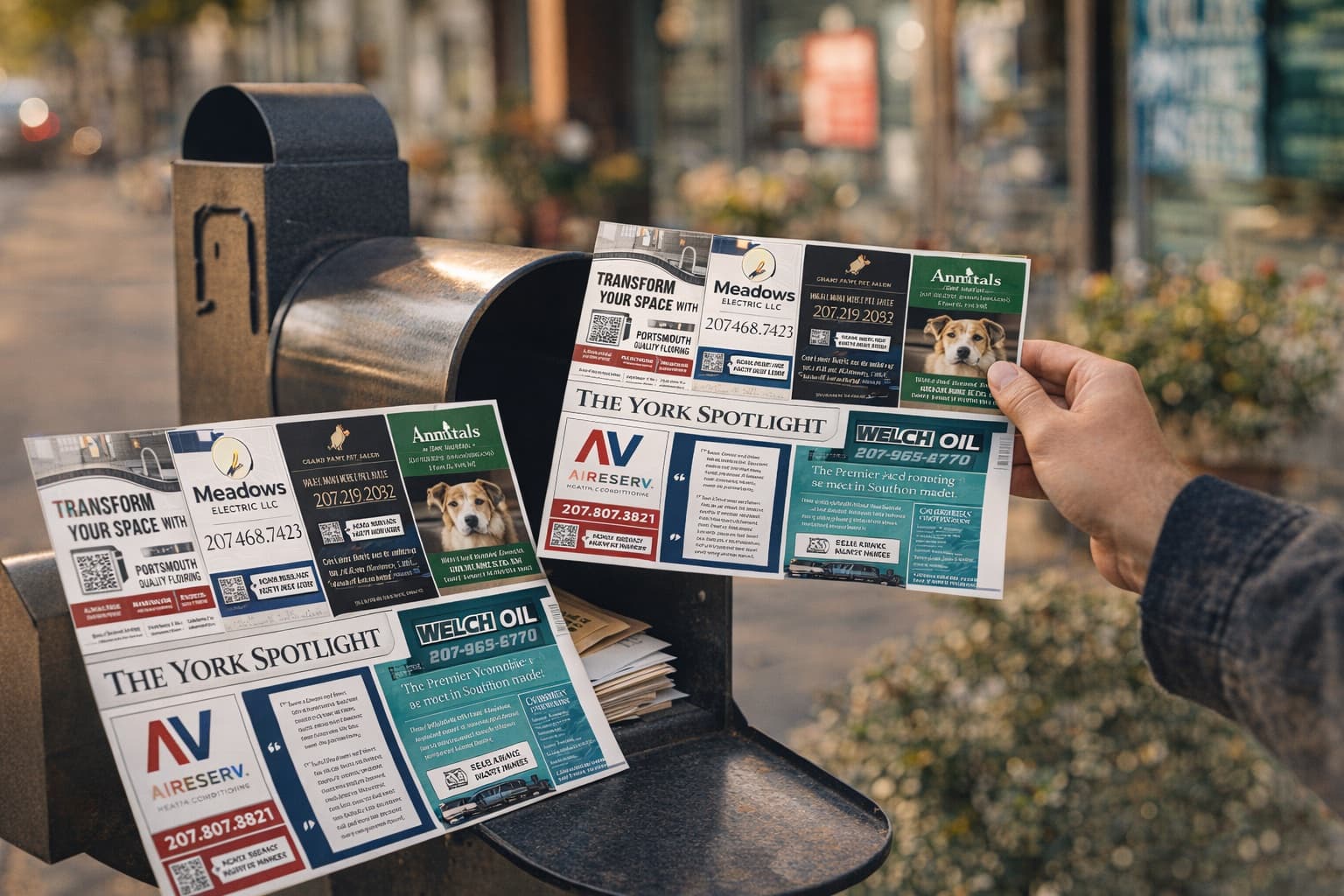
Most people who start a postcard business are thinking about card number one, not about the day they hand the whole thing to somebody else. Fair enough. But if you're running cards already, or you want to build something that's worth more than your next paycheck, you need to know how to sell a direct mail business before you ever want to. Because the things a buyer pays for are things you have to start doing years ahead.
Here's the thing. Google "how to sell a direct mail business" and you'll get tips for selling with direct mail. Search "how to sell an advertising business" and you'll get broker blogs about digital agencies. Nobody talks about a local mail ad business, where every advertiser decides again every mailing and half your best customers have already paid you for spots you haven't mailed yet.
So let me break it down from the seller's side.
Full transparency before we start. I'm not a lawyer or an accountant, and nothing here replaces one. Also, I'm not going to pretend I have a stack of members who've sold their card businesses. What I have is a pretty clear picture of what makes a book of advertisers worth something, from watching 2,800+ people build them.
Yes, but only if there's something to sell besides you.
A member named Rick asked this exact question in one of our interviews. He'd sold out a community card and said, "I don't know how sellable this business is. I would like to sell it." The answer he got is the best one-paragraph summary of this whole post:
With solid systems, a very solid database of advertisers and... real stickiness to the card... so that there doesn't have to be a ton of outbound prospecting, then it's definitely sellable.
Read that again. A buyer isn't paying for your Canva files, your logo, or the name on the card. They're paying for advertisers who come back without being chased, plus a way to keep the machine running after you leave.
If every card you mail takes 60 cold calls to fill from scratch, you don't have a business to sell. You have a job. A good job, honestly. But a job.
Equipment. You don't have any. Your printer does the printing.
Inventory. There isn't any. Every card is sold before it's printed.
Your hustle. It leaves when you leave.
That's why the SBA's three ways to value a business all point at the same place for us. The SBA's guide to selling lists an income approach ("looks at projected revenue and accounts for potential risks"), a market approach (compares you to similar businesses that sold), and an assets approach (assets minus liabilities). For a seller, the word to underline is "risks." In a card business it mostly comes down to one question: will the advertisers stay after you're gone?
Okay so here's how I'd think about direct mail business valuation from the buyer's chair. They'll look at what you made last year, sure. But what they really want to know is how much of next year is already sold.
Look at what a sticky book looks like, using real member wins:
Joey saw his card 1 advertisers ask for bigger spots on card 2.
Gabriel locked an insurance agent in for 3 months with a $1,200 quarterly special, against a $600 standard spot.
Ezra's friend in insurance bought 3 spots on a recurring quarterly deal: $1,200 the first month, then $1,500 going forward.
Michael ran a spin-the-wheel prize giveaway for his advertisers, sent them the recording, and two weeks later offered a $20 discount to renew for summer.
Every one of those is the kind of line a buyer would circle. Repeat. Prepaid. Growing. And Michael's is the part people skip: he had a renewal habit, not just lucky renewals. A habit is something a new owner can keep doing.
Now here's what a buyer sees when they open your records, using one full 9x12 card as the example.
Metric
Value
Spots on one 9x12 card
16
Price per spot
$500
Revenue per card
$8,000
All Inclusive print and mail, 5,000 homes
$2,999
Profit per card
$5,001
Same card, two different businesses. In one, 12 of the 16 spots are advertisers who've been on the last several cards. In the other, all 16 are brand new every time. The profit per card is identical. The business is not. The first one sells itself. The second one sells only as long as somebody is grinding.
If you want the how behind this, I wrote a whole post on how to get advertisers to renew. It's the single most important thing you can do for the value of your business, whether you ever sell or not.
Before you ever talk to a buyer, answer these honestly. Each one is a question a buyer will ask you anyway.
Renewal rate: how many advertisers on your last card were also on the one before?
Biggest advertiser: what share of your revenue comes from your single biggest advertiser? If one business leaving would sink a card, a buyer will see that right away.
Prepaid months: how many future mailings are already paid for?
Who sells: how much of your revenue was closed by someone other than you?
Proof: how many years of records match your bank deposits?
Here's the stuff a buyer will ask for. I go through the buyer's side of this in my post on what a buyer checks before buying a mail business, and you can flip that list around and use it as your prep list. Start keeping these now, even if selling is years away.
Every advertiser, every mailing. Name, spot size, price, date paid, how they paid. Going back as far as you have it.
Bank deposits that match. If your records say $8,000 and the bank says $6,400, the buyer trusts the bank.
Tax returns. Clean ones that show the business, not one blended with your other income.
Signed agreements. A simple written agreement for every spot, especially the prepaid ones.
Every mailing you've done. The routes, the home count, the print invoice, and a sample card.
Who the advertisers deal with. If every relationship is on your personal cell, write that down honestly. You'll fix it below.
This is where most people get burned. They've been running cards for two years out of text threads, Venmo, and memory. Then a buyer asks for the history and they can't prove any of it.
The free 9x12 Method CRM was built for exactly this: every advertiser, every deal, every renewal in one place. Then the history is just there when somebody asks for it.
This is the hard part, and it's the part the broker blogs get right. A business that only works because you personally call every advertiser is very hard to sell, because the buyer can't buy you.
So the goal is simple. Every job in the business should be something you could hand to somebody else with a page of instructions. Here's the order I'd do it in.
Write down your mailing calendar. Which towns, which months, the deadlines for artwork, and when the card goes to print.
Write down how a sale happens. Your outreach channels, your scripts, your pricing, your follow-up, start to finish.
Hand off design. Whoever builds the ads works off a written spec, not your memory.
Hand off printing and mailing to one printer, with one way of ordering. With an All Inclusive run from 9x12 Method Printing, postage and the Post Office drop-off are handled, so there's no "only the owner knows how" step there.
Bring in another seller. William, one of our members, hired his first employee the same week he revamped his mailer. A commission-only sales rep who sells and renews advertisers means the relationships aren't all tied to you.
Take a month off from selling and see what breaks. Whatever breaks is the next thing to write down.
Look, I know "systems" sounds boring. It is boring. Boring but profitable. On one of our live training calls someone put it perfectly: "It's all about building assets so you're not just relying on the grind."
A business that needs you every day is a job. A business that runs off a calendar, a script, and a book of repeat advertisers is something a buyer can actually own.
This one sneaks up on people. In this business, advertisers often pay ahead. That's a good thing. It's also a promise.
Say a roofer prepaid $3,000 for 12 monthly mailings, like Rachel's did. That's $250 a mailing. If you sell after the fourth mailing, there are 8 mailings left, and somebody owes that roofer $2,000 worth of mailings. The buyer is the one who's going to do the mailing, so the buyer is going to want that covered in the deal.
The SBA's selling guide says to "note all adjustments" in the sales agreement and warns: "Don't leave out any assets and liabilities, or this can create problems even after the sale has been finalized." Prepaid spots are exactly the kind of thing that gets left out.
So before you tell anyone it's for sale:
List every prepaid advertiser, what they paid, and how many mailings they're still owed.
Decide with your attorney how that gets handled in the price, usually as an adjustment.
Check your advertiser agreements. Ask your attorney whether they can be handed to a new owner as written, or whether you need each advertiser's okay.
The SBA describes three ways to transfer a business, and all three can work for a card business.
Outright sale. In the SBA's words, "you will transfer ownership immediately and receive payment right away." Clean, but the buyer has to have the money, or a lender. (Buyers can look at SBA loans, which I cover in the buyer's guide linked above.)
Gradual sale. The buyer pays you over time. The SBA says it "often benefits individuals that can't afford an outright sale" and calls it "a flexible option for transferring a business." If you want part of the price tied to how many advertisers stay, that's a specific deal term. Ask your attorney.
Lease agreement. You give someone temporary rights to the business under a contract that spells out the conditions and payments. Less common, but it exists.
Whichever way you go, the SBA is clear that you need a written sales agreement and that "an attorney should review it." It should list everything being sold, the names of the buyer and seller, any adjustments, and any broker fees.
A rep or helper who's been selling for you and knows the advertisers.
Another operator who wants to add your town to their run.
A local publisher or marketing agency that already sells to the same businesses.
Somebody who wants in and would rather start with a full card than an empty one.
On the broker question: a broker finds buyers and does the legwork for a fee. Selling it yourself saves the fee and takes a lot more of your time. For a small, one-town book, a lot of the natural buyers are people you already know.
I'm keeping this simple, because the details depend on your situation. Have a tax pro handle the actual filing. But you should know these four things going in.
It's not one big sale to the IRS. On its sale of a business page, the IRS says "each asset is treated as being sold separately" when it figures out gain or loss.
The price gets split up. Buyer and seller use what the IRS calls the residual method to allocate the price across the business's assets.
In an asset sale, both of you usually file Form 8594. When the business's assets are sold (not shares of a corporation), the Form 8594 instructions say "generally, both the purchaser and seller must file Form 8594." It sorts the price into classes. Class VI covers intangibles like customer-based intangibles, business books and records, and a non-compete you sign as part of the deal. Goodwill (the reputation and relationships that bring advertisers back) is Class VII. With so little equipment, a card business's price will likely land mostly in those intangible buckets.
Getting paid over time has its own rules. The IRS defines an installment sale as "a sale of property where you receive at least one payment after the tax year of the sale," and Publication 537 explains how a business sold on installments gets reported.
How the price gets split can change what you owe. That's why you want a tax pro looking at the split before you sign, not after.
And after it's done, keep your records. The SBA says common guidelines are to keep tax and employment records for three to seven years.
Honest take. Most people I talk to don't need to sell. The beauty of this business is that a sticky card keeps paying you. A full 9x12 is $5,001 of profit, and a 6x11 community card is 16 spots at $250, $1,449 All Inclusive to 2,500 homes, and $2,551 profit. Keep stacking cards and you've got real income without ever finding a buyer.
But building it like you could sell it is a no-brainer, because every one of those habits makes you more money today:
Renewals mean less prospecting.
Clean records mean easy taxes and no surprises.
Systems mean you can take a vacation without the card falling apart.
A second seller means more cards.
Full transparency. I teach all of this inside the 9x12 Method community, from renewal scripts to how members hand off design and sales. You don't need it to do anything in this post. But if you'd rather build your book with a few thousand people doing the same thing, we'd love to have you.
Yes, if there's something to buy besides your personal effort. A buyer is paying for advertisers who renew without being chased, records that prove it, and a way to run the business without you. If every card is filled from scratch by you personally, there's very little to sell.
The SBA lists three approaches: income, market, and assets. A card business has almost no equipment or inventory, so the value comes mostly from expected income and how risky it is. The biggest risk is whether advertisers keep coming back, so a documented renewal history matters more than any single good year. Get a professional valuation before you set a price.
A list of every advertiser on every mailing (name, spot, price, date paid), bank statements that match, clean tax returns, signed advertiser agreements, and the routes, home counts, and print invoices for each mailing. Start keeping them now. Records you rebuild later are hard to prove.
The buyer will be the one mailing their remaining spots, so the deal has to account for it. List every prepaid advertiser and what they're still owed, and have your attorney handle it in the sales agreement, usually as an adjustment to the price. Your advertiser agreements don't automatically move to a new owner just because you sold, so ask your attorney whether they can be transferred as written or whether each advertiser has to agree.
Yes. The SBA calls this a gradual sale, where the buyer pays on a long-term plan. The IRS calls a sale with at least one payment after the year of the sale an installment sale, and Publication 537 explains the reporting. For a relationship business, it also keeps you involved while advertisers get to know the new owner.
Usually, yes. When a business's assets are sold (not shares of a corporation), both the buyer and seller generally file Form 8594 with their tax returns to show how the price was split among the assets, including goodwill and any non-compete. Have a tax professional prepare it, because the split affects what you owe.
Look, you may never sell. That's totally fine. But build it like somebody would want to buy it, and you'll end up with a business that pays you more and needs you less. Either way, you win.
As always, I'm rooting for you.
Love you, bye-bye.
Ready to run your own card?
Get the course, scripts, tools, and weekly coaching inside the 9x12 Method community.

 Mitchell Tebo