If you're scrolling broker sites for a direct mail business for sale, I get it. Buying something that already makes money feels safer than starting from scratch. But here's the thing nobody on those listing pages tells you: a lot of what shows up under that search isn't an advertising business at all. And the ones that are live or die on one thing a listing summary can't show you: whether the advertisers come back.
So let's fix that. I'll walk you through what these listings are actually selling, how to judge the one asset that matters in a mail advertising business, the questions to ask the seller, and the honest math on buying one versus building your own, one card at a time.
Full transparency before we start. I teach people to build a shared postcard business from zero, so I'm biased toward building. I'll tell you exactly where that bias shows up. And if buying is the right move for you, I want you to walk into that deal knowing what to look for.
Type the phrase into any broker site and you'll get a mix of four very different businesses wearing the same label. Look, they are not the same thing, and the price, the work, and the risk are totally different for each.
These are retail counters: private mailbox rentals, packing, UPS and FedEx drop-off, notary, copies. When I ran this search on BizBen in November 2026, every result on its direct mail service for sale page was one of these. One was a mail and shipping franchise asking $98,000, with $141,350 in gross sales and $35,000 in cash flow.
That's a real business. It's just a retail store with a lease and hours. It has nothing to do with selling ads.
These print, address, fold, insert, and sort mail for other companies. Think machines, employees, a building, and big business clients. You're buying a production shop. Equipment-heavy, payroll-heavy, and a whole different skill set.
A coupon mailer business for sale is often a franchise territory. You're buying the right to sell ads in a set area under a national brand, with the brand's printing, rules, and fees attached. More on how to check those below.
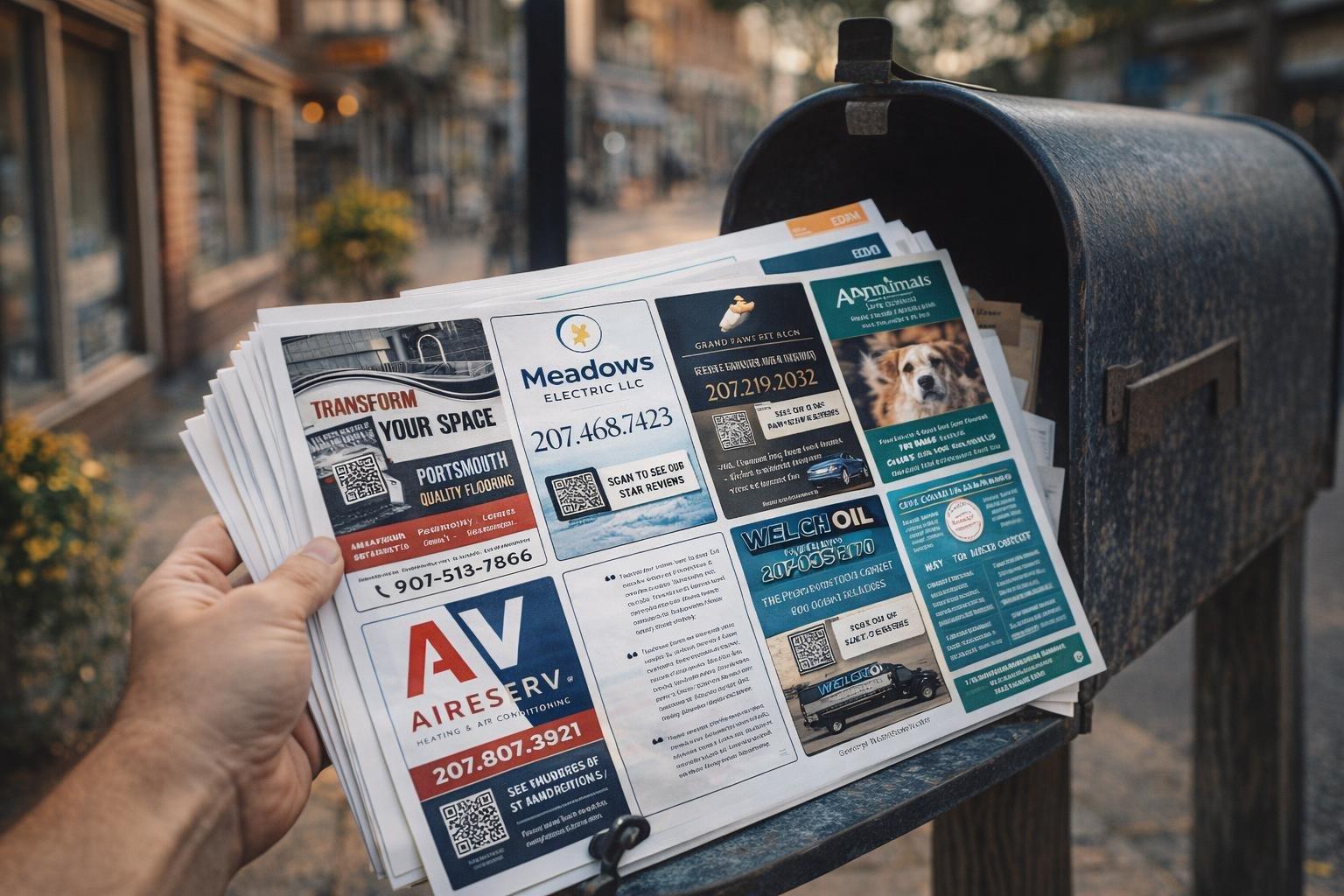
This is the one most people actually mean. One owner sells ad spots to local businesses, puts them all on one mailer or magazine, and mails it to homes. This is the closest cousin to what I teach, and it's the one I'll spend most of this post on.
Here's why. When you buy an independent shared mailer, you're not really buying printers or a logo or a website. You're buying a list of local business owners who keep paying for spots. That's it. That's the business.
And that list has a funny property. Every advertiser decides again, every single mailing, whether to come back. So the question isn't "how much did this business make last year?" It's "how many of last year's advertisers already said yes to next year?"
Let me show you what a healthy book looks like, using real stories from people who built theirs from nothing.
Rachel got a roofer to buy 12 monthly mailings and pay $3,000 up front, from a single Facebook Group post.
Michael woke up to an email from a client asking how much it would cost to "lock in our spot for the rest of the year." He's now done four cards and runs seasonal editions.
Darin had one client go from a single spot, to a double, to doubles in all three of his markets, with other clients booked months out.
That's what you want to see in a book you're buying. Prepaid months. Advertisers moving up in size. Repeat names, drop after drop. If the book is all one-time buyers, you're not buying a business. You're buying a list of people who tried it once.
You're not buying a mailer. You're buying the yes from the next mailing, and that yes was given to the seller, not to you.
In a local ad business, the relationship is personal. The plumber renews because he likes the guy who walks in with the sample card every quarter. When that guy leaves, some of those renewals leave with him.
So the question is how much of the book is tied to the seller personally, and what the seller will do to hand it over. That's the biggest risk in the whole deal, and we'll build your questions around it.
Due diligence is just a fancy name for checking the seller's story before you hand over money. The SBA's guide to buying an existing business covers the basic paperwork: contracts, financial statements, tax returns, and the sales agreement. Start there. Then add the ad-business stuff on top.
Here's the order I'd do it in if I were buying one tomorrow.
Sign a confidentiality agreement, then ask for the last three years of tax returns and the last 12 months of bank statements. Tax returns beat a broker's summary every time.
Get the advertiser list for the last 12 mailings: name, size of spot, price paid, and how they paid. Count how many names appear in more than half of the mailings. That's your real core.
Ask what's already sold for upcoming mailings, and which of those spots are paid. A sold spot that hasn't been paid is a maybe.
Check the costs per mailing: printing, postage, design, delivery. If they mail through USPS EDDM, postage is $0.26 per piece as of July 12, 2026, so you can check their math yourself.
Ask how much of the selling the seller does personally, and how many hours a week. Then ask for a transition plan in writing: the seller introduces you to every advertiser, in person or on a call, before the money changes hands in full.
Get a non-compete in the purchase agreement to help stop the seller from starting a new mailer in the same towns next year. Have a local attorney write it, since the rules vary by state.
Talk to five advertisers yourself. Ask why they buy, what results they get, and if they'd keep buying from a new owner.
Different rules apply. When you buy from the franchisor, the FTC says you must get its Franchise Disclosure Document at least 14 days before you sign or pay. Buying a territory from an existing owner can work differently, so ask the franchisor for the current disclosure document anyway, and ask how transfers work, what the transfer fee is, and whether you'll sign a brand new agreement with new terms. Also read what ongoing fees you'll owe on every dollar you sell. Those come out before you see a cent.
Most small business listings price the business as a multiple of the cash flow it puts in the owner's pocket. To give you one real example: on a BizBen county page I checked in November 2026, the 7 listings that showed both numbers had a median asking price of 2.5 times cash flow. That's one county and all kinds of businesses, so treat it as an example, not a rule.
The SBA's guide lists several ways to value a business, from cash flow to the stuff you can touch. For an ad business, the stuff you can touch is tiny. No inventory, very little equipment. So almost the whole price is for the advertiser book and the seller's goodwill (goodwill is just the reputation and relationships that make customers come back). That's exactly why Step 2 above matters so much.
Here's how to use it. Say the listing shows 40 advertisers last year, but only 22 of them show up in more than half the mailings. Your real core is 22 advertisers, about 55% of the list. The other 18 are people who tried it once or twice. If the asking price assumes all 40 come back, you're paying for 18 advertisers you may never see again. Price your offer on the core, not the total.
Two more practical notes:
The IRS has a form for this. When you buy a business's assets (not the company's shares) and goodwill comes along with them, both the buyer and the seller file Form 8594 to report how the price was split up. Your accountant will handle it, but know it's coming.
SBA loans can be used for this. The SBA's 7(a) loan page lists "changes of ownership" as an allowed use, up to $5 million. Expect a down payment, a lender who wants clean tax returns, and paperwork. Ask a lender for the current rules, since they've been changing.
Okay so let's put real numbers on this. Say you find a solid independent shared mailer that puts $80,000 a year in the owner's pocket. Using that one county's 2.5x as an example, the asking price would be $200,000. Before you earn your first dollar, you either pay $200,000 or take on a loan for most of it.
Now here's what building one card looks like, using our real prices.
Metric
Value
Spots on one 9x12 card
16
Price per spot
$500
Revenue per card
$8,000
All Inclusive print and mail, 5,000 homes
$2,999
Profit per card
$5,001
Money you put in first
$0
That last line is the whole point. Advertisers pay before anything gets printed, so you collect the money first and pay the print bill out of it. In one of my training videos I put it this way: "Now let's say you got all 16 ad slots sold. You have $8,000 in your pocket. And you've still spent no money out of pocket." As one of our group calls put it, "nobody ever complains about having to pay upfront." And the pitch for a longer prepay is just as simple: "your entry point is a lot lower if you're willing to pay upfront for a longer period of time." That's how you end up with prepaid books like Rachel's.
Want something smaller to start? A 6x11 community card is 16 spots at $250, so $4,000 in, $1,449 All Inclusive to 2,500 homes, and $2,551 left over.
Here's where my bias shows. Building is slower. Your first card might take around 30 days to fill, and you'll hear plenty of no's. A purchase hands you cash flow on day one, if the book holds. But building means you never pay for goodwill that might walk out the door with the seller. Every advertiser in your book said yes to you.
I'm not going to pretend buying is always wrong. It isn't. Buying a direct mail business can make sense when:
You have the capital and want income from month one. Building takes time to hit full speed.
The book is genuinely recurring. Prepaid months, the same names every drop, and advertisers who confirm it to you directly.
The seller is staying on for a real transition. Months, not a weekend.
The price is mostly backed by contracts already paid for. Not by promises.
And it usually doesn't make sense when the business is really a mailbox store or print shop you didn't mean to buy, when most of the revenue came from three advertisers, or when the seller is the only salesperson and is leaving next month.
Here's the part people forget. Even after you buy, you still have to sell. Advertisers drop off every year for normal reasons: they retire, they get busy, they change budgets. The owner of a mail advertising business is always a salesperson. If you hate that idea, buying won't fix it. So before you pay anybody for a list of advertisers, learn the habits behind keeping advertisers renewing. They matter whether you buy or build.
Here's what I'd actually do with $200,000 and the urge to buy. Keep the money. Build one card. Then another.
Every card you sell builds the exact asset you'd be paying a seller for, except it's yours and it's tied to your relationships. Every book I showed you above was built from zero. Nobody bought one.
If you're coming from a coupon book background or you're comparing every way to make money with direct mail, the logic is the same: the business is the relationships, so build them first.
A few things to set up early so your book stays clean:
Track every advertiser and every renewal from day one. The free 9x12 Method CRM is built for this. If you ever do sell, a clean renewal history is exactly what a buyer will ask for.
Get comfortable selling. Facebook Groups, cold email, cold calls, and walking into businesses all work. Pick one and get reps.
Full transparency. I teach all of this inside the 9x12 Method community, with the scripts, templates, and weekly calls. You do not need it to get started. Everything above works without it. But if you'd rather not figure it out alone, 2,800+ people are in there doing the same thing.
It depends on the kind of business and how much cash it produces. A mailbox and shipping franchise on BizBen in November 2026 was asking $98,000 with $35,000 in cash flow, while ad businesses and franchise territories vary widely. Small businesses are usually priced as a multiple of yearly cash flow, so always ask for tax returns to check that number.
Usually, yes. With a shared 9x12 card, advertisers pay before printing, so you can start with $0 of your own money. One card is 16 spots at $500 for $8,000 in revenue, and $2,999 All Inclusive to print and mail to 5,000 homes, which leaves $5,001. Buying gets you cash flow sooner, but you pay for it up front.
Ask for three years of tax returns, 12 months of bank statements, and a list of every advertiser from the last 12 mailings with what they paid. Count the repeat advertisers. Ask what's already sold and paid for upcoming mailings, how much selling the seller does personally, and whether they'll introduce you to every advertiser before closing.
The SBA's 7(a) program lists changes of ownership as an allowed use, with a maximum loan of $5 million. Expect a down payment and a full review of the business's financials. Rules change, so ask an SBA lender for the current requirements before you make an offer.
Nothing forces them to stay. Each advertiser decides again at every mailing. That's why a written transition plan matters: the seller should introduce you personally to every advertiser, and a non-compete can help keep the seller from starting a rival mailer in the same area. Have a local attorney write it, since the rules vary by state.
It can be, but read the Franchise Disclosure Document closely. When you buy from the franchisor, the FTC says you must get it at least 14 days before you sign or pay; on a resale, ask for the current one anyway. Look at ongoing fees, transfer rules, and territory limits, and call former owners in nearby territories. Compare that with building an independent card, where you don't pay ongoing royalties.
Look, there's nothing wrong with buying a business. Just make sure you know what you're buying. In this world, it's the advertisers and their yes, and that yes has to be earned again every mailing, no matter who owns the name on the door. If you'd rather earn it yourself from day one, you know where to find us.
As always, I'm rooting for you.
Love you, bye-bye.
Ready to run your own card?
Get the course, scripts, tools, and weekly coaching inside the 9x12 Method community.

 Mitchell Tebo