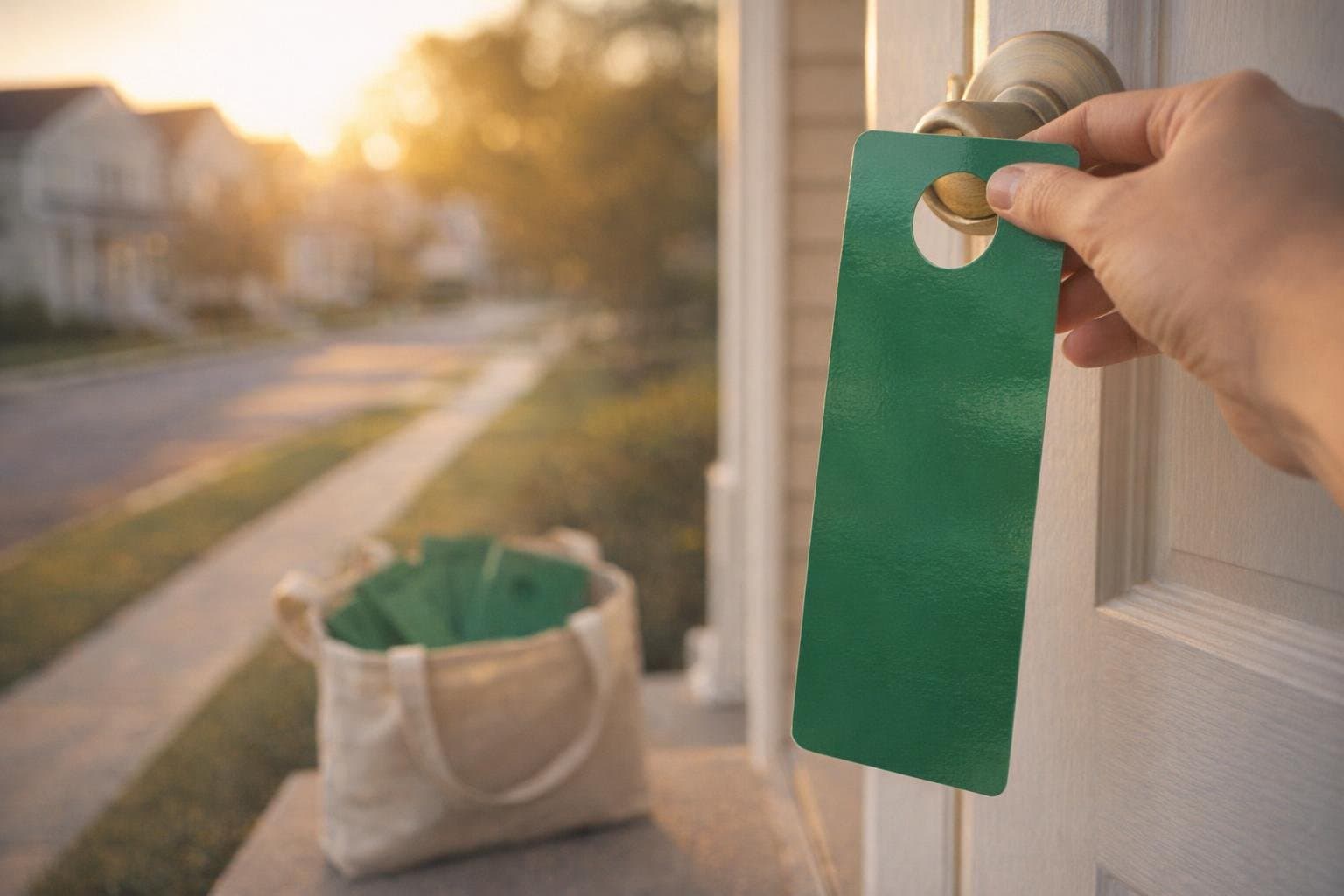
How to start a door hanger business: what to charge per door, what you really earn per hour, permits, the mailbox law, finding clients, and an easier option.
Every week somebody asks me some version of this: "Could I just make money hanging ads on doors around town?" And honestly? Yes, you can. So if you're trying to figure out how to start a door hanger business, this is the version with real math in it. What to charge per door, what you actually earn per hour once you do the walking, the permits and the mailbox law, how to land clients, and the one thing every other guide skips.
Full transparency before we start. I don't run a door hanger business. I run and teach something really close: one big shared postcard that about 16 local businesses split, where the mail carrier does the walking instead of me. So I'm biased, and I'll tell you exactly where. But a door hanger business is a real business, and if it fits you, I want you to leave this page knowing how to run it well.
A local business gives you their printed hangers. Or you get them printed and bill it back.
You hang them on every door in the neighborhoods they pick.
You charge per door. Your product is feet on the pavement, plus proof you actually did it.
This is the classic door hanger distribution business. Lawn care, pest control, roofers, pizza shops, realtors. Anybody who wants to show up on specific streets.
You design one hanger with ads from several local businesses. One business per category.
Each business pays for a spot.
You print it and hang it on every door in your area.
Model 2 is basically a co-op mailer on a doorknob. Several businesses split the cost of reaching the same homes, so each one pays way less than going solo. It's the same idea behind a local coupon book, just on one piece of cardstock.
Both models have the same two jobs: get local businesses to say yes, and get the hangers on the doors.
Here's the simple version, with example prices (not quotes). Say you put 6 businesses on one hanger at $200 a spot. That's $1,200 in revenue. Out of that comes the printing for every hanger, plus the same walking hours as any other job. And here's the catch: you're still the one walking every door. Selling more spots raises your revenue, but it doesn't shrink the walk. Hold that thought, because it's the whole reason I do mail instead.
Build your price from the work, not from a number you saw online. But it helps to know what the market looks like.
One door hanger distribution company lists its door hangers on its pricing page (updated October 26, 2026) as starting around $695 for 1,000 pieces, printed and distributed, with a 1,000-piece minimum and proof-of-delivery photos included. That's one company's starting price, it includes printing, and bigger jobs are quoted. But it tells you what a local business might be comparing you against.
Now here's the number that actually matters to you. Your hourly pay is your price per door times the doors you hang per hour. That same pricing page says an experienced distributor covers roughly 80 to 120 doors an hour. So:
Price per door (example)
At 80 doors/hour
At 120 doors/hour
10 cents
$8 an hour
$12 an hour
15 cents
$12 an hour
$18 an hour
20 cents
$16 an hour
$24 an hour
Those prices are examples, not quotes. Plug in your own. And that's before gas, the drive to the neighborhood, bad weather, and the streets where houses sit on half-acre lots. Townhouse rows go fast. Big lots go slow.
In a door hanger business, you're not really selling ads. You're selling hours.
That's not a knock on it. It's just the truth you want to know before you start. Your income is capped by how many doors you (or your crew) can physically reach.
Say a roofer wants 5,000 homes covered after a storm.
5,000
Doors
80 to 120 an hour
Pace (experienced distributor)
About 42 to 63 hours
Walking time
Extra
Driving between streets
That's more than a full work week of walking, for one client. If you hire walkers to do it, your margin is whatever's left between your price and their pay, so multiply those hours by what you'll pay per hour before you quote. (In my door hangers vs EDDM cost breakdown, written for the business owner's side, I used a slower 60 to 100 doors an hour, so the hours there run a bit higher.)
Quick nerd note: you'll see some guides cite "Section 1708" and a $5,000 fine for this. Section 1708 is the mail theft law. The one about unstamped stuff in a mailbox is 1725, and it doesn't list a dollar figure. It just says you'll be "fined under this title" for each offense. Either way, the answer is the same: never the mailbox. And that rule applies to every single walker you hire, so train them on it.
Lots of towns treat "leaving paper on a door" and "knocking and talking to people" as two different things, with two different permits.
Here's a real example. The Borough of Woodbury Heights, New Jersey spells it out in its permit FAQ: delivering handbills takes a Handbill Distribution Permit (good through the end of the calendar year). Going door to door to sell takes a separate Solicitation Permit. And if you hand out handbills AND talk to people about your products or services, you need both.
Every town is different. Some don't require anything for hangers. Some want a permit, an ID badge, or a background check for anybody going door to door. So when you call the clerk, ask two questions: "What do I need to hang handbills on doors?" and "What changes if I talk to residents?" Get the answer in writing if you can.
Gated communities: You often can't get in, and many HOAs ban uninvited marketing materials. Check before you send a crew.
"No Soliciting" signs: Whether a sign legally covers a door hanger depends on your local code. My advice? Skip those houses anyway. A homeowner who already told you no isn't going to call your client, and complaints are bad for repeat business.
Apartments with locked lobbies: You're not getting in there either.
Jose, one of our members, actually turned this gap into a sales line. When he was pitching an insurance office in person on his shared postcard, he told them, "gated communities can't really go flyers, you know, or anything like that. So you can bypass all that with being on the postcard." Mail goes where walkers can't.
Here's the good news. Selling door hanger distribution works exactly the same way our members sell spots on a shared card. You're a local business owner talking to other local business owners.
The best move is the simplest one: walk in with a hanger in your hand. My exact advice to members walking into businesses is, "I would just walk in with one in my hand." People buy what they can see.
And you don't need to be a salesperson. Real examples from our community:
Travis builds vehicles in a factory for a living. Zero sales experience. He walked into 10 local businesses in one day and sold 8 spots on his card.
Michelle did 12 walk-ins in about two and a half hours. Five maybes, and one said yes and paid the same day. Then she made it a daily habit of 10 businesses.
Joh, who is deaf, avoided in-person selling for almost a year. Then he mocked up ads for real local businesses, walked in, showed them, and sold two spots in the first hour.
Emily went door to door to businesses with a simple flyer that had a QR code on it, hitting little pockets like one shopping center at a time.
I wrote a whole guide on walking into businesses if you want the scripts. For door hangers specifically, a few things help:
Go after businesses that already use hangers. If you see a lawn care or pest control hanger on your own door, that business already has a budget for it.
Lead with proof of delivery. Offer photos or a GPS track of the streets you covered. Think about it from their side: they're paying for something they'll never see happen.
Offer repeat routes. A business that wants the same neighborhoods every month is way more valuable than ten one-off jobs.
Don't just call your walkers "contractors" because it's easier. The IRS decides whether someone is an employee or an independent contractor based on how much control you have over the work, the money side of the job, and the relationship. If you're telling people which streets to walk, when, and how, talk to an accountant before you pay anybody.
Here's the uncomfortable truth about this business. When nobody's checking, dumping a box of hangers in a dumpster is a lot faster than 50 hours of walking. Your clients know that. So:
Spot-check your own crew. Drive a few random streets after every job.
Use photos or GPS tracks from walkers' phones, and share them with the client.
Pay by the route, not just the hour, so the incentive lines up with finishing the job right.
And hang it firmly on the knob or handle. A hanger blown onto the lawn is litter, not an ad.
Okay, here's where my bias comes in, and I'll own it.
Strip a door hanger business down to where the money comes from, and it's one thing: local businesses paying to show up at local homes. The walking is just how you deliver it. And the walking is the part that caps your income.
So what if somebody else walked every route, every day, already?
That's a shared 9x12 card. One giant 9 x 12 inch piece with about 16 local businesses on it, one per industry, mailed to 5,000 homes through USPS Every Door Direct Mail. The mail carrier puts it in every mailbox on the routes you pick. You don't walk a single door.
16
Slots per card
$500
Price per slot
$8,000
Revenue per card
$2,999
All Inclusive print + postage
$5,001
Profit per card
0
Doors you walk
Here's the beauty of it. Your time goes into selling about 16 businesses, not into 40 to 60 hours of walking. Advertisers pay up front, before anything gets printed, so there's no upfront capital. The first card usually takes around 30 days to fill, and honestly, it's the hardest one you'll ever do.
Full transparency, that $2,999 is the All Inclusive price at my own print shop, 9x12 Method Printing: printing, packing, postage, and USPS fulfillment to 5,000 doors. You don't have to use it. Plenty of people use a local printer and handle the Post Office themselves. EDDM Retail postage is $0.26 per piece as of July 12, 2026.
Want something smaller? The community card is 6 x 11 inches, about 16 slots at $250, mailed to 2,500 homes. That's $4,000 in revenue against $1,449 All Inclusive, which leaves $2,551 in profit, and it usually fills in about two weeks.
And mail fixes the stuff that's hard about hangers. It reaches gated communities and homes with "No Soliciting" signs. Nobody has to wonder whether your crew dumped the box. And Rachel, one of our members, had a roofer buy 12 monthly mailings and pay $3,000 up front. Try getting a year of doorknobs paid in advance.
One more nerd note: in USPS terms, a 9x12 is a "flat," not a postcard. So leave the word "Postcard" off the printed piece.
Depends on printing and USPS (no delivery window guaranteed)
Permits
Check your town
No mailing permit needed for EDDM Retail
Income grows with
More walking hours
More cards
Where door hangers win: if a client wants three specific streets hit by Saturday, a hanger beats mail every time. It's also a great fit if you like being outside and want cash this week.
Where the card wins: scale. Your income isn't tied to your feet.
Honestly, they can live together. Plenty of people start with something they can do this weekend and then move to the thing that scales. If you're doing this around a full-time job, that difference in hours matters a lot. Want to see how many homes are near you? Our free EDDM route planner shows every carrier route on a map with the home count.
Full transparency: I teach the card side of this inside the 9x12 Method community on Skool, with 2,800+ members, scripts, templates, and coaching calls. You don't need it to get started. But if you want people next to you while you sell the first one, that's what it's there for.
It varies by company, density, and whether printing is included. One distribution company lists door hangers starting around $695 for 1,000 pieces printed and distributed (as of its October 26, 2026 pricing page), with a 1,000-piece minimum. Get a couple of local quotes so you know what businesses in your area are comparing you against.
One distribution company's pricing page says an experienced distributor covers roughly 80 to 120 doors an hour. Over an 8-hour day, that's about 640 to 960 doors. Townhouse rows go faster, and big lots, hills, and bad weather go slower. Time yourself on one street of 100 doors before you price a job.
It depends on your town. Some places require nothing, and some require a handbill permit. Woodbury Heights, New Jersey, for example, requires a Handbill Distribution Permit to deliver handbills and a separate Solicitation Permit to go door to door selling. Call your city or county clerk and ask about both.
No. Under 18 U.S.C. 1725, knowingly putting unstamped mailable matter in a mailbox to avoid postage is a federal offense with a fine for each offense, and USPS rules say nothing without postage can be placed on, attached to, or hung from a mailbox. Hang it on the door.
It can be, but your income is tied to hours. Your hourly pay is roughly your price per door times the doors you hang per hour, minus gas, printing, and any walkers you pay. At 15 cents a door and 80 to 120 doors an hour, that's $12 to $18 an hour before costs. Repeat clients and good neighborhood density are what make it work.
Start with distribution only, where the client supplies the printed hangers, and collect a deposit before you walk. That keeps your upfront cost near zero. A shared 9x12 card works the same way: advertisers pay before anything is printed, so you collect the $8,000 and then pay the $2,999 All Inclusive print and postage bill.
Look, a door hanger business is honest work, and you can start it this weekend. Just go in knowing you're selling hours, check your town's rules, and never, ever touch the mailbox. And if you ever get tired of walking, you know where to find the version where the mail carrier does it for you.
As always, I'm rooting for you.
Love you, bye-bye.
Ready to run your own card?
Get the course, scripts, tools, and weekly coaching inside the 9x12 Method community.

 Mitchell Tebo