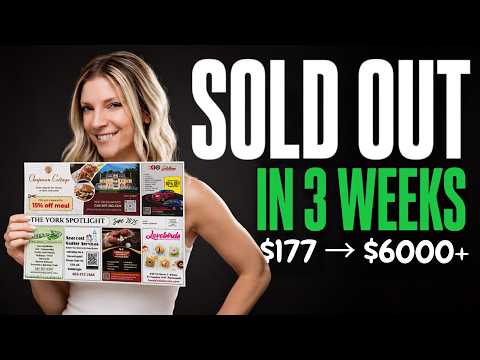
He Sold Out His 1st Community Card in 3 Weeks: $1000s in Profit
Mitchell TeboJuly 13, 202639:13
Corey, a full-time teacher, sold out his first community card in under three weeks without cold calling, using a local Facebook group and his own network.
Key takeaways
- Corey bought a local business Facebook group with about 3,500 members for $100, and a single post there landed three advertisers.
- He sold 12 of 16 slots on his first card in under three weeks, mostly by calling or texting business owners he already knew.
- He raised his community card slot price from $200 to $250 on his second card and saw no difference in how many people said yes.
- Brick-and-mortar advertisers wanted to stay in their own town, while service businesses like a tree company wanted to reach neighboring towns.
- Mitchell advises running separate cards in separate towns rather than splitting cards by industry type, because keeping it simple scales better.
Read the full guide
 Getting Started
How to Start a Community Card Business in 2026
How to start a community card business: the 6x11 postcard with 16 ad slots at $250 each. Step-by-step guide to $2,551 profit per card, zero upfront cost.
17 min readVideo
 Sales & Outreach
Facebook Group Scripts to Sell Postcard Ads
How to sell postcard ads in Facebook groups: the post scripts that work, where to post, what to say in DMs, and how to stand out when everyone copies a script.
13 min readVideo
Read the full transcript
Auto-generated from the video, lightly formatted. Expect a few typos.
I just sat down with Corey, who's a full-time school teacher who sold out his first community card in less than three weeks and made thousands of dollars, all without making a single cold call. Corey talked about how he bought and leveraged a local Facebook group with 3,500 local business owners in it, and it's already landed in multiple clients. He's also going to break down the exact three selling points he uses to close his advertisers and the one mistake that wasted hours of his time on his first card. and his master plan to lock in 16 businesses paying him over $1,000 every single month each using a newsletter that he's been building. So, this is one you're going to want to take a notepad out for.
Let's get into it. Corey, congrats on selling out your first couple community cards. Obviously, you and I know each other because you're in the 9x12 accelerator program, so we've worked more closely together, but it sounds like you're brewing up some pretty huge things in your community alongside these cards. So, I'm looking forward to talking about that a little bit later on. But first, why don't you tell everybody who you are, what you do outside of this business, and why you decided to get started with the 9 by12 method.
>> Oh, well, my name is Corey. Uh, might be quicker to tell you what I don't do because I feel like I do a lot. Uh, just kidding. I'm [clears throat] school teacher. Uh, just finished year 19, so going to hit year 20 here in about eight more weeks of summer.
Uh, that's what I've been trained to do and honestly what I still love. Uh but about 10 years ago, you know, we were in a sticky situation. I started doing some side hustly things and the next thing I knew I started a a dog poop scooping business and then the entrepreneur in me kind of was unleashed. Uh it turns out it in hindsight I I I I'm more creative than I ever gave myself credit for. I don't really play guitar or draw.
I like to build things uh the best I can anyway. And so that started me down this side hustle, you know, path. And, you know, I'm 50 now, so I can't be out scooping yards, hosting phone parties, and doing all these things. So, I kind of landed on a newsletter a couple years ago. Found you six months ago, five months ago.
I honestly forget where I first heard the idea. I'm sure it was on a podcast. Um, you know, then I start searching around and obviously you came up first. hopped in your group and honestly I couldn't believe this is the of all the side hustles I've done I haven't even mentioned a fraction of them. I've never made money quicker ever.
I've never put in relatively the least less time to make money fast. I've there's been times I spent six months putting my time and my own money into things just to make a couple bucks. But the you know maybe it's the network the network I've built over the last 10 years. I'm not sure. But uh and man, once that happened, you know, hook, line, and sinker.
So, here I am. And I'm sure I haven't even done anything what I'm capable of at this point. So, still lots of learning to >> that. That's why I love this this business. It's so simple.
The startup, you just really just get right to it. you're just reaching out to local businesses and asking if they want to split the cost of marketing, so you can start making an income immediately versus other businesses where it could take months for you to actually ramp up and build an income. And obviously, you're you're a school teacher, so you probably had some pre-existing relationships. I know you you you talked about a newsletter. We'll probably get into that in a little bit, but um how is how did that help you starting out having those pre-existing relationships?
>> Look, I've heard this about eight years ago. Your net work is your net worth. And that's just true. And you don't see it at 30 like you do at 40. And you don't see it at 40 like you do at 50.
And I imagine in 10 more years, I'll be like, man, I it's still true to this day. So, I think it had a big deal. You know, I I knew some existing businesses. I knew people who were super small business owners, and I was like, well, I'm just going to start there because I don't I'm really honestly not a fan of cold calling. I I think I'm probably not a great salesman.
Um, you know, I just want to help people. But when these people started saying yes right away, I was like, "All right, if these guys are going to, you know, not even blink an eye at doing this, then I probably need to, you know, get a little better at at building a list and making some calls and walking into businesses and shaking hands and doing things like that." So, uh, the network was it was huge for me. It was honestly it was huge for me. >> Yeah.
Yeah. So tactically, how did you go about reaching out to those existing relationships? Obviously, you you didn't run like a marketing agency before, so you you didn't have like a business relationship with these other businesses. You just had like a familiar relationship with them. So, tactically, how'd you bring it to them?
>> Well, if I had their phone number, I I called them or texted them. Um, I do I stumbled upon a business Facebook group about a year ago that some lady offloaded to me for a hundred bucks. It's got like 3,500 local business owners in it. Um, I'm not as excited about that as I was, but I actually, you know, I made one post in there and it did land me three clients, so I guess I should be a little more excited. But, you know, Facebook to me is a real pain in the neck sometimes with the algorithms and what have you.
>> Yeah. >> But, so I definitely got three clients off there. Two of them actually bought again for the second one. So, I I should probably take it back a little bit. the group's been a little more helpful than than I originally thought, but I know not everybody has that.
Um, but they're out there. Those groups are everywhere. So, I would definitely be posting there because these guys have marketing on their mind 24/7. And the physical product, I think, in my opinion, the physical product is a much much easier sell than a digital product, an ad or a video for them. Um, people like the physical things, man.
I could like walk up and say, "Here you go. this is what landed in 25 or 5,000 mailbox mailboxes. >> Yeah, that is actually a huge nugget because a lot of people talk about we we we all post in Facebook groups because it it can just land you some quick sales. Businesses are reaching out to you. Um and some people have talked about like starting Facebook groups, but obviously that's a a grind to build a Facebook group and somehow get distribution, get people to join, but I never even thought of purchasing a Facebook group.
Honestly, I've heard that Facebook group admins are pretty burnt out. So, there might be some admins that want to just offload their group like that person did to you for a hundred bucks. So, obviously, if you posted in your group that you own that you paid 100 bucks for and you made three sales, what's that? That was probably $600. Do you charge $250 a slot?
>> Uh, the first one was $200. The second one was $ 250. >> Cool. So, like $600 to $750. The ROI is insane.
>> It's insane, right? And they're out there. And I think the tired I look the tired admins are out there. These people it was like take it. >> Yeah.
>> And there's still a few I'm working on much bigger groups but um you know it it is what it is and keep posting in them cuz people don't see anything. If you ever add them in a group and you see how few people in your group see your post, you'll be like what's happening here? >> So yeah, >> I would definitely stay aggressive in in the local Facebook groups. >> Absolutely. People are on at all different times of day.
So, it's good to, you know, choose different times a day to post. But let's rewind a little bit. I want to talk about like where you are at right now with the community cards because as far as I know, you've sold out two cards now, but I kind of want to know about like your timeline, how long it took you to sell out the first one, how it ended up, you know, how it resulted for you, and then what it was like to get people to renew for the second one. Can you walk me through that? >> Sure.
I will recall the best I can. Um, >> that's fine. of 16 slots on the first card. I kept four for a few of my things and my wife's thing. Um, so I sold 12 and it took me less than three weeks and I I have to be very clear like I did not put a whole lot in my opinion a whole lot of effort into doing that.
I probably could have done a better job. where I'm still trying to get better is figuring out how to I hated that I threw a time on it. Like I got to have these sold by X. I hated that I did that. Um so that was like a first lesson for me.
But at the same time, the number one question you're going to get is well when are these going to go out? So, uh sorry I'm getting off task a little bit here, but so I sold 12 of those in less than 3 weeks. And then I was like, okay, I'm going to go do a neighboring town. And I went to do a neighboring town and I went back to a few of the people like, "Oh, you're not going to do King of Prussia, the same town again." And I'm like, "Uh, I don't know.
Should I?" And they're like, "Yeah, if you go King of Prussia, I'm in. If you go over here next door to Wayne, I'm out." So, those were my first two conversations. Now, again, a whole learning process for me.
These are brick-andmortar places that are located in town. So, obviously, their number one client is the person in town. if it's, you know, the tree guy, like he wanted to go next door because, you know, he's a tree guy, so he's not he's he's everywhere. He's probably traveling a 20 mile radius for these big ticket items. >> Yeah.
>> So, that got me thinking about like just so many more things like how can I niche down these cards a little bit more? Maybe have one for brick-andmortar type businesses, you know, and one for, you know, bluecollar businesses that travel a little bit more. You know, there's probably so many options and honestly I get so distracted because I have severe ADHD when I try to think about how to build them out. At this point, I'm just like, who's paying me for them? Let me start there.
Who's willing to to fork over the money? >> Yeah. >> The second one had again I put the time constraint on the second one, which was frustrating because the end of my school year is mad. It's just maddening. I have five massive events and I didn't have hardly any time to do anything and I was dealing with, you know, my elderly parent.
Uh, so life was nuts. So of those 16 slots, I sold nine and two of them were doubles, which kind of surprised me that people would pay more for a bigger ad, but they did. >> Yeah. Um, and then [clears throat] so I probably could have sold more had I not put the time on it. Uh, [clears throat] see I sold n.
And then of course I left the rest again for some of the other stuff that I do and that my wife does. You know, she does some traveling stuff on the side. Um, and they went really quick. So now I'm just trying to pump the brakes, but not pump the brakes because momentum is real in this game. You know, I should be going back to these people like, "Okay, August is on deck.
Are you in or are you out?" Because they get it. Like, you know, the waxy lady doesn't want the other waxing lady in town on the card. That, you know, I know we haven't really discussed it yet, but that that's a massive upsell to some of these people, especially if their competitor numbers are low. If there's only two or three other ones in town, you know, if you're the the power washing guy, it's whatever.
There's 20 of you racing to the bottom. But, [clears throat] no offense powerashing people. I didn't mean that in a bad way. Um, so I don't know if I answered your question, Mitch. >> No, you did.
And that's that's the thing about community cards is you can really run them monthly because obviously you're charging 250 bucks. That's very realistic for a business to fork up on a monthly basis. If it means keeping their competitor out and making sure they stay top of- mind for people in their community. And so you talked about two separate cards and you're wondering if you should do like an ind industry specific card for like home service businesses versus brick and mortar. Can I give you an honest piece of advice?
>> Sure. >> All right. I'd keep it simple. If you're already thinking about running two cards, I would just run two separate cards in those two separate locations. And you can have brickandmortar businesses that you reach out and make connections with in this location and you already have the brickandmortar locations here.
But I think you would be over complicating it by making it like a niche specific card. You're kind of limiting yourself. And if you're doing two two cards anyway, simplicity is key. Does that make sense? >> Right.
It totally makes sense. And and where personally for me is like in King of Prussia, I don't have to cold call too much. Like I know a lot of these people. I get to the next town like now I'm calling complete strangers that don't know Corey and that's tougher for me, you know? That's fair.
Um but but 100% I get it and I I I absolutely agree because they're everywhere. You look towns like mine, I'm surrounded by them. >> So yeah, there's no there's no short no shortage. And I didn't say this yet and I think I should. It's important for anyone especially if they're on the fence.
>> The website was a huge seller for the professionals. Not that it wasn't for the others, but like the dentists like to be able to send them to my website, which I didn't have to build. My website being your website that you offer >> by sites took me >> it took me five minutes to set that thing up and it looks better than anything I could have paid >> blank for to someone else. I don't want to cop you at your price here, but um but I'm serious. It's it's so effective and they see the cards on there and [clears throat] it was it was a big deal, you know, to send them there and then, you know, you can uh I don't use Stripe, I use Wave Payments.
Uh they don't pay me to say that, but I use Wave Payments and to link it all up to where they could just pay online and it takes all when you could take all the friction out of anyone buying anything from you. >> Yeah. >> You're you're winning. And the and the site does the 9 by12 sites do that. So >> big fan.
>> Yeah, the social proof the social proof is huge because I think I remember you texting me that a couple of your advertisers like they said they loved that they could see the other businesses that had already joined on the card. So that made them like kind of trust you more because they saw Bill's Burgers who they recognized already is on the card. >> Yeah, they know these people. They all all these businesses know each other. if they're not they're either in all the Facebook groups together or if there's a com you know chamber of commerce or being they know all these people so that if they see so and so especially if it's a respectable company to them like that's a that's another notch in your belt as far as I'm concerned.
>> Yeah. So obviously you are also so you're busting these cards out pretty fast. You're not selling all of the slots because you're also using it for free advertising for the other businesses you have going on because you're obviously very entrepreneurial. But what so what does your script look like? Because you aren't necessarily just selling ads a lot.
You are, you know, teaming up with local businesses to get free advertising yourself. Well, I'd be lying if I told you that I had a script that I read from. Um the the the three biggest points for me is shared direct mail. One, I used to run postcard campaigns back when I owned the poop scooping business. So, the amount of a money you're saving, but way more importantly, the time, the fact that I don't have to touch a card or bundle one, anyone that's ever tried to do that before, that's a massive pain point for them.
And when they find out that they don't have to touch a single thing, not even the ad if they don't want to, that's a big big big upsell for them. So, the shared marketing, the shared price, the the I don't think I mentioned the price per home. you you get them you talk to them about 10 98 cents per home and then that they don't have to lift a finger. Those are my three big points. And I think the fourth biggest one is that I'm I'm a business owner, too.
So, I'm like, "Hey, man. My businesses go on these cards, too. They're going to look good. It's not going to be crap. I'm not trying to sell you something that's not going to work."
Like, my expectation is that these do what they're supposed to do. >> Yeah. And that part right there. >> That part right there is huge. >> Sorry, I keep talking over you.
That part is huge because you're not coming across as a salesperson at that point. You're coming across as somebody that's trying to partner up with them to split the cost. So, anybody >> anybody out there who is listening and has like a little side hustle that they do, it's worth just throwing your ad on the card. That way you can come across that way when you are trying to sell ads. It if you're you're losing $500 in revenue by putting your own ad on there, but you can make sales so much easier because now you're not just a salesperson.
the the friction is so much less. >> Yeah, I think it's an unforced air to not do that. And you got to think about the net. Don't think about the 500 bucks you didn't make or whatever on that specific ad slot. Like there's there's a lot of value there.
>> Yeah. Yeah. Now, so what does your day-to-day typically look like now? Now that you're two cards in, you are you still in school? It's July 7th.
You guys are probably done now. Yeah. >> I probably go longer than anybody in the country. Yeah, we we get every holiday under the sun off. So I went till June 18th.
So my day doesn't look anything like it did a month ago. >> Gotcha. >> I've already worked out. I've already cleaned. I've already took a big long walk with the dog and done, you know.
So um are you asking like the typical day like when school's in session or just >> Yeah. Let's say let's say when you're when you're working the job. So when school's in session, how are you building this business around that? So, I I work from about 5:30 to 7 in the morning. I'm an early bird guy.
Um, I go to school early most days because I run clubs in the morning. So, I that 90 minutes means a lot to me. And I try to put in an hour sometime in the evening if it's not a softball day. You know, my youngest plays and I coach her team. So, it's a pretty big commitment in the evenings.
And I've learned to balance the the teacher, the father, the husband. you know, it's a big it's a big balance. Um, but it hasn't it hasn't been an issue yet. So, I I haven't had to I haven't made a single co uh I haven't picked up and made a single cold call yet. I'm I'm working on the email, but I was honestly a little frustrated with me and Gmail just aren't friends right now.
I don't like how much emails are landing in in spam boxes and I and I know you've talked about that. you're actually very helpful with the the warming up process, which I unfortunately hadn't done before I heard you talk about this. So, I think I probably messed up one of my emails that I was sending from. Uh, but I'm a I'm a really look, I want to build relationships with these people for other reasons we'll talk about in a little bit. So, I'm trying to get a lot better about out of the email, get on the phone, at least text them.
Now, I'm off. I'm going to be walking into some businesses today because I have the time to do that. Walking into a business during the school year, honestly, for me, is incredibly tough. So, and I'm going to be out of town the next in about a week, for a month. So, I'm going to I'm going to walk into many businesses as I can over the next like nine days before I leave.
[snorts] Um, so that they can see the face and hear the name, shake their hand, like those those that means a lot to a lot of people. >> Totally. >> So, but I'm kind of in limbo about what to do next. So, I'm not like uh I kind of just made a decision today like, okay, I'm definitely going to run one more car before I roll out this big master plan. Um, [clears throat] so I'll I'll probably work on that a little bit starting this afternoon.
But I have four businesses in mind that I that I want to that I want to, you know, go to today and show them show them the 9 by12 because I'm I'm going to start going up to the the big guy, get away from the community cards, I think. Okay, cool. So, are you are you doing this next card in your local town, King of Prosa? >> Yep. >> Okay, good.
And are you have you already reached out to like the advertisers that were on your community card? And if you have, how do you plan on how are you framing that like the step up to the 9 by12 card since it's probably double the price? >> So, I have reached out to them. I've heard back from one. They were a yes.
So, I already feel confident. Uh, but it's I mean, there's a reason I added some some things in there for them, which I can um but the I sold it the price increase as to it's going to twice as many homes now, >> and you're getting a bigger ad. So, you're getting a bigger ad. It's going to twice as many homes. They speak that language for the most part.
Um, and like I said, I've I've reached out to four and the four I'm going to walk in today will be So, those are my eight big ones that I really feel like, you know, will come to me every month and be on the cards. I'm I'm being a little picky about who I go to right now. Um, because I'm curious. I have a theory that there's businesses that are great for a 9 by12 and businesses that are great for a community card. >> Oh, yeah.
just a working theory. Have you anything I agree because a community card should be really I mean the way that I've always talked about it is really it's about the offer. It's just like a very simple ad with the offer and the offer gets people to make a move. It's not necessarily like a big branding play like the 9x12 postcard. Um so that really is the difference.
Probably the smaller ticket businesses are more valuable with offers like the restaurants and cafes and stuff. Consumers love those types of offers. the discounts, buy one get one free at the pizza shop, things like that. Obviously, you can still still have offers on the 9 by12, but it's different. Like you said, >> I so glad that you said that because I hate when I think I know everything and I make up these, you know, you start to learn.
This is a brand new industry for me. I've never been on this side of business before. Uh, but I'm starting to feel I'm very glad to hear you say that this is live. This is live breaking news. Like Mitch is confirming what I'm affirming what I'm feeling right now.
So, uh, >> absolutely. So, what was um Do you have a card in front of you by chance? Do you have one of your cards with you? >> I don't, man. I'm all the way up on the loft.
I knew I should have brought them. They don't. [laughter] They're all the way down. >> It's all good. >> I have a house full of teenage girls right now, so I'm not leaving.
>> Yeah. Yeah. You got to No background noise. >> No. But um so what was one mistake you feel like you made or what what was the biggest learning lesson you made?
And I I know you posted about this so I think I know the answer but I want to hear what you have to say. >> We'll say on your first card. We'll say on your first card. >> Well the first thing I did is I didn't charge enough. I don't know if that's what you're referring to.
Now, I I do think everything's relative depending upon like you got to know, you know, your local economy. Uh I I I could probably sell a community car for 350 if I if I wanted to work just a little bit harder. I probably could do that, but I know that's not everywhere. You know, the first thing I did was I did not charge enough money. >> Totally.
So you >> you charged 200 the first month and now you're charging 250 and you see basically no difference in how interested people are. >> None. >> Boom. So that's >> I know >> that's that's a lot more income. >> I know.
I know. So but it's I've never been good at that. No matter what industry I was in, I've never been good at pricing ever. I still I asked I just asked for help the other day in the group with some pricing questions and I just I don't know. I know what I would pay but I know not everyone is me, you know.
>> Yeah. Well, it's all it's all an experiment anyway. And luckily for us, you can kind of experiment with it in one location. If you don't want to change things up in your prime location, you can split test it over here first. But um the one thing I was talking about the mistake that you felt you made was wasting time with ad design.
Do you remember that? >> Oh yes. Yes. Shocked I didn't say that. What a time suck.
Especially for someone like me that wants everything. First of all, I'm not even a designer. So I don't even know what business I have trying to do this. But I made one design in Canva for five minutes. I won't say for which which guy, but I sent it to him and you'd have thought that I created this Mona Lisa for him.
I was like, "Bro, this took me five minutes, [laughter] you know, but you take that time 16 and then the second time they get a little bit more comfortable asking you to do a few more things." And I went straight to your guy after that for my second one. I forget the gentleman's name. I apologize, but >> um and he did a great job. So, that's a massive time suck.
You should be selling, selling, selling, selling, selling, not designing. designing. Well, probably another reason on top of putting that that time constraint on when I needed the card to be done um was the amount of time I wasted creating design >> on the first one. >> Yep. >> That's what I always That's what I always say.
I mean, in the amount of time it takes you to design one ad, you could probably sell another ad and it cost you like 25 bucks to get it designed by somebody, take it completely off of your hands. And um yeah, it's basically the first thing that anybody should outsource unless it's absolutely something that lights you up and you actually want to do, but in your case, it sounds like it's obviously not. >> It's not. And you could reach out to 20 more people. Like the [clears throat] the numbers are in your favor, right?
Like instead of designing an ad, you could probably reach out to 20 20 more people. >> So, which eventually results in sales, but yeah. >> Yeah. No, no more no more designing. >> Absolutely.
Now, I want to get into this master plan you have coming up in a second, >> but we're going to keep making them wait for a second. First, I want to hear what what your tech stack looks like. What do you use for tech? Are there any tools that you use that are really helpful for you or are you just totally raw, organic, just reaching out to people, you know? >> Uh, no tech stack.
Um, I'm a Canva guy, but I don't need that anymore because I don't need I don't need to Well, I need it to, you know, put the cards together and send them to you. But that's >> I I I don't want to say it's elementary and offend anyone because I'm sure it's it's hard for some people. Um I I appreciate the ability to go in your group though when I have a question and people many people know the answer. Um if you don't another reason the group itself is so beneficial. >> Yeah.
>> Um no I don't really have a a text deck. I could see a day where uh there's a Zap or something set up for email responses. If I ever got around to literally sending hundreds of emails, I don't know that I will, but if I did, I could see that being helpful. Or even better, figuring out something on SMS. I I would I would much rather be on the phone than be on my computer emailing to be quite honest with you.
[snorts] >> Yeah. >> I don't know if that exists, but >> Yeah. I mean, there's a There's a lot of people that are total introverts and prefer to just do things over email and Facebook Messenger like me. Um, and then there's people that just prefer to get it over with on the phone and it's a lot faster process when you're talking to people and they can hear your voice. Email response rate is pretty abysmal.
But yeah, >> but it everything works. But let's let's get into your master plan. What do you have going on? I don't know much. I know you you have a newsletter that you already had prior to this, so I'm assuming that's a part of it.
Talk to me. >> So, I do have a newsletter. I started about two years ago. It's a hyper local newsletter just for my town or my area. Um, you know, the grand plan there was to a sell ads and b, you know, promote our own businesses.
and it turned into the newsletter, a directory, an event calendar. Now I have an app. Uh and then you know you you me you blend in these cards and I was like I talked to a friend the other day. It was a I talked to a friend and then I saw your YouTube video about uh being able to go deeper with your clients, sell them more things and such. And I was like, why am I just selling a card when I can also create a logo while on my newsletter?
I could put display ads on my event calendar. I can make use section sponsors either in my app or on my newsletter as well. I try not to make the newsletter too uh adheavy to be honest with you. So the the logo wall pretty much lives on the newsletter now. So my plan is to uh include all of it, you know, but I but not to sell space.
I I want to be able to offer a local business to become the most familiar business in town. >> And this here's how I can do it because I have a big audience for this size town. I have a great size audience. >> Uh it's it's not about getting you clicks. It's not about getting you leads.
It's about making you the most familiar. They might not need you now, but they might need you in six months when a storm rolls through and there's a tree landing on their house or your driveway needs shoveled with the snow or what have you. You know, your pool needs clean. Go on and on and on. So, if I could find 16 and I've been told to stop throwing a number on it, but you know why I say 16.
if I could find 16 businesses that were, you know, really serious about wanting to be the most familiar ex in town. I was like, how could I create like a, $1,200 monthly package for them that included a postcard every month? I can get in their mailbox. I can get in their inbox. I can get, you know, uh, I didn't even talk about my socials yet.
Like, I can make you show up everywhere in town. They might not have the newsletter, but they have the app or they get the postcard or they follow me on social media. So, I'm working on like a big package. I would rather have 16 clients that pay me that much money than me have to continually go out and find new and new clients. Now, some people are are really good at going out and selling.
They have the time. I don't have the time to do that. I I don't want to have a, you know, a CRM full of 500 people. I want to find like really really really deep good partnerships with businesses in the community that want to become the most familiar in town. And I think I can offer that for them.
But the cards are a big part of it. It's the only physical product I have. If you try to do this just digitally, it is a much much harder sell when I can start with a postcard in their mouth in 5,000 homes every month. You almost have them right there. >> Yeah.
Yeah. >> And I could throw in the logo wall in the newsletter or the display ad on the event calendar and you know the mentions on the social on the socials and things of that nature. So that's my plan. Not all my plans have worked out, Mitch. Some have, some haven't, but that's kind of where I'm heading.
>> Well, I don't see any reason that this wouldn't at least increase the average revenue you receive from a customer because you already have these different forms of distribution. The only one that really costs you any money to actually distribute is the postcards. So, like I've always talked about, the postcard is like the Trojan horse. Like you mentioned, this is a great way to get in the door with them because it's not something they get pitched every day. They've gotten pitched like to, hey, do you want to come on our newsletter and advertise [clears throat] on our newsletter?
They've gotten pitched all sorts of different forms of advertisement, but they've probably never gotten pitched this. So, at least they listen. And then the ones it resonates with, you have the relationship with them now to then, you know, sell them into other services. And I think for you, it would be helpful to have like different tiers. You can have like a tier where it's just the postcard.
So you still aren't like just telling people to f off if they can only afford the postcard cuz some local businesses can only afford the postcard. And they might still want to be on the postcard every single month. They might still be a solid customer so that you don't need a CRM of 500 people. But it's good to have those different packages. Um, and one could just be the own your town package where it's just everything, like you said, $1,200 a month.
>> Yeah, something something creative like that. >> Yeah, I I hate capping myself, you know? I do. And I can only I only have so much space digitally, but you're right. Like some people might just want the cards and like why would I say no to you?
>> I have no reason. >> I don't have to design your ad. I got someone that'll do that. I don't have to go make the cards or take them to the post office. Have someone that does that.
Systems are everything. Systems and distribution are everything. When you can figure out those two things, you can really you can really make some noise in whatever space you're working in. >> Exactly. And the beauty for you is obviously the hardest part is making the relationship with the client.
That's like 90% of the battle. Like I talked about in the video you said you watched. That's 90% of the battle. And most people are leaving it right at the postcard. you make 500 bucks off off the customer and that's that.
>> Whereas you stack it deep, you now on average are going to receive 1,200 bucks from a customer. Not I'm just making up the numbers, but it's going to be greater than the 500 for very little extra work. You still send the newsletter off every week anyways. Or I don't know if it's every week, but you still send off the newsletter anyways. Now you're just putting an extra logo every day.
Wow. So you're already putting in the work anyways. Now you're making a little bit of extra income and also providing way more value to the advertiser because you know hitting when you're advertising hitting people from multiple angles is the way to really own your town. Like sure you could just have a billboard in town but when you have a billboard in town and you're in everybody's mailbox that's when they really start to recognize you. So you're able to provide that to them.
They don't need to like reach out to five different advertising companies now. They can buy one big package from you probably at a cheaper rate versus going to five different people. >> Absolutely. I I know they can because I know newsletter guys are selling ad spaces for incredulous amounts of money. Like I mean good for them.
Good for them. But yeah, speaking of look and the newsletter people love these postcards. I've been I've been hyping you up in my Discords. I'm in a couple of big Discords with these [clears throat] local newsletter people and they love that they're all about the physical product. So >> yeah.
>> Um they get it. That's awesome. So, let's step it back to the beginner out there. Maybe this is the first interview that they watched about the 9 by12 method and community cards. They're trying to figure out where to start.
What advice would you give to somebody who's either brand new or has been sitting on the fence for a while but just hasn't pulled the trigger yet? >> Hey, get in the group. Got to be in the group. Uh there's just there's too much value. There's way too much value in the group.
Um B would be start with your network. You got to have a network. You I guarantee you know someone that runs a business. Um I would definitely start there. If you hate coal calling like I do, maybe email's great.
Uh but watch Mitch's video on how to prime your email first so you don't ruin everything [laughter] in the beginning. Um it's important. >> Yeah. Look, you got I think it helps that I know my community, too. And it I think a lot of people don't like I think a lot of people undervalue or overvalue things uh because they don't have a good feel for, you know, just what they're capable of in their I I not exactly know how to articulate what I'm trying to say there.
Like know your ind know your industry. know your know who you're trying to sell to. And this is something we didn't talk about either and I think maybe you've talked about this Atlantic before. I haven't seen it yet. Um, look, the you got to know who you're selling to, too.
Like these people that are getting a roof job, they're making a lot of coin on one job versus someone who's trying to get you to come into their restaurant and save 10% on like a lunch meal. like so there's value in who is is buying your ad space. So I think they you know make sure you do a little bit homework there. Um those are my I'd say I'm sure I'll think of another one when we're done. But >> yeah, I mean if there's if there the biggest takeaways I've gotten from you is leverage your network even and it's not like you had like a business relationship with these businesses but it's just businesses you knew.
That's number one. Number two, leverage what you already do. you run a couple businesses, so you're coming across as, you know, a partner with them rather than just a salesperson. That's huge. Number three is you're taking advantage of the relationship once you actually have the relationship.
You're stacking other services on. And number four, which is most important, is you're really thinking about who you're selling to. Obviously, the higher ticket businesses are more likely to stay for the long term, which means you aren't going to need a CRM of 500 contacts. you're thinking in advance of who you're really driving to get onto the card. That way you have people who stick for longer.
It's less work on your end prospecting every single month and much more scalable. So those are my biggest four takeaways from you. >> I that's pretty accurate. >> It's been a pleasure. I I appreciate you coming on here.
Um obviously I'm sure people have a ton of notes and I'm super excited to see how the uh how the service stacking really goes for you and your master plan. I'm sure it's all going to evolve over time. So, I can't wait to watch. >> Yeah. Awesome.
Hey, I appreciate I appreciate your time. I appreciate everything that you do, too. I really do. I look, I've been doing these groups and these things for 10 years, and I genuinely mean this that you provide more value than any other group, course, anything I've ever been a part of. And I've been a part of a lot of them.
If you got value out of this and you're ready to start your own postcard business, consider joining the community that Corey talked about where you'll get the full step-by-step roadmap, the templates, live group calls, and the ability to post and ask questions whenever you have them. It's the same group that Cory said gave him more value than literally anything he's joined in 10 years. So, the link to join that is down in the description along with the link to 9x12 sites, which is the website builder that Cory raved about, which he used to close his advertisers and collect payments with zero friction. And if you're not ready to join the community yet, that's fine. Just watch this video master class right here, which breaks down step by step exactly how to sell out and fulfill your first postcard.
All right, love you.
New videos every week on YouTube.
Subscribe on YouTube