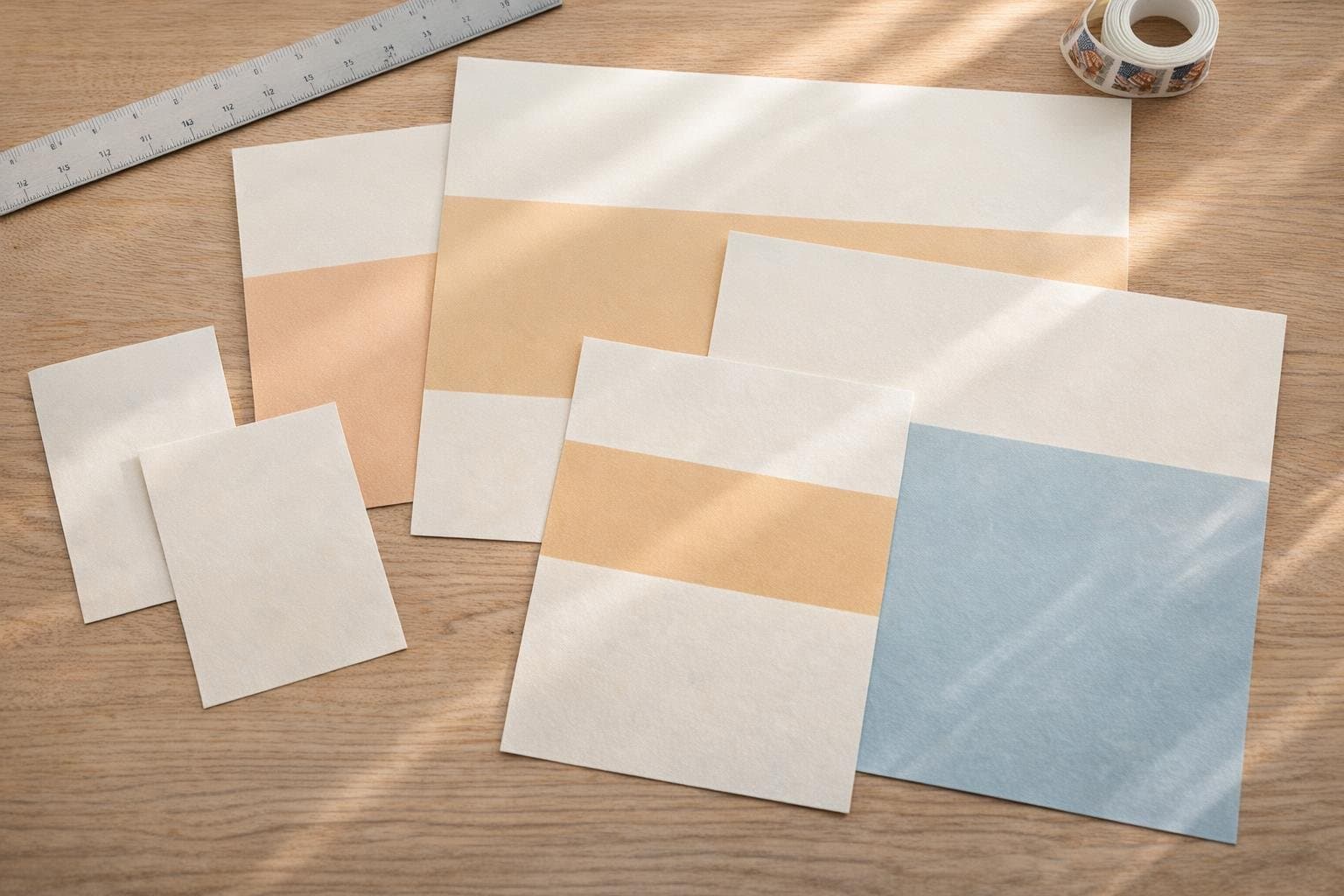
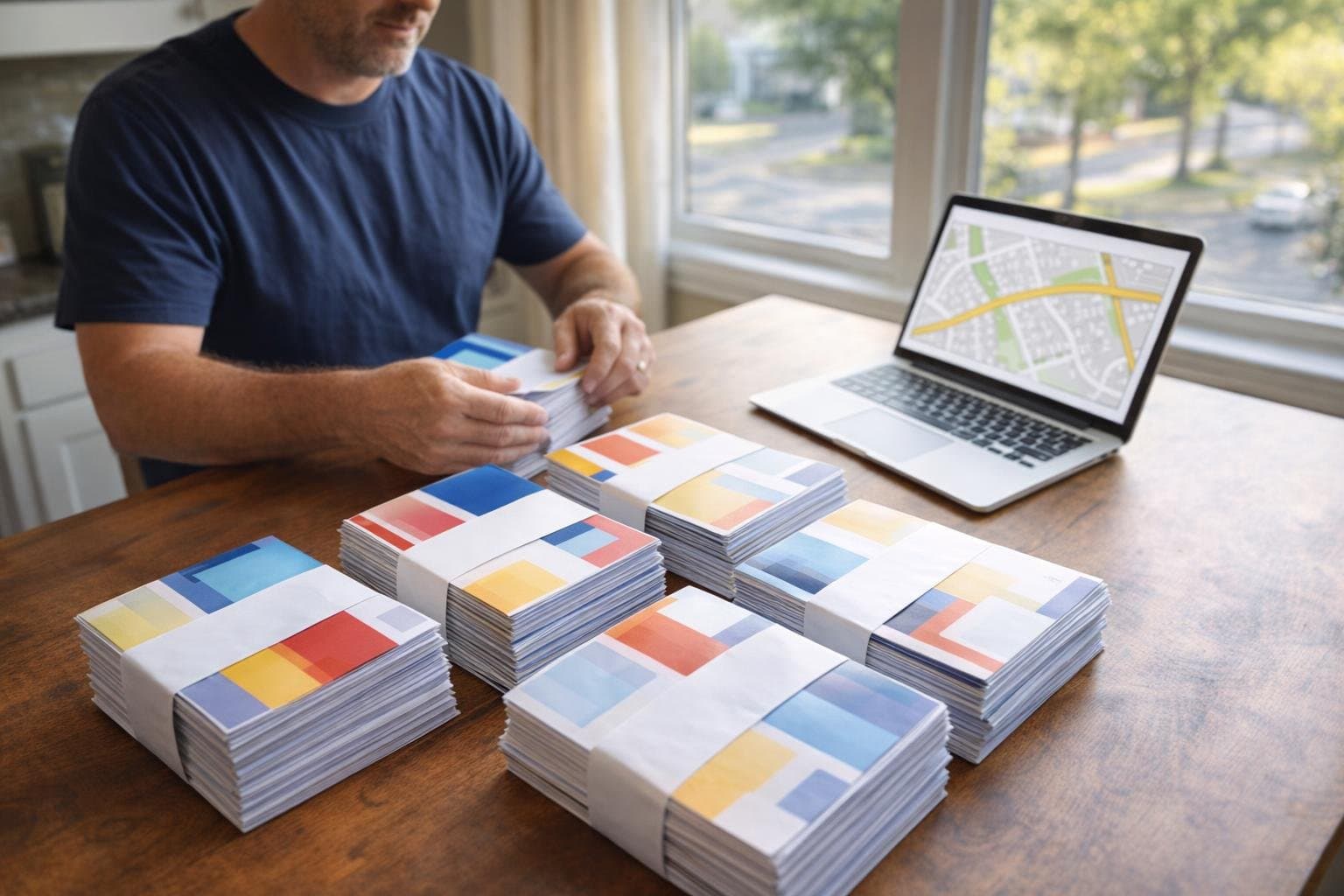
Most size guides tell you a postcard is 4x6 and leave it there. That's half the answer. The other half is what each size costs to mail, because the Post Office sorts every card into a different price bucket based on its dimensions, and a size that's only an inch bigger can cost you a lot more. So here are the standard postcard sizes, the USPS class each one lands in, and what it costs to mail today, whether you're sending ten thank-you cards or 5,000 ads to a neighborhood.
Here's the thing. Printers sell about eight sizes over and over. Each one falls into one of three USPS buckets: postcard, letter, or flat. The bucket sets the price.
Size (inches)
Common name
USPS class with a stamp
Stamped price
EDDM Retail price
4 x 6
Standard postcard
Postcard
$0.65
Doesn't qualify
4.13 x 5.83 (A6)
International standard
Postcard
$0.65
Doesn't qualify
5 x 7
Medium
Letter
$0.82
Doesn't qualify
5.5 x 8.5
Half-letter
Letter
$0.82
Doesn't qualify
6 x 9
Large
Letter
$0.82
Doesn't qualify
6 x 11
Jumbo
Letter
$0.82
$0.26
8.5 x 11
Full-page
Flat
$1.69
$0.26
9 x 12
Oversized
Flat
$1.69
$0.26
All prices in this post come from USPS Notice 123, checked October 31, 2026. Stamped prices are for the first ounce. Prices change, so check before you buy a roll of stamps.
Two rows should jump out at you. The 6x9 doesn't qualify for EDDM, even though one popular size guide says it does. And the 6x11 has two prices depending on how you mail it. I'll explain both below.
The A6 size is the international one, 105 x 148 mm (papersizes.org), so it lands in the same bucket as a 4x6 in the U.S. And those cute 4x4 square cards some printers sell? They're under the USPS minimum of 5 inches long, so they can't go in the mail on their own. Put them in an envelope.
Paper thickness is measured in points, and one point is 0.001 inch. So 14 pt stock is 0.014 inch and 16 pt is 0.016 inch, right at the ceiling. Point sizes are nominal and real stock varies a bit, so if you're on 16 pt, ask your printer for the actual thickness. Order a super-thick "luxury" 4x6 on heavier stock than that and USPS no longer treats it as a postcard, so the postcard price is off the table. Pretty card. Wrong bucket.
Once a card is bigger than 4.25 x 6, USPS mails it as a letter, as long as it stays within letter size. Letter size maxes out at 11-1/2 inches long, 6-1/8 inches high, and 1/4 inch thick (DMM 101.1.1). Pieces more than 6 inches long or 4.25 inches high also need to be at least 0.009 inch thick.
So the 5x7, the 5.5x8.5, the 6x9, and even the 6x11 are all letters when you stamp them. Each one costs the 1-ounce letter price: $0.82 with a stamp, or $0.78 if you use a postage meter. That's 13 to 17 cents more than a 4x6 for the exact same trip to the mailbox.
In plain English: bigger than a 4x6 but no more than 6-1/8 inches high and 11-1/2 inches long, it's a letter.
Square postcards look great on Instagram. In the mail, not so much. USPS calls a letter "nonmachinable" if its length divided by its height is under 1.3 or over 2.5 (DMM 101.1.2). A square card is 1.0. So a 5x5 card is a letter (it's too tall to be a postcard) AND it's nonmachinable:
$0.82 letter price
plus the $0.49 nonmachinable surcharge
$1.31 per card
Twice the price of a 4x6. For a wedding invite, sure. For a marketing mailer, that's a tough sell.
You'll see pages claim the postcard rate goes up to 6x9. They're mixing up two different rulebooks. The 6 x 9 limit is real, but it's in USPS's commercial rules (DMM 201.1.2.1), which cover presorted commercial First-Class mailings. That's mailing-house territory. If you walk into the Post Office with a stamp, the ceiling is 4.25 x 6. Full stop.
Go past letter size and you're in flat territory. A flat is more than 11-1/2 inches long, or more than 6-1/8 inches high, or more than 1/4 inch thick, and no bigger than 15 x 12 x 0.75 inches (DMM 101.2.1). Large envelopes, catalogs, and big postcards.
So a 9x12 is a flat. So is an 8.5x11. So is a 6.25x9, because 6.25 inches high is over the 6-1/8 letter limit.
Mail a flat one at a time with stamps and it's the large envelope price: $1.69 for the first ounce, and $1.98 at 2 ounces. That's why nobody mails big cards with stamps. Honestly, it would be crazy.
Here's where it flips. Every Door Direct Mail (EDDM) Retail lets you mail to every address on a carrier route with no mailing list and no permit, and it charges $0.26 per piece for flats up to 3.3 ounces, as of October 31, 2026. One price, whether the card is 6x11 or 12x15.
EDDM Retail takes flats only, but it uses its own size test. A piece qualifies if it's longer than 10.5 inches, OR taller than 6.125 inches, OR thicker than 0.25 inch, up to 15 x 12 x 0.75 and 3.3 ounces (DMM 143). Pass one test and you're in. I go through every common size, folding, and vertical designs in the EDDM size requirements post, so I won't repeat all of it here.
What matters for this post:
4x6, 5x7, 5.5x8.5, 6x9: fail all three tests. Not EDDM.
6x11: 11 inches beats 10.5 on length. EDDM Retail flat, $0.26. But stamp it and it's a letter at $0.82. Same card, two prices, depending on how you mail it.
8.5x11 and 9x12: pass on length and height. $0.26.
And EDDM has a 200-piece minimum per mailing, not per route. So it's for neighborhoods, not your Christmas card list. It also comes in a permit version for bigger mailers, covered in EDDM Retail vs BMEU. If you're new to it, how EDDM works covers the basics.
Okay so let me break it down with real numbers. Same 5,000 homes, postage only, no printing:
$3,250
4x6 with postcard stamps
$4,100
6x9 with letter stamps
$8,450
9x12 with large envelope postage
$1,300
9x12 or 6x11 by EDDM Retail
That's 5,000 times $0.65, $0.82, $1.69 (one ounce), and $0.26.
Read that again. The biggest card costs the least to mail, as long as you mail it the right way. The little 4x6 everybody calls "standard" costs two and a half times as much in postage to reach the same houses, and you'd also need every name and address.
The size everybody calls standard is the one that costs the most to put in every mailbox on the street.
That's not a knock on 4x6. For a personal note, a thank-you to a customer, or a mailing list of 80 past clients, a 4x6 with a stamp is perfect. It's just the wrong tool for hitting a whole neighborhood.
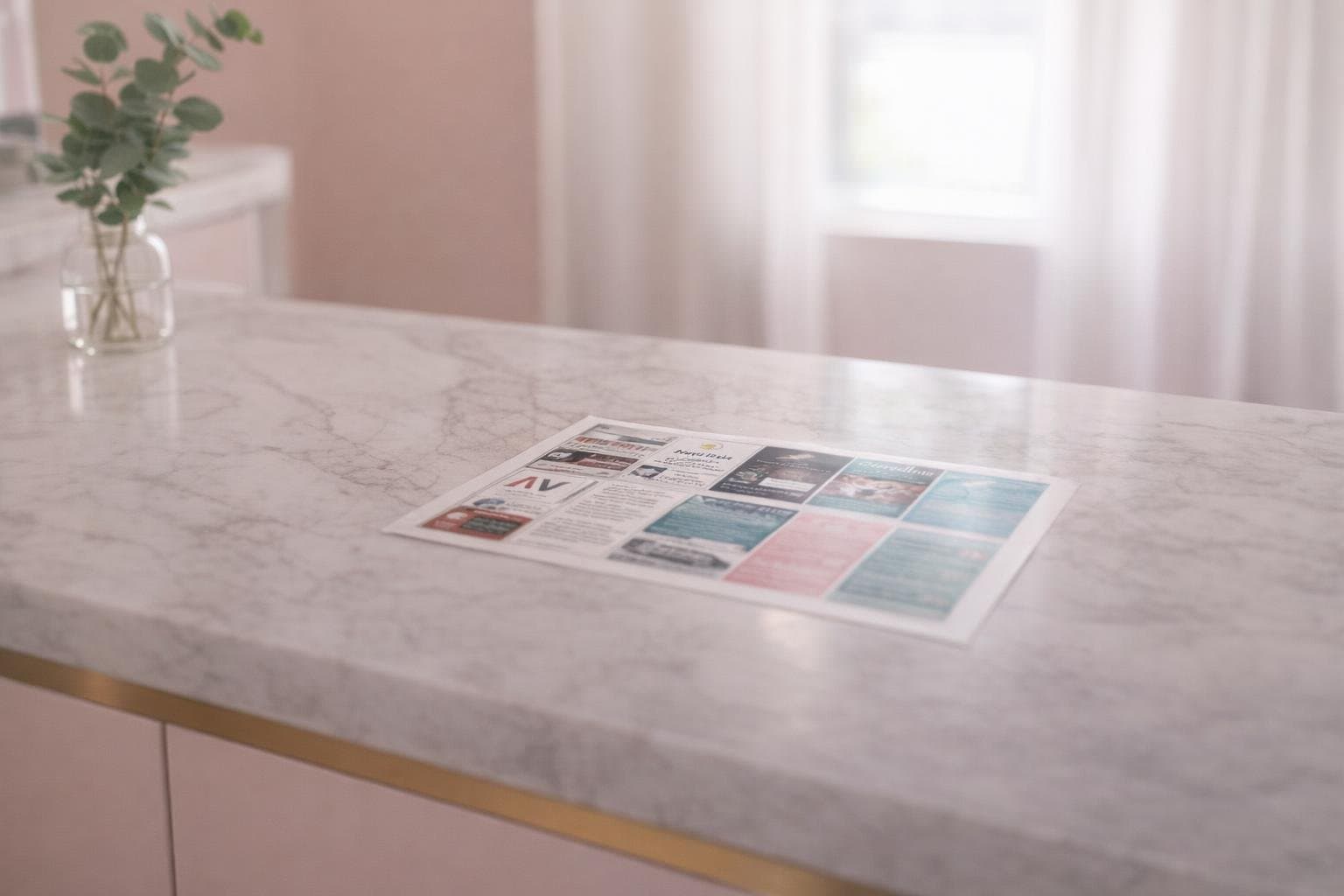
Full transparency, I'm biased here. The whole 9x12 Method is built on the big card. As I always say, it's the "biggest thing anybody ever receives in their mailbox." Then you sell 16 ad slots on it to local businesses for about $500 each.
Here's a fun way to picture it. A standard ad slot on our 9x12 is about 3.8 x 2.8 inches. A double slot is 4x6. So a whole "standard postcard" is just one double slot on our card. Sixteen businesses share a card where a single 4x6 would be one ad.
And businesses buy those 4x6 doubles. Michael sold 10 slots before noon one morning, all from email and calls (his card used 2x3, 4x3, and 4x6 spots): three 2x3s, six 4x3s, and one 4x6. Another time he filled an empty 4x6 spot with a Mexican restaurant in 10 minutes to hit a print deadline. Leland had two clients take double slots at $900 each on his very first card.
I teach slot sizes, layouts, and pricing inside the 9x12 Method community. You don't need it to pick a size, though. The table at the top of this post is honestly all you need.
4 x 6 inches. It fits inside the USPS postcard limits (3.5 x 5 up to 4.25 x 6 inches, 0.007 to 0.016 inch thick), so it mails at the postcard stamp price, $0.65 as of October 31, 2026.
At the counter or with stamps, a 6x9 is a letter: $0.82 as of October 31, 2026. It does not qualify for EDDM Retail, because 9 inches isn't over 10.5 and 6 inches isn't over 6.125. Presorted commercial mailings through a mail house can get card prices on cards up to 6x9.
Yes. A square card is nonmachinable because its length divided by its height is under 1.3. A 5x5 card pays the $0.82 letter price plus a $0.49 surcharge, $1.31 total as of October 31, 2026.
One that's longer than 10.5 inches, taller than 6.125 inches, or thicker than 0.25 inch, and no bigger than 15 x 12 x 0.75 inches and 3.3 ounces. 6x11, 8.5x11, and 9x12 all qualify. 4x6, 5x7, and 6x9 don't.
For the postcard price, no more than 0.016 inch, which is 16 pt stock, and no thinner than 0.007 inch. Our 9x12 and 6x11 cards are 14 pt, but they're flats, so the postcard thickness limit doesn't apply to them.
Whatever size you go with, I hope this saves you a surprise at the Post Office counter. As always, I'm rooting for you.
Ready to run your own card?
Get the course, scripts, tools, and weekly coaching inside the 9x12 Method community.

 Mitchell Tebo