Insurance agent postcards that bring in local quotes: what to put on the card, license number and gift rules, real costs, when to mail, and how to track it.
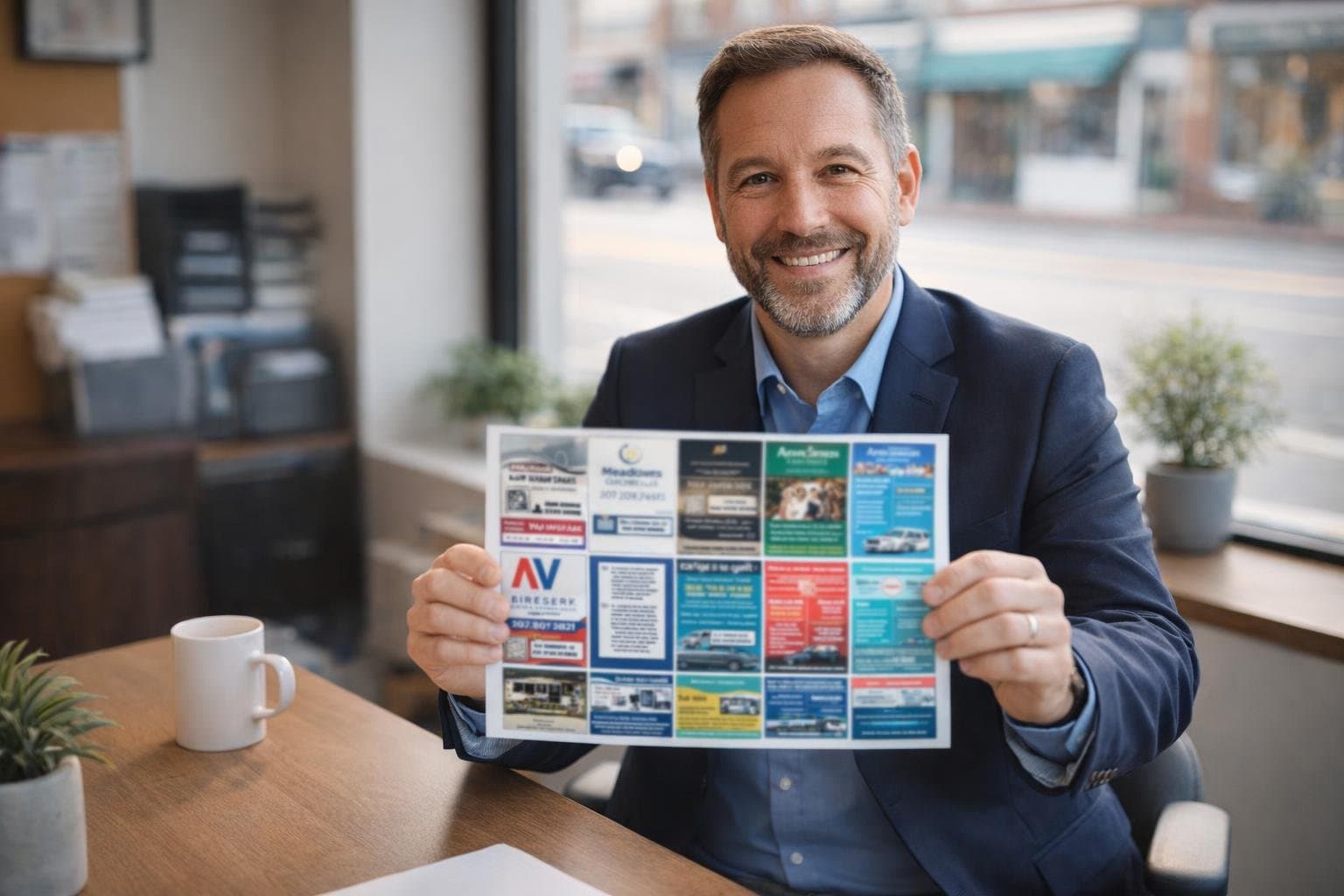
Most local insurance agents grow on referrals, a few renewals, and whatever leads they can afford to buy. Then a slow month hits and there's nobody new in the pipeline. Insurance agent postcards fix that by putting your face and your name in the one place every future policyholder checks every day, which is their mailbox. Here's the thing, though. Most insurance postcards look the same, and a few of the "proven" offers you'll see online can get an agent in trouble with the state. So let me show you what goes on the card, what you're allowed to say, what it really costs, and how a shared 9x12 card puts your agency in front of 5,000 local homes for $500.
Honest answer: it depends on how you do them. On agent forums, some say postcards are expensive and don't work for a one-agent shop. Others have mailed for decades. The difference comes down to three things:
Cost per home. Mailing your own card to thousands of homes every month gets expensive fast.
Consistency. Nobody needs you today. They need you when their renewal jumps, they buy a house, or they have a baby. You have to be the name they remember that day.
A real reason to call. "Auto, Home, Life. Call today!" is not a reason. A free policy review with your name and face on it is.
And Hunter is my favorite proof of this. He was 23, active duty in the Marine Corps, and running an insurance agency on the side when he started. He found the 9x12 Method while looking for ways to get leads for his agency. Digital marketing companies quoted him around $3,000 a month plus ad spend, and the direct mail he looked into came out to about $3,000 to $5,000 for every run. So he started his own 9x12 card and put his agency on one of the spots. He paid for that spot out of the insurance business like any other advertiser.
Insurance is a memory business. The agent people call is the one they remember, and mail is how they remember you.
Here's the stuff nobody tells you about insurance agent direct mail, and it's the part that can actually cost you money. Look, this is boring. But a $1,000 fine is less boring. Your state regulates insurance ads, and if you're captive, so does your carrier.
Some states require your license number right on the ad. California is the clearest example. California Insurance Code section 1725.5 says licensees have to put their license number on business cards, written price quotes, and print ads distributed only in California. On an ad, it has to be at least as big as any phone number, address, or fax number on it, or 12-point type, whichever is larger. The word "Insurance" has to be on there too. Fines start at $200 for a first offense and go up to $1,000.
Not in California? Put your license number on anyway. It takes one line, it builds trust, and it covers you if your state has a similar rule.
States have anti-rebating laws that limit what an agent can give someone to win their business. The National Association of Insurance Commissioners (NAIC) has loosened its model law to allow some value-added services. According to Nationwide's agent guide to the changes, the NAIC recommended capping gifts in personal lines at the lesser of 5% of premium or $250. But here's the catch. The model only counts in states that adopt it, and the rules vary state by state.
Simple version: a free policy review is a service, and it's the cleanest hook you can print. A gift card for a quote depends on your state, so ask your compliance contact first.
If you sell Medicare Advantage, the federal rules are strict, but mail is allowed. The regulation at 42 CFR 422.2264 says plans "may make unsolicited direct contact by conventional mail and other print media." The same rule bans unsolicited door-to-door solicitation, including leaving information of any kind. So a postcard in the mailbox is fine. Dropping flyers on porches is not.
Timing matters too. Under 42 CFR 422.2263, plans "may begin marketing prospective plan year offerings on October 1 of each year." So a card about next year's plans can't hit mailboxes in September. And Medicare materials usually need specific disclaimers, which is exactly why your carrier's compliance team should approve the copy before it prints.
If you're a captive agent, your carrier may need to approve your ad. Get that done first, then send the approved artwork to whoever prints the card. It adds a few days.
I'm not a lawyer, and this isn't legal advice. Rules change and every state is different. But a free policy review, your license number, and an approved design keeps your card a whole lot simpler.
A standard slot on a shared 9x12 is about 3.8" x 2.8". That's not a lot of room, so every inch has to earn its spot.
Element
What to put there
Why
Headline
The offer: "Free Policy Review"
People know the deal in two seconds
Photo
You, smiling, in your office or around town
People buy insurance from a person, not a logo
Name and agency
"Dana, your [town] agent" plus the agency name or carrier logo
Answers "who is this?" instantly
Lines you write
Two or three (home, auto, life)
A list of nine lines in tiny type gets skipped
Contact
A big phone number, a QR code to a quote form, your address
Older clients call, younger ones scan
Compliance line
License number and anything your state or carrier requires
See the rules above
Navy with gold or red reads as trust. Skip the stock family under an umbrella. Everybody has that one. Your real face beats it. My postcard ad design tips go deeper on layout.
Let me break it down. Here are three ways to get a card in front of 5,000 local homes:
Option
What you pay
Homes reached
One slot on a shared 9x12 card
$500
5,000
Your own 9x12 card, printed and mailed through 9x12 Method Printing
$2,999 (postage included)
5,000
For comparison, one direct mail company's insurance program lists $1,790 a month for 2,500 postcards, with a 3-month minimum. And when Hunter priced out direct mail for his agency, it came to $3,000 to $5,000 a run. That's not a knock on anybody. Mailing your own card just costs real money.
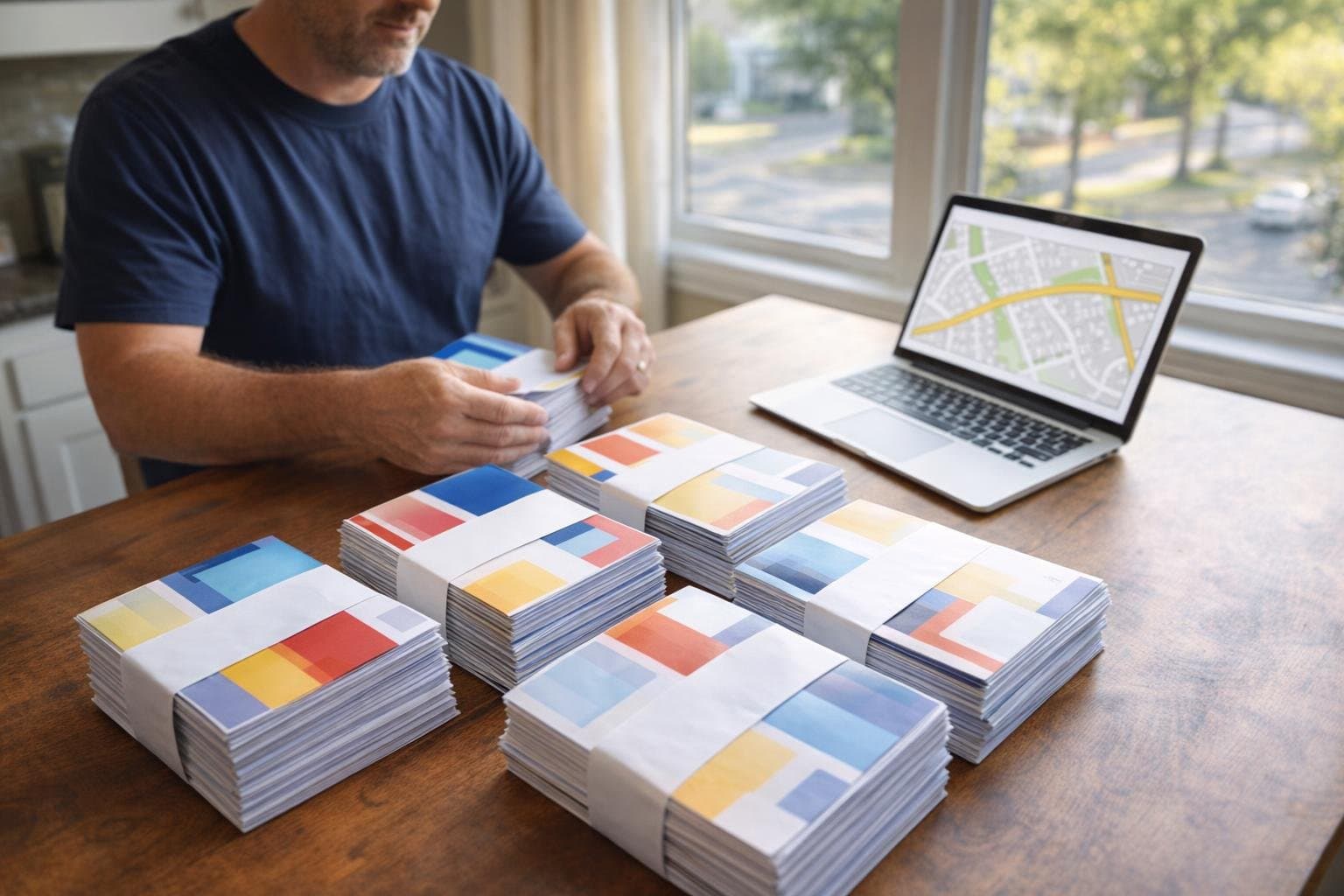
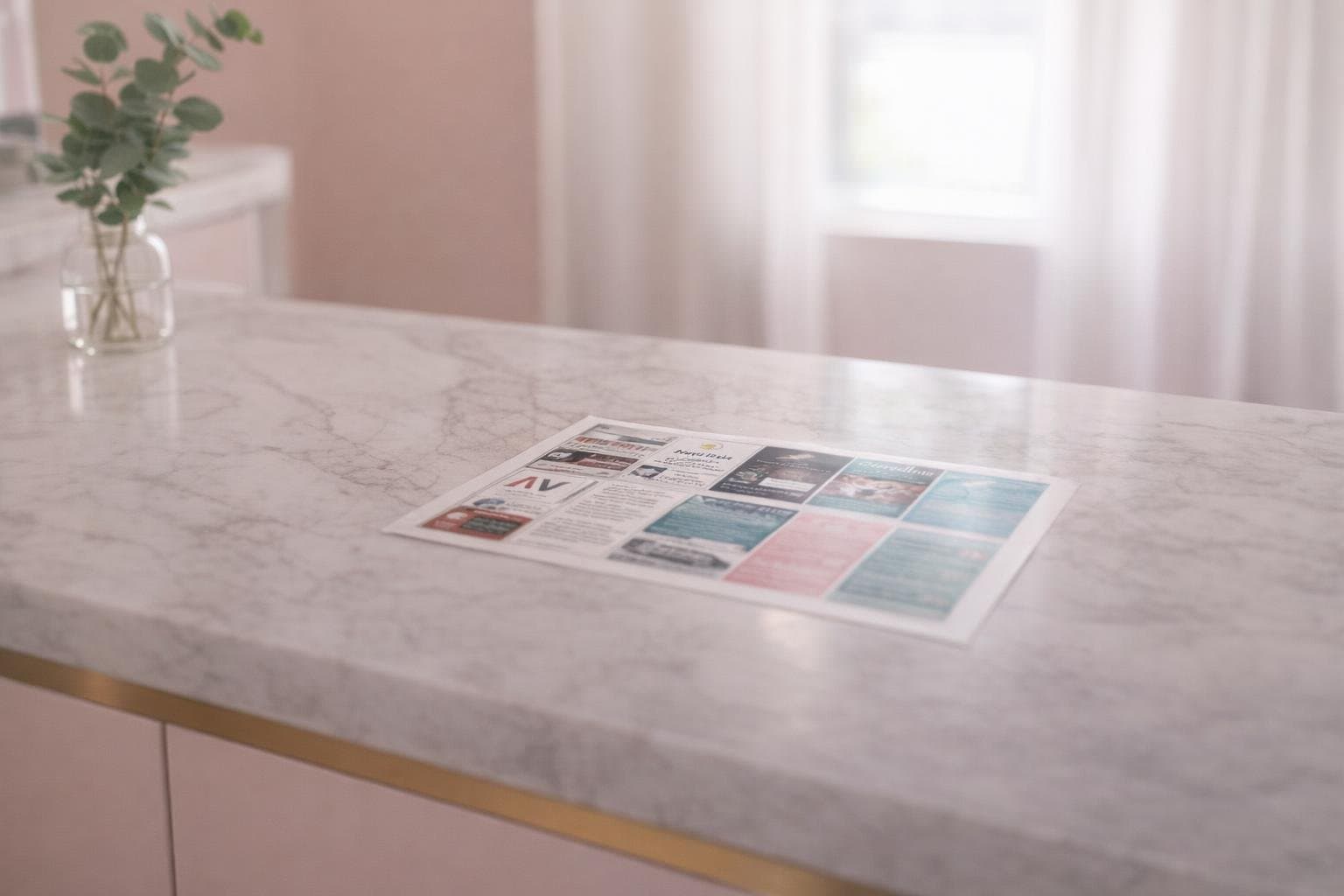
A shared card works differently. Up to 16 local businesses split one big 9x12 card, each in a different industry, and it goes to 5,000 homes through USPS EDDM (Every Door Direct Mail). EDDM means no mailing list. You pick carrier routes and every home on them gets the card.
$500
One slot
5,000
Homes reached
10 cents
Cost per home
1
Insurance agents on the card
Now the test. Think about what one new household is worth to your agency in commission over the years they stay with you. You know that number better than I do. If it's more than $500, one new policyholder covers the slot. It is that simple.
Rather run your own card? My EDDM postcards page shows how we print and mail one for a business. USPS lists EDDM Retail postage at $0.26 per piece as of July 12, 2026, and the All Inclusive package from 9x12 Method Printing already includes it in the $2,999.
On a good shared card, there's only one insurance agent. Not one auto agent and one life agent. One agent, period. Every month you stay on, that's 5,000 homes seeing you and no competitor.
That's why the insurance agents in our community often commit to more than one round. Gabriel locked an insurance agent in for three months. His normal ad was $600, and the agent took a three-month special at $1,200. Ezra's friend in insurance bought three spots and wanted to be on the card every quarter: $1,200 the first time, then $1,500 every time after, with a free ad design each quarter. They don't want to be on once. They want to own the category.
Almost every household needs coverage, but not every route is equal:
Home and auto: routes near your office with lots of single-family homes and owner-occupied houses. Homeowners need home, auto, and often umbrella coverage.
Life insurance: routes with lots of households with kids.
Medicare: routes with an older median age.
The free EDDM route planner shows the carrier routes in any ZIP Code or city with median income, median age, owner-occupied share, and households with kids. So you can pick on purpose instead of guessing.
Two heads ups for Medicare cards. Plan-year marketing can't start before October 1, so the earliest a card about next year's plans should land is October. And USPS doesn't promise a delivery date for Marketing Mail, so drop it early in October if you want it in homes before October 15.
One member on a group call put it this way: "I find insurance agencies are just the easiest to close. They close themselves." Tax season is when they're slammed, and busy agents want somebody else to handle the marketing.
QR code to your quote form with a "postcard" tag. ScanLab or any QR tool with scan counts works.
A tracking phone number that forwards to your office.
"Postcard" as a lead source in your agency management system, so you can count it twice: at the quote and when they buy.
Every few rounds, add up new policies from the card and compare them to what you paid for the slot. My guide to tracking direct mail results walks through it.
If you sell slots on a shared card, insurance agents are a great category. Here's what members have learned:
Look for independently owned offices. Travis works with a big carrier whose offices each have a different owner, so he has one on every card. Skip company-owned stores and online-only carriers.
Lead with exclusivity: "5,000 homes in [town]. One insurance agent on this card."
Offer a multi-month option. Gabriel's three-month special and Ezra's quarterly deal both came from offering more than one round.
Ask for the compliance file up front. Captive agents may need carrier approval, so build that time in.
Ask for referrals even if they say no. One member walked into an agent who was "full up" and didn't want new business. So he asked who he'd recommend, walked into that agent's office, and in his words, it was "less than five minutes" before she handed him a check.
The objection you'll hear most is "We get all our leads from referrals." Here's the counter: "This is what makes the referral happen. A family moves to town, asks a neighbor for an agent, and the neighbor remembers your face from the card on the counter."
Full transparency, I teach the operator side of this (building the card, selling the slots, the scripts) inside the 9x12 Method community. You don't need it to buy a slot or try this on your own. If you're an agent, everything above is enough to get started.
They can, when the card is local, shows up consistently, and gives people a real reason to call, like a free policy review. A shared 9x12 card puts one agent in front of 5,000 nearby homes for a $500 slot, about 10 cents a home.
One slot on a shared 9x12 card is typically $500 for 5,000 homes. Mailing your own 9x12 to 5,000 homes costs $2,999 with postage included through 9x12 Method Printing. For comparison, one insurance mail program lists $1,790 a month for 2,500 postcards with a 3-month minimum.
In some states, yes. California Insurance Code section 1725.5 requires the license number on print ads distributed only in California, at least as big as any phone number on the ad or 12-point type, plus the word "Insurance." Putting it on the card is smart even where it isn't required.
It depends on your state. Anti-rebating laws limit what an agent can give someone to win their business, and the rules vary. A free policy review is the cleaner offer. Check with your state department of insurance or compliance contact first.
Yes. Federal rules for Medicare Advantage allow unsolicited contact by mail and other print media, but they ban unsolicited door-to-door solicitation, including leaving materials at the door. Marketing for next year's plans can't start before October 1, and Medicare materials have strict content rules, so have your carrier's compliance team approve the copy before it prints.
Lead with one clear offer, like a free 15-minute policy review. Add your photo, first name, agency name, two or three lines you write, a big phone number, a QR code, and your license number. Skip savings guarantees.
As always, I'm rooting for you. Peace.
Ready to run your own card?
Get the course, scripts, tools, and weekly coaching inside the 9x12 Method community.

 Mitchell Tebo