How to start an advertising business: 7 models compared on startup cost, who pays first, and real 2026 numbers, plus the one you can start with $0 upfront.
Most guides on how to start an advertising business assume you mean a digital marketing agency, then hand you a checklist about LLCs and business plans. But "advertising business" covers a bunch of very different businesses. Some cost thousands before you sell a single ad. One costs nothing, because the advertisers pay you before you spend a dime.
So if you're trying to figure out how to start an advertising business, this is the honest version. Seven real models, what each one costs before your first dollar comes in, who pays first, and which one I'd pick if I were starting over today with no money and no experience.
Full transparency before we start. I run and teach one of these models: a big shared postcard that about 16 local businesses split. So I'm biased, and I'll tell you exactly where. But I'm going to lay out the other six fairly, because some of you are a better fit for them.
Here's the thing. Every advertising business sells the same product: attention you control. A magazine controls its readers. A billboard controls a stretch of road. An agency doesn't own any attention. It rents it from Google and Facebook for its clients.
So before you pick a model, ask three questions:
Who owns the audience? You, a platform, or nobody yet?
Who pays first? Do advertisers pay you up front, or do you front the bill and hope?
What's the bill before revenue? Printing, a sign structure, software, or nothing?
Those three questions sort every advertising business idea out there. Let's run them.
This is what most "start an advertising company" guides are really about. You run Google ads, Facebook ads, websites, or social media for local businesses and charge a monthly fee.
Here's the thing. Starting one is cheap and the money comes in monthly. Getting the first client is the hard part. In the State of Digital Agencies survey from SparkToro and Paddy Moogan, referrals were the top source of new clients, and of the agencies that tried outbound sales, only 9% called it very effective. Brand-new agencies don't have referrals yet. That's the trap. I wrote a whole guide on how to get clients for a marketing agency if this is your lane.
You write the content, sell the ad pages, print it, and get it into homes. It's two businesses at once: a publishing business and an ad sales business.
The bill is the problem. When I priced a 24-page, 8.5 x 11 magazine for 5,000 homes on 48HourPrint's online calculator (September 27, 2026), printing alone was $6,416. Mail it with EDDM at $0.26 per piece (as of July 12, 2026) and that's another $1,300. $7,716 per issue before design, writers, or paying yourself. All the math is in my guide on how to start a local magazine.
Same idea, minus the articles. A booklet of listings or coupons, mailed to every home. A 16-page booklet priced at $4,285.50 for 5,000 copies (48HourPrint, September 28, 2026), plus $1,300 in postage, comes to $5,585.50 per edition. Lighter than a magazine, but still a lot of pages to sell. See my local business directory breakdown for the full picture.
The lowest cost to launch. beehiiv's free plan covered up to 2,500 subscribers when I checked on October 26, 2026. The catch: advertisers want readers, and you start with zero. You can sell your first ads before you have a big list, but it takes a story and a plan. My guide on starting a local newsletter covers how.
Billboards are a real business, but they're not a beginner one. You need land or a lease, a structure, and permits. Along Interstates and primary highways, the federal Highway Beautification Act requires states to control outdoor advertising, and local sign rules can add more. I couldn't find a startup number I'd stand behind, which honestly tells you something. It's a lot of capital and paperwork before anyone pays you.
You hang ads on doors for local businesses and charge per door. Low startup cost, and clients usually pay you. But you're selling hours. One distribution company says an experienced distributor hangs about 80 to 120 doors an hour, so 5,000 doors is roughly 42 to 63 hours of walking for one job. Full math in my post on starting a door hanger business.
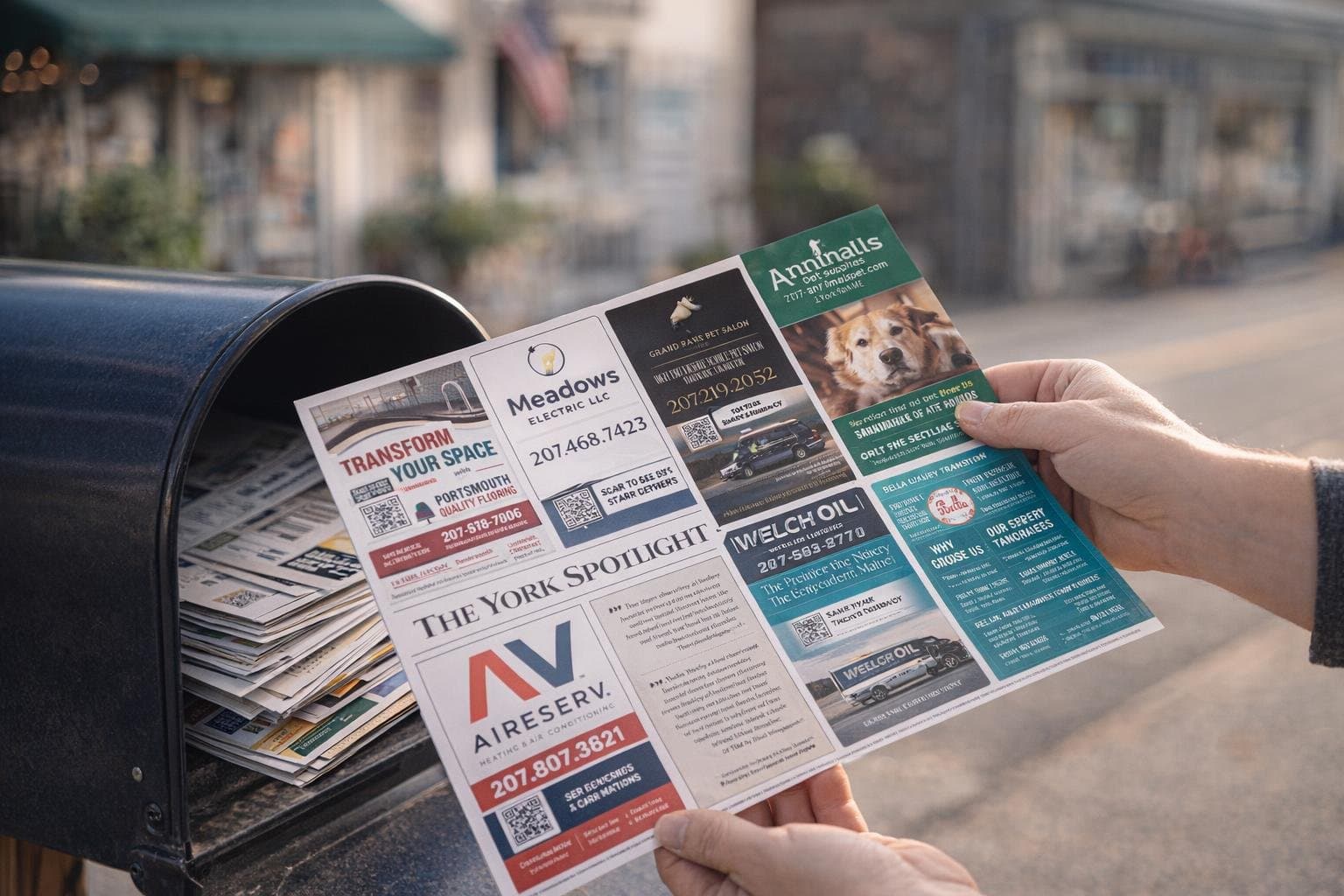
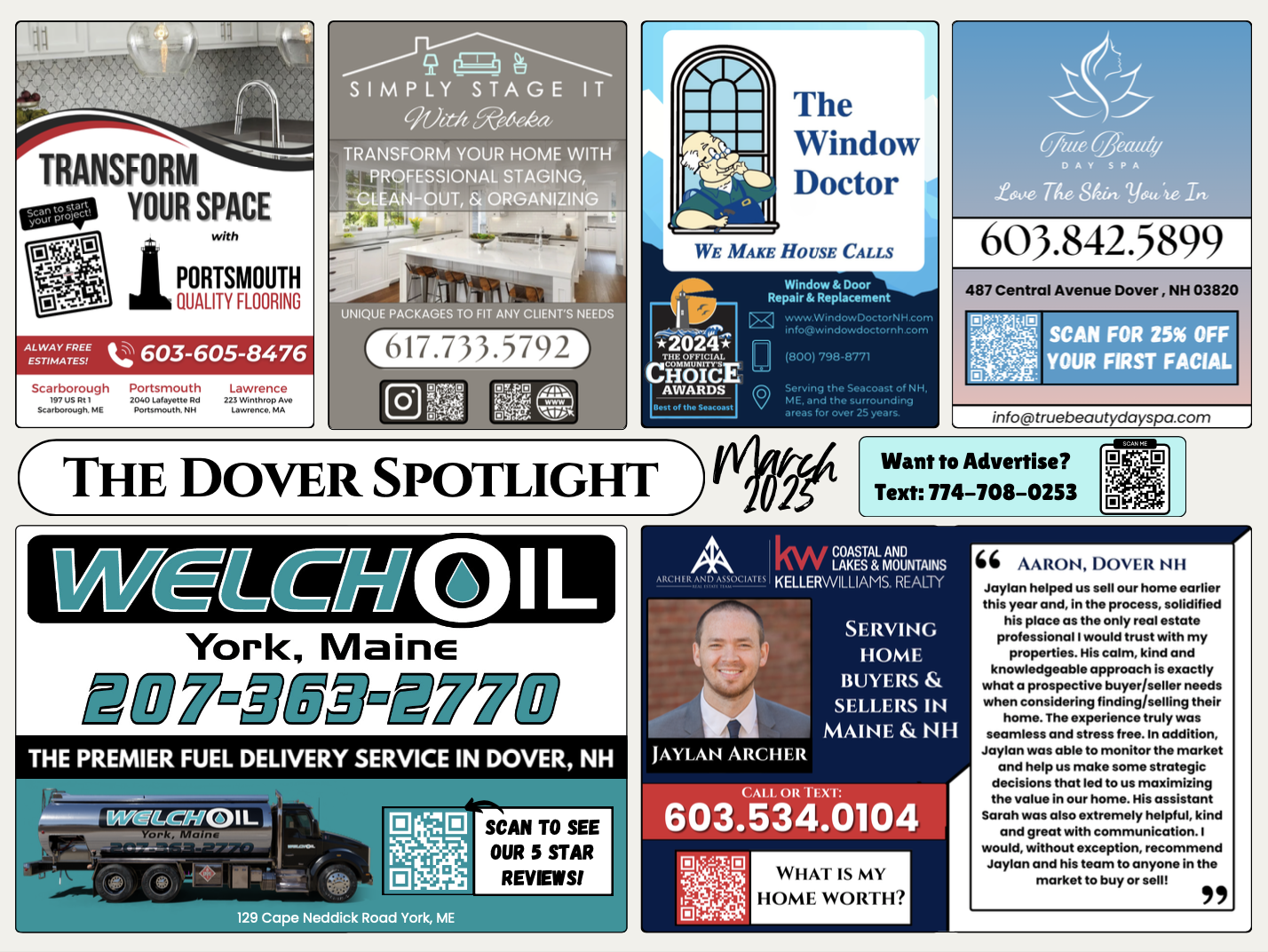
This is mine. One big 9x12 card, about 16 local businesses each buy a spot, and USPS Every Door Direct Mail (EDDM) delivers it to every home on the routes you pick. You collect the money first, then print.
That's a real card from a member's town. Four single spots and two double-size spots on this side (eight spots' worth), a banner in the middle, and a "Want to Advertise?" box so the next round of advertisers finds the operator.
Okay so let me break down the one I know best, because these numbers are fixed and I can show you all of them.
16
Ad spots on one 9x12 card
$500
Price per spot
$8,000
Revenue on a full card
$2,999
Print + mail, All Inclusive
$5,001
Your profit on a full card
$0
Money you front
The $2,999 is our All Inclusive price through 9x12 Method Printing: printing, packing, postage, and USPS fulfillment for 5,000 homes. You pay it out of the money advertisers already paid you. You sell first, then print. It is that simple. (If you'd rather handle the Post Office drop-off yourself, Print Only is $1,309 for 5,000 cards, and you pay the postage.)
There's a smaller version too, the 6x11 community card. About 16 spots at $250 is $4,000, the All Inclusive run to 2,500 homes is $1,449, and you keep $2,551. Members usually fill those in about two weeks, versus about 30 days for a first 9x12.
Look, I'm biased. But here's why, in plain English.
You don't have to build the audience. With a newsletter or magazine, you have to build readers before advertisers care. With EDDM, the audience is every home on the routes you choose. 5,000 mailboxes. No followers needed.
Advertisers pay first. This is the whole game. "Up front ALWAYS. Never chase money, it won't be there by the time you ask for it." That's what I tell every member. If the card doesn't fill, you can push the date or refund, but you never owe a printer money you don't have.
The mail carrier does the walking. Door hangers sell your hours. A shared card sells space, and USPS delivers it.
It's easy to explain. "We're splitting the cost of marketing on a huge 9x12 inch postcard. It's like a community mailer." A plumber gets that in ten seconds. Try explaining a programmatic ad retainer to a plumber.
And here's the part agency people love. I've said it a hundred times: "This model is a great 'Trojan horse' for your marketing business." You sit down with 16 local owners every month. Some of them need a website, a Google profile fixed, or ads run. One member on a group call put it this way: "for the amount of pain in the neck it is to run a digital marketing agency, I think the 9 by12 cards are more profitable time-wise." That member uses those card conversations to bring Google Business Profile work back to a spouse's business.
Sell the card first. The other services find you once you're the person in town who knows every business owner.
Here's the order I'd do it in, using the shared card as the model. If you picked a different model above, steps 2, 3, and 7 still apply almost word for word.
Pick a town or a set of neighborhoods. Look for areas around 15,000 to 100,000 people with lots of local businesses, then pick about 5,000 homes worth of routes in the EDDM route planner.
Build a list of local businesses that already advertise. Billboards, yard signs, truck wraps, old yellow pages ads. These people already have a marketing budget. Keep the list in the free 9x12 Method CRM, not a scrap of paper.
Make a sample. A mockup of your card with the spots laid out. People buy what they can see.
Reach out every day. Facebook groups, cold email, calls, and walking in. Introduce yourself as a local business owner bringing businesses together, never as a marketing agency.
Collect payment up front for every spot. Invoice, card, Cash App, whatever. No money, no spot. Here's what to charge per size.
Design the ads, get approvals, and send the file to print once the card is full.
Mail it, send every advertiser photos, and start selling the next card to the same people.
Full transparency: I teach every one of these steps inside the 9x12 Method community, with scripts, templates, and coaching calls with 2,800+ members. You don't need it to get started. Honestly, you could figure out your first card from this blog and a lot of conversations. But if you want people next to you while you sell the first one, that's what it's there for.
If you already know Google ads or web design cold, an agency can work. But you're selling a skill, the client judges you on results you don't fully control, and the work never stops. Selling ad space is simpler: you sell a spot, deliver the card, and you're done until next month. My honest take? Start with the card, then offer the agency work to the advertisers who ask for it. That's the Trojan horse.
I'm nothing special. And neither are most of the people winning at this. That's the point.
Travis builds vehicles in a factory. No sales background. Walked into 10 local businesses cold and closed 8 in one day. The 2 who passed were sticker-shocked, not uninterested.
Jp bought the course at 9:50am, posted in a local Facebook group at 11:30am, and sold his first ad at 2:25pm. Paid through Cash App the same day.
Michael saw a company on a billboard, called them, got told to email, the owner opened it and called back, and they bought a 3x4 spot for two months. Remember that one when you build your list. Anybody on a billboard is already buying advertising.
Leland shared the whole first card P&L: $7,150 in revenue, $200 on Facebook ads, $150 in discounts, $1,000 in free spots, $3,000 for print and postage. $3,850 profit on card number one.
And here's the honest side, because it matters. Gabriel's first card didn't make a profit. He treated it as the brochure to sell card two. And one member on a call, who ran a marketing agency for 20 years, said cold calling was still "my weak point." About a month in, that card had 8 spots sold and was right at break-even. Experience helps. It doesn't do the outreach for you.
I read the pages ranking for this so you don't have to. A few things jumped out.
The startup costs are all over the place. One of the top agency guides lists a startup cost of $100,000 to $500,000 in its summary, then says a few paragraphs later that you could start with little more than "a website and a few lattes." Both can't be true. The real answer depends completely on the model, which is why I put the numbers side by side above.
They treat "advertising" like it only means digital. Local owners still buy print, and plenty of them are already spending on it. Every billboard, wrapped truck, and yard sign in your town is a lead.
Fair question. The Bureau of Labor Statistics projects that employment of advertising sales agents to decline 7% from 2025 to 2035. Median pay was $64,820 in May 2025, usually some mix of salary, commission, and bonus.
But read that carefully. That's people selling ads for someone else's newspaper, station, or platform. Owning the ad product is different. When you own the card, you set the price, you keep the margin, and there's no boss deciding your territory. Honestly, a shrinking pool of ad sales reps in your town just means fewer people knocking on the same doors you are.
Boring but profitable. Mail isn't sexy. That's why it still works.
It depends on the model. A shared postcard costs $0 up front because advertisers pay before you print, then $2,999 All Inclusive for 5,000 homes comes out of that money. A 24-page magazine to 5,000 homes was about $7,716 per issue in my September 2026 example, paid before you know if the ads sell. An agency or newsletter can start with free or cheap tools.
Yes, if you pick a model where advertisers pay first. With a shared card, you sell the spots, collect the money, and pay for printing and postage out of what you collected. Models where you print or build first (magazines, directories, billboards) need cash before revenue.
No. Travis builds vehicles in a factory and walked into 10 businesses and closed 8 of them in one day. What you need is a simple offer, a sample, and the willingness to reach out every day. Experience in marketing helps, but it doesn't replace the outreach.
Go where local owners already are. Jp posted in a local Facebook group and sold a first ad less than five hours after buying the course. Travis walked into 10 businesses with a sample and closed 8. Start with businesses that already advertise (billboards, truck wraps, yellow pages), show them a mockup, and follow up. Most sales close on the second or third touch, not the first.
They sell access to an audience. Magazines, newsletters, directories, and shared postcards sell ad space. Billboards sell time on a sign. Agencies sell services, usually as a monthly fee. On a full 9x12 shared card, 16 spots at $500 is $8,000, and you keep $5,001 after the $2,999 All Inclusive print and mail cost.
The easiest to start is usually the one with no upfront bill and an audience you don't have to build. That's why I like the shared postcard: EDDM puts it in every mailbox on your routes, and the advertisers pay before you print. Easy to start isn't the same as easy to sell, though. You still have to do the outreach.
Look, whichever model you pick, pick the one where the money comes in before the bills go out. Everything else is just reps. Whether or not you join us, I hope you're absolutely killing it at life.
As always, I'm rooting for you.
Ready to run your own card?
Get the course, scripts, tools, and weekly coaching inside the 9x12 Method community.

 Mitchell Tebo