Local marketing for franchises that fills your store: what your FDD lets you do, where the money comes from, getting ads approved, and mail that hits your area.
You bought a franchise for the brand. Then you opened the doors and found out the national commercials don't care which location people walk into. They might drive past you to the one six miles away. That's the gap local marketing for franchises has to fill. And honestly, most of the answers are already sitting in a document you signed and never reread.
An independent shop can do whatever it wants. You can't. You have brand rules, a franchisor who wants a say, and maybe a territory line. But you also have a name people already trust.
Here's the thing. The national fund builds the brand. It doesn't pick your store over the one across town. Every location in your market gets the same national ads. What makes a customer choose your door is local:
Being the location they see in their own mailbox
Being the location their neighbor talks about
Being the owner they've actually met
So the job is simple. Get your location, your address, and your face in front of the homes closest to you, over and over, inside the brand rules.
The brand gets you trusted. Local marketing gets you chosen.
Before you spend a dollar, pull out your Franchise Disclosure Document. The federal Franchise Rule makes the franchisor spell out exactly what you need to know here.
Under the FTC's Franchise Rule, 16 CFR 436.5(k), Item 11 has to describe the advertising program for the system. That includes:
Whether the franchisor has to spend anything in your area. The rule asks "whether the franchisor must spend any amount on advertising in the area or territory where the franchisee is located." If the answer is no, nobody is promising to spend a dime on your neighborhood but you.
When you can use your own ads. It has to state "the circumstances when the franchisor will permit franchisees to use their own advertising material." This is your approval rule. Read it twice.
Co-ops. Whether you have to join a local or regional advertising cooperative, how the co-op area is defined, how much you pay in, and whether company-owned stores pay in too.
The fund itself. Who runs it, whether it's audited, whether you can see its financial statements, and how the money was spent last fiscal year (production, media, admin).
Franchise sales. "The percentage of advertising funds, if any, that the franchisor uses principally to solicit new franchise sales." Some of your contribution might be selling new franchises, not your store.
Read that list again. Right? You'll know exactly what you already pay for and what's on you.
Item 6 (other fees) is where you'll see what you pay for "advertising" and "advertising cooperatives" in dollars.
Item 12 covers territory, and two lines matter for local marketing. It has to say "whether the franchisor grants an exclusive territory," and if it doesn't, the document literally says "You will not receive an exclusive territory." It also has to disclose "any restrictions on the franchisee from soliciting or accepting orders from consumers outside of his or her territory."
That second line is the one that bites people who mail. More on that below. Boring stuff, I know. But boring is where the money's at.
Most franchise owners pay into marketing three different ways and only control one of them. Let me break it down.
The franchisor
National or brand fund
Whoever Item 11 names (franchisor, franchisees, or an agency)
Local or regional co-op
You
Your local advertising requirement
You
Anything above the requirement
That third line is your money. Many agreements require a minimum local spend. Common setups in real FDDs are a percentage of gross sales, a flat monthly dollar minimum, or the greater of the two.
Say your requirement is 2% of sales and your store does $40,000 a month (just an example, use your own numbers). That's $800 a month you have to spend locally anyway, which covers a $500 spot on a shared card with room left over.
So when someone says "corporate handles our marketing," that's half true. Corporate handles the brand. Your local requirement is a budget you already have to spend. The question is whether you spend it on things that reach your actual neighbors.
This is where a lot of franchise local store marketing stalls. The owner has a good idea, sends it to the brand team, waits, and the moment passes. Here's how to keep approval moving:
Ask your franchise rep for the brand standards file: logos, colors, fonts, approved photos, and required legal lines.
Ask what's pre-approved. If the brand has ready-made local ad templates, start there.
If you need a custom ad, build it inside the standards from the start. Send the file to whoever designs it.
Submit the proof with the offer, the dates, and where it runs. One email, everything attached.
Get the approval in writing and keep it with your receipt.
The operators in our community who sell ads to franchise owners know brand approval slows things down, so they build in a buffer. You should too. Start early, not the week the card prints. It is that simple.
Most franchise marketing ideas online are the same list: local SEO, social media, events, referrals. Those are fine, and I covered them in my list of local advertising ideas. But three things only work because you're a franchise:
A local offer only your store honors. A brand-wide coupon gets redeemed at whichever location is closest. A "this location only" offer sends people to you.
Your face. "Locally owned and operated by [your name]" is a line the national ad can't run. People like buying from a neighbor.
Mail to the homes around your store. The only one of these that reaches every home in a neighborhood on purpose.
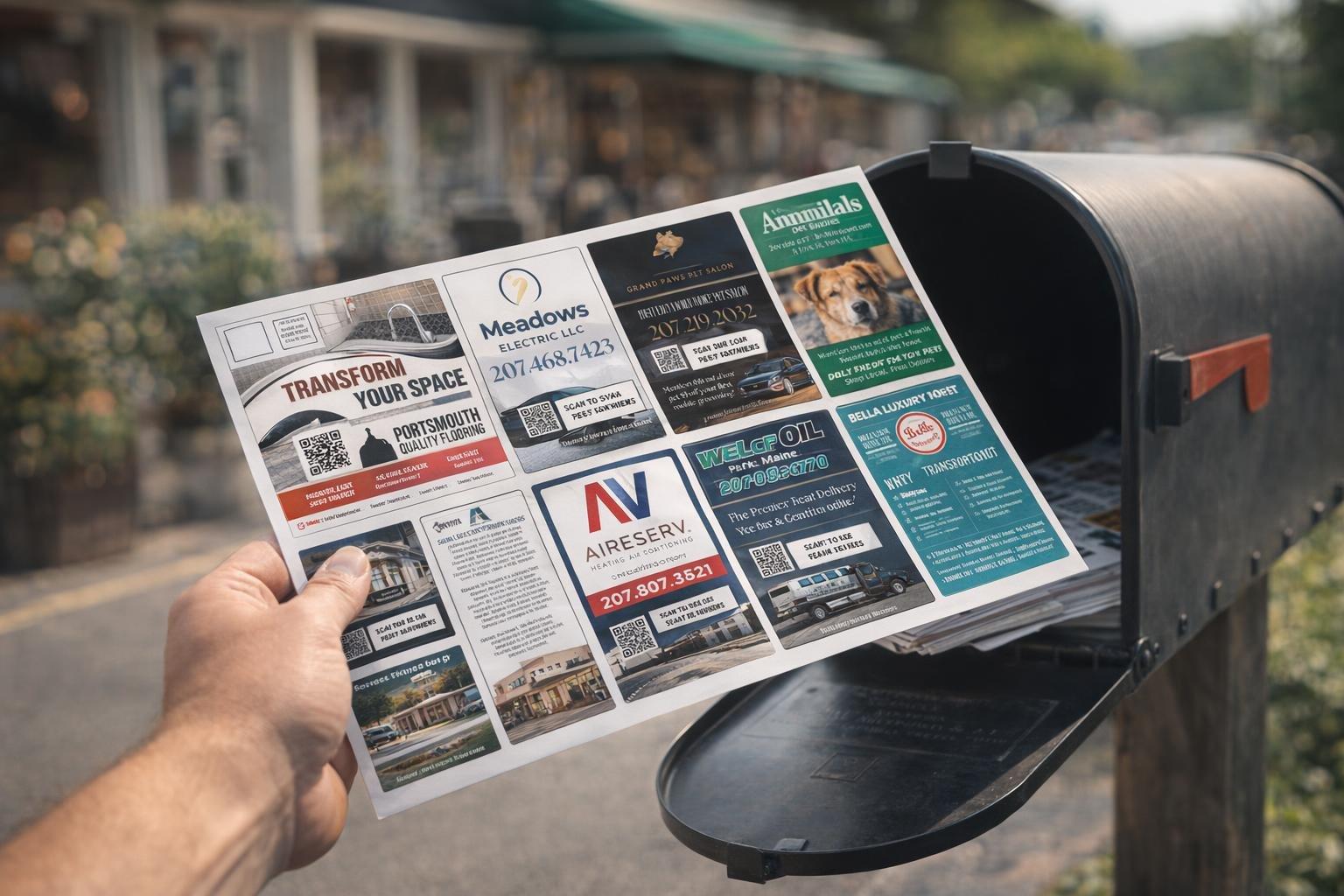
Here's why mail works so well for a franchise location. Social ads find people who might be near you. USPS Every Door Direct Mail goes to every address on the carrier routes you pick. No mailing list, no guessing. You pick the neighborhoods around your store, and every home gets the card.
There are two ways to do it: a spot on a shared card or your own card. The cost difference is huge.
Option
Cost
One spot on a shared 9x12 card, 5,000 homes
$500
One spot on a shared community card, 2,500 homes
$250
Your own 9x12 card, 5,000 homes, All Inclusive
$2,999
Your own 9x12 card, 10,000 homes, All Inclusive
$5,799
Postcard stamps alone for 5,000 homes
$3,250
That stamp line is at the $0.65 retail postcard stamp (July 2026), before you print a thing. EDDM Retail postage is $0.26 per piece as of July 12, 2026, which is a big part of why every-door mail costs so much less than stamping each card.
A shared postcard is one big 9x12 card with about 16 local businesses on it, one per industry, mailed to 5,000 homes. You're the only tire shop, the only pizza place, the only shipping store. At $500 that's 10 cents a home.
Look, I don't know a lower-cost way to put your location in every mailbox around you. And it often fits inside a local spend requirement without blowing it up. A percentage-of-sales requirement can often cover a $500 spot, like the example above.
If you have the budget, or you own more than one location, your own 9x12 card puts the whole space to work for your brand. We print and mail them through our done-for-you EDDM postcard service: 9x12 runs from 250 to 20,000 homes, postage included, and a full design is $60. Send us your brand standards file and your approved photos, and you get a proof to send to your franchise rep before anything prints.
On one of our group calls, a member knew a guy who owned five Dunkin' locations. The idea that came up was a smaller card that's nothing but his locations. That's the multi-unit play.
Remember Item 12? Here's where it shows up in real life.
Lucy, one of our members, was selling spots on her 9x12 card to 10,000 homes. A UPS Store owner wanted in. But the owner told her UPS is very territorial, so she could only take a spot on the 5,000 homes closest to her store. The other 5,000 would have to go to a different UPS Store in that area.
That's the right move. Mailing into another franchisee's territory can break your agreement, and it can start a fight with a fellow owner you'll see at every regional meeting. So before you mail:
Pull up your territory map from your agreement.
Pick carrier routes that sit inside it. Our free EDDM route planner shows every route on a map.
If a route crosses the line, skip it or ask your rep.
I run a community of people who sell spots on these shared cards, so I hear a lot of franchise stories. A few of my favorites:
Lucy and the tire shop. Lucy's area has two Big O Tires locations. When one owner hesitated, she told him no big deal, she'd go talk to the other one. His answer: "Nope, I want the spot cause I want those leads." Her plan was to mail the wealthy neighborhoods around his store.
Phil and the roofer. Phil walked into a roofing franchise and started talking to a rep. The franchisee popped his head out of the office, "What is this about?", pulled Phil in, and wanted to sign up right away. Phil already had other roofers in the mix, so he held off. But look at how fast the owner wanted in.
Bruce and the pizza shops. Bruce signs a national pizza franchisee, then visits the same brand 10 miles away and asks if they'll honor the coupons. If they will, he offers them the spot on the card in their own area.
Travis and the insurance offices. Each of the Farmers offices near Travis is owned by a different agent, so he puts one on every card.
Notice the pattern. The owner who decides on the spot is the locally owned franchisee. As one member put it on a call, walk into a company-owned store and it's "hello, goodbye," because nobody there can say yes. Does that make sense?
One honest heads up. Not every shared card takes franchises. Some operators pitch their card as local businesses only. Ask before you assume.
Your spot is small. So inside your brand standards, make sure it has:
The brand logo, exactly as the standards file says.
Your location's address and phone, not the 1-800 number.
A location-only offer with an end date.
A trust line: "Locally owned and operated by [your first name]."
A brand-approved photo, or you and your team in front of the store.
A QR code or a unique code so you can tell this card brought them in.
That last one matters. Your national fund reports usually don't tell you which customers came from where. A code that only exists on this card does. I wrote more about tracking direct mail results if you want the details.
Quick note for the operators reading this. Locally owned franchises are great spots on a card: a local budget, a brand people recognize, and an owner who can decide.
Ask the first question up front: "Are you the owner of this location, or is it corporate-owned?" Then ask about territory. When they say "corporate handles our marketing," the answer is: "National handles the brand. I'm helping you spend the local part." And plan on 14 to 45 days to close, because brand approval slows things down.
Full transparency, I teach all of this inside the 9x12 Method community, scripts and all. You don't need it to sell your first franchise spot. Start with my list of the best industries for postcard advertising.
Usually not. The fund builds the brand across the system. Item 11 of your FDD has to say whether the franchisor must spend any amount in your area. If it doesn't, plan on paying for your own local marketing.
Start with what your agreement requires, often a percentage of gross sales, a monthly minimum, or the greater of the two. That's your floor. A $500 spot on a shared 9x12 card that reaches 5,000 homes is an easy way to put part of it to work.
Probably. Item 11 has to state when the franchisor lets you use your own advertising material. Expect a review for anything with the brand logo on it. Ask for pre-approved templates first, and send custom ads in early.
It's a group of franchisees in one area who pool money for regional ads. Your FDD has to say whether you must join, how the area is defined, how much you pay in, and whether company-owned stores pay too. It's separate from your own local spend.
Check Item 12 and your agreement first. The FDD has to disclose any restriction on soliciting customers outside your territory. If there is one, pick only the carrier routes inside your territory map.
Yes, if you're locally owned, can decide on your own, and the brand allows it. Many operators love having a known brand on their card. Some keep their cards local-only, so just ask.
Get your FDD out, pick the homes closest to your store, and go be the location they choose. As always, I'm rooting for you.
Ready to run your own card?
Get the course, scripts, tools, and weekly coaching inside the 9x12 Method community.

 Mitchell Tebo