15 local advertising ideas for small business with real, dated costs, the legal traps that get owners fined, and how to tell which idea brought customers.
Most lists of local advertising ideas give you 27 options, prices with no source or date, and a sales pitch for whatever the author sells. So you finish reading and you still don't know where your first $500 should go. This one is different. Every idea below has a real cost (dated and sourced, or honestly marked "you set it"), who it actually fits, and the legal trap that bites people.
Full transparency, I do have a horse in this race. I run the 9x12 Method, where 2,800+ people learn to sell ad spots on big shared postcards to local businesses. So yes, mail is on this list. But it's one idea out of 15, and for a lot of businesses it isn't the first one you should try. Let me break it down.
6
Ideas that cost $0
Free
Google Business Profile
About 10 cents
Shared postcard, per home
$0.26 per piece
EDDM postage (July 12, 2026)
Watch: How To Get UNLIMITED FREE ADVERTISING For Your Business (Crazy Simple) · Summary and transcript
Being findable when someone already wants what you sell (Google, reviews, groups). Mostly free.
Being remembered by people who don't need you yet but will (mail, sponsorships, signs, ads). That costs money.
Owners usually skip the first job and pay for the second. Then the ad works, somebody searches your name, finds four reviews and a closed sign from 2023, and calls the other guy. So do the free stuff first. It makes every paid idea work better.
This is number one on purpose. Google says it straight: "creating a Business Profile and listing your business on Google is free." Fill out every field. Real hours, real photos of your work, your service area, and posts when you run a deal. It's the page people see when they search "plumber near me," and most of your competitors have half-finished ones.
Reviews are the first thing people check before they call you. But there are rules now, and the ranking guides skip them:
The FTC's rule on fake reviews took effect October 21, 2024. It bans fake reviews and buying reviews that have to say something positive, and the FTC can seek civil penalties.
Asking all your customers for a review is fine. The FTC calls that a "generalized solicitation."
Every town has a "What's happening in [town]" group, and business owners lurk in them too. Don't spam your ad. Answer questions, post a before-and-after, and when someone asks for a recommendation, your name is already familiar. Honestly, this is the #1 channel our members use to find advertisers, because that's where the locals already are.
A roofer and a gutter guy. A dog groomer and a vet. Swap referrals, put each other's cards on the counter, run a joint offer. Zero dollars. And when the vet says "call this groomer," that beats any ad you could buy.
Dues vary by town, so call yours and ask. What you get is a member directory, events, and a handshake with every other owner in the area. Doug, one of our members in Connecticut, joined his local chamber and pulled prospects straight out of its member directory.
Local reporters need local stories. "New business opens" is boring. "Local woman takes on the big guys and splits one ad spot four ways so cottage businesses can afford it" is a story. That's literally what happened to Lucy: a reporter saw her Facebook posts, pitched it as a David vs Goliath small-business story, and she ended up on her local ABC TV news. Free airtime. Pitch the human angle, not the sale.
Coffee shops, laundromats, the library, the hardware store. It sounds old-school, but Charlie, one of our members, put a flyer up in a McDonald's drive-thru and got 10 calls and 2 sales of ad spots out of it. It is that simple sometimes. One thing: always ask the manager first. A flyer nobody approved doesn't stay up long.
Google Ads can get expensive fast, so here's the one rule to know before you start. Google can spend up to 2x your daily budget on a busy day, but over a month it will never charge more than 30.4 times your daily budget. So a $10 a day budget can never cost more than $304 in a month. Start there. Target your town and the 3 or 4 searches that mean "I need you right now."
These are the ads at the top with the "Google Verified" badge. The big difference: you pay only for leads, not clicks. The badge means you passed Google's screening, and the badge isn't available for auto, beauty, or dining businesses. If you're a plumber, roofer, cleaner, or HVAC company, look at this before regular Google Ads.
Small and simple beats fancy here. Leland, one of our members, ran two simple Facebook ads at $100 each to sell spots on his card, and both paid for themselves. Pick a radius around your shop, use a real photo, and give people one reason to call. If you're stuck deciding between this and mail, I broke down Facebook ads or direct mail side by side.
A banner at the Little League field, your logo on the 5K shirts. You get seen by the same families every weekend, all season long. Ask what's included before you pay, and if you're on the other side of the table, here's how local business sponsorships usually get priced.
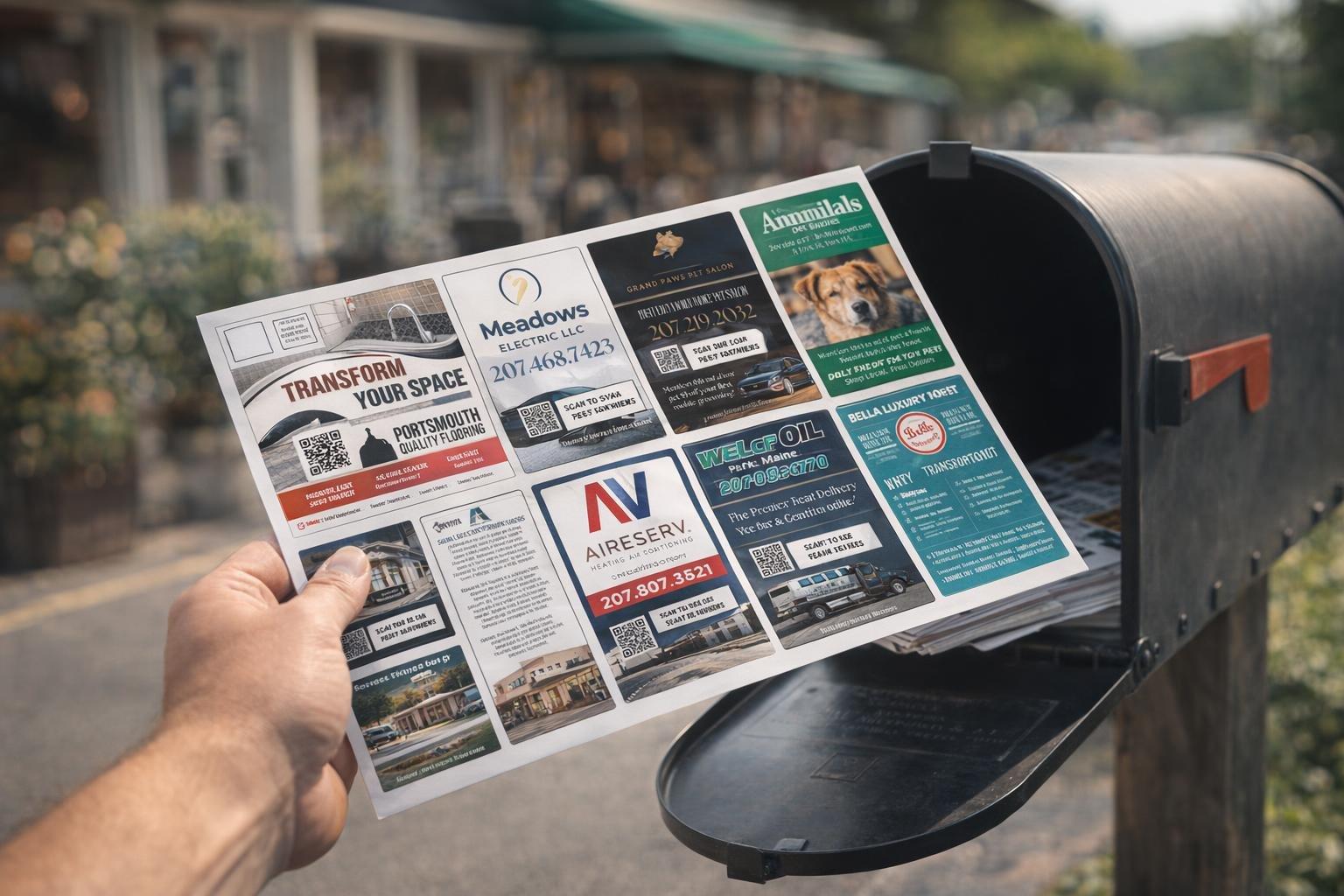
A shared postcard is one big card split between about 16 non-competing local businesses and mailed to every home on chosen USPS routes. You're the only plumber, the only dentist, the only roofer on it. The math is the whole point:
$500 to 5,000 homes
9x12 spot
$250 to 2,500 homes
Community card spot
About 10 cents
Cost per home (both)
About 60 cents a home
Your own solo mailing
That's 5,000 homes for the price of reaching about 830 on your own. And here's what it looks like for real advertisers on our members' cards:
Lucy's Amish butcher got six phone calls the day the cards landed and sold a half beef ($1,600), a half hog, and 100 pounds of ground beef. The voicemail said it all: "I had six phone calls today."
Ryan's dumpster-rental advertiser booked three jobs within days. Each job paid for the ad seven times over.
Darin's HVAC advertiser sold a full furnace plus install from one card.
Ben put his own knife-sharpening ad on a card and booked his first client 14 days after it mailed.
I won't pretend every ad does that. Nobody can promise you customers. What you're buying is your name in 5,000 mailboxes, and you're the only one in your industry on the card.
USPS Every Door Direct Mail lets you mail every home on a carrier route without buying a list. Postage is $0.26 per piece as of July 12, 2026, and the minimum is 200 pieces per mailing. Real numbers from our price sheet for a 9x12:
$779
1,000 homes, All Inclusive
$2,999
5,000 homes, All Inclusive
$2,609
5,000 Print Only + postage
Print Only means you do the bundling, paperwork, and the Post Office trip yourself ($1,309 printing plus $1,300 postage). All Inclusive means we print, pack, pay the postage, and ship it to the Post Office. If you want to do it yourself, here's how to mail your own flyer step by step, and the free EDDM route planner shows how many homes are on each route around you.
Prices are all over the map and usually come with a contract. One of our members priced his area and said the cheapest newspaper ad was "like 1,500 a month with a contract," and a radio contract he was quoted at 20 to 25 grand. That doesn't make them bad. It means they fit businesses with steady budgets that can commit for months, because repetition is what makes them work.
Billboards are everywhere. But think about how they work. On one of our member interviews, it came up perfectly: a billboard depends on "somebody driving by and in the moment looking up," and they're not stopping the car to write your number down. So a billboard builds recognition, and it works best alongside something people can hold. A wrap on your own truck works the same way, except you pay once and it rides around with you every day. I don't have a sourced price for either, and they swing a lot by market, so get real quotes.
Full transparency, I teach all of this inside the community, mostly to people selling ads to local businesses. You don't need it to try any idea on this list. But if you want to be the one running the shared card in your town, that's where we hang out.
Free. A complete Google Business Profile, reviews from every customer, local Facebook groups, and referral swaps cost nothing but time. For paid reach, a spot on a shared postcard is about 10 cents a home ($500 to 5,000 homes), and Google Ads lets you cap spend, since a $10 daily budget can never bill more than $304 in a month.
Not on Google. Google's policy bans offering payment, discounts, or free goods or services for reviews, and bans asking only happy customers. The FTC rule that took effect October 21, 2024 bans buying reviews that must be positive. Asking every customer for an honest review is fine.
There's no magic percentage, and anyone who gives you one is guessing. Pick an amount you can repeat three times without stress, test one idea with it, and track what comes back. Repetition matters more than the size of any single ad.
For a lot of local businesses, yes, because it reaches every home on a route, not just people who happen to search or scroll. The cost depends on how you do it: a solo 9x12 mailing to 5,000 homes is $2,999 All Inclusive with us, while one spot on a shared card is $500 to the same number of homes.
No. Putting anything without postage in a mailbox is a federal offense under 18 U.S.C. 1725. Mail it through USPS (EDDM needs no mailing list), hang it on the door, or hand it to people.
Regular Google Ads charge per click. Local Services Ads charge per lead, carry the "Google Verified" badge after Google screens your business, and are built for service businesses like plumbers and cleaners. They aren't available with the badge for auto, beauty, or dining businesses.
Whether you mail a single postcard or not, I hope you're absolutely killing it at life. As always, I'm rooting for you.
Ready to run your own card?
Get the course, scripts, tools, and weekly coaching inside the 9x12 Method community.

 Mitchell Tebo