EDDM tracking explained: what USPS shows you, how to confirm delivery with seed homes and first scans, the refund rule, and what to tell advertisers meanwhile.
You dropped 5,000 cards at the Post Office, sixteen advertisers paid you $500 each, and now every one of them is asking the same thing: "Did it go out yet?" So you go looking for EDDM tracking, a little box where you type in a number and watch your cards roll down Main Street. Bad news first. That box doesn't exist. Good news: you can still know your cards landed, and prove it, if you know where to look.
Not the way a package does. Here's the thing. A package has a barcode that gets scanned at every stop. An EDDM Retail card is addressed to "Postal Customer," carries the EDDM indicia, and goes out with your carrier's regular mail. USPS's own EDDM terms describe it in one line: pieces "are delivered with the day's mail to the target areas selected by the mailer." There's no piece-by-piece scan for you to follow to the mailbox.
And USPS doesn't promise a delivery date either (more on timing below).
So when a vendor shows you a "Delivered" status for an EDDM job, ask what it's based on. One big online mailer's help page says it flat out: USPS doesn't give them delivery confirmation for EDDM, so their "delivered" is an estimate from their own software. That's not a scam. It's just an educated guess wearing a nice badge.
Okay so if there's no single tracking number, what do you have? A paper trail. Four checkpoints, each one proving a little more than the last.
The boxes reach the right Post Office. If your cards ship to the Post Office by Priority Mail, every box has to carry a USPS Tracking label (DMM 146). That number shows you the exact day the boxes were delivered to the Postmaster.
The Post Office accepts the mailing. Your PS Form 3587 gets checked, signed, and date-stamped by the clerk. That stamped form is your proof the mailing was accepted and paid for. Keep it.
Cards show up in real mailboxes. This is where seed homes come in (more on that below). It's the closest thing you'll get to EDDM delivery confirmation.
Responses start. A QR scan, a phone call, a "hey, I got your card" text. Nobody scans a card they never received.
Step 1 says the cards got there. Step 2 says USPS took them. Steps 3 and 4 say people are holding them.
USPS lets you send EDDM Retail bundles by Priority Mail, addressed to "Postmaster" at the Post Office that delivers your routes. The Postmaster Instruction letter that rides in box 1 tells the Post Office to account for every package (1 of 5 through 5 of 5), find your paperwork and payment, and follow its acceptance procedure. So when tracking says "Delivered" on all of your boxes, the Post Office has everything it needs to start.
Your stamped 3587 is the receipt. If you're doing your own drop, the EDDM drop-off checklist walks through what the clerk checks so you get that stamp on the first trip. Snap a photo of it before you leave the counter.
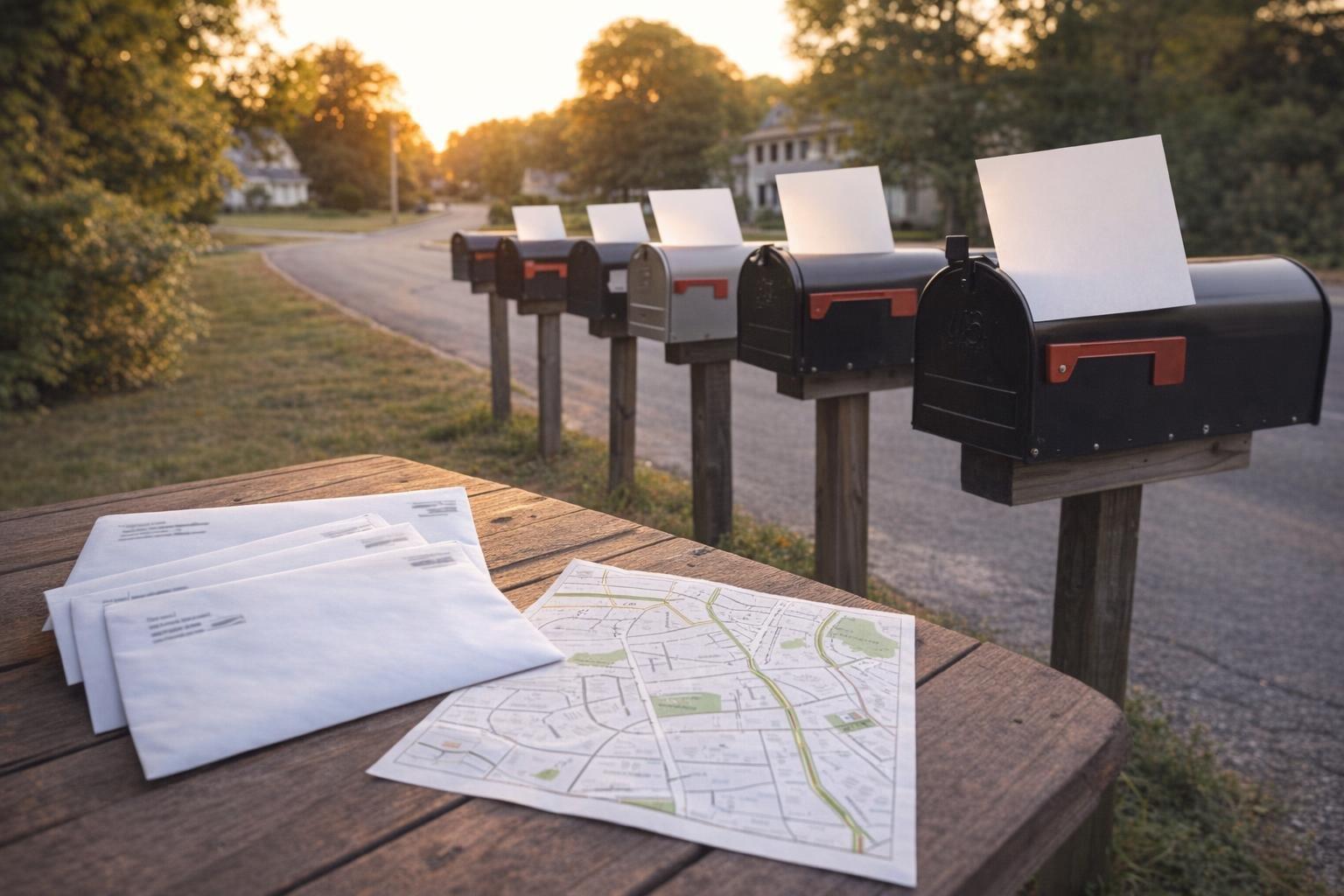
Here's the trick nobody on page one of Google really explains. You can't track a card, but you can plant people on your routes.
When you pick your routes, look at who you know who lives on them. You, your mom, a buddy, a past customer, and honestly, your advertisers. A dentist whose office sits on one of your routes works too, but only if you mailed to every delivery, not residential only. Then ask them one thing: "Text me the day the card shows up."
Why this works: EDDM covers every delivery on a route (or every residential delivery, if that's what you picked). So if your friend on route C012 got one, the carrier on C012 is out there doing it.
A few rules so you don't panic over nothing:
Get more than one seed per route if you can. One person missing a card proves very little. Mail gets grabbed by a spouse, tossed with the junk, left on the counter.
Pick seeds across your routes. If you mailed four routes from two Post Offices, you want a seed from each.
Expect a spread. Different carriers, different days. One seed getting it Tuesday and another Thursday is normal.
A few houses missing isn't a failed mailing. On one of our coaching calls, a member who preps his own bundles asked how exact the counts need to be, and guessed that a short bundle just means "you miss two or three houses." The answer on the call: it's "not that crucial" as long as it's close. That's the nature of mail. What you're watching for is a whole route that goes quiet.
Probably not, and this trips a lot of people up. USPS says Informed Delivery shows images of "letter-sized mailpieces that are processed through USPS's automated equipment," plus color images of some things like catalogs or magazines. A 9x12 isn't letter-sized. In USPS terms it's a flat. So if your seed checks their Informed Delivery email and doesn't see your card, that doesn't mean anything. Have them check the actual mailbox.
Seed homes tell you cards are out. Responses tell you people are reading them.
Travis, one of our members, came on a coaching call the week his first card hit. Here's how he knew it landed: "Had a few customers have already relayed getting that, seeing some scans... The realtor got a scan, the cabinet company got three." He'd also put his own photo on the card, and people he knew in the neighborhood started messaging him: "Dude, you're in my mailbox."
That's the whole system right there. Scans, calls, and neighbors texting you.
So give every advertiser their own QR code. ScanLab does this, and the first QR scans (not to be confused with USPS barcode scans) double as your delivery signal. Once the scans and calls start rolling, this stops being a delivery question and turns into a results question. That's when you switch over to tracking the calls and the money for each advertiser.
Nobody scans a card that never made it to the mailbox. Your first QR scan is the best delivery confirmation you'll ever get.
Let me be really clear here, because people get burned on this. USPS doesn't promise a number. You'll see vendor pages that say 3 to 10 business days, others that say a week or two. None of them cite USPS, because USPS doesn't guarantee one.
What I'd do:
Plan on our members' typical experience (cards usually land 3 to 5 days after the drop), but never promise an advertiser a date.
Never time an advertiser's offer tight to the drop. If the pizza place wants a "this weekend only" deal, that's the wrong offer for a mailer.
Start asking questions if a full week passes after the Post Office accepted the mailing and none of your seeds have it and there are zero scans across 16 advertisers. That's when you pick up the phone. Before that, you're mostly just anxious. (I get it. I've been there.)
Okay, worst case. A week goes by, a whole route is silent, or worse, somebody finds a stack of your cards in an apartment lobby. It happens. In 2025, WPXI in Pittsburgh reported on a local realtor whose mailers were found dumped. USPS investigated, apologized, refunded her for the undelivered postcards, and asked customers to report problems like it.
Here's the order I'd go in:
Confirm it's real. Check the box tracking, your stamped 3587, and every seed on the affected route. Make sure you dropped at the Post Office that actually delivers those routes. Dropping at the wrong Post Office is an easy way for an EDDM job to go sideways.
Call the delivering Post Office. Ask for the Postmaster or supervisor. Give them the date, the route IDs, and the piece count from your 3587. Be friendly. They're the ones who can walk back to the carrier and ask.
Document everything. Photos of any dumped cards (where, when), your stamped 3587, seed texts with dates.
Know the refund rule. For EDDM Retail, USPS's terms allow a refund only when USPS systems show no barcode scan events and no other evidence of delivery. Requests are accepted up to 30 days from the expected drop-off date you chose. If you paid online, it's the Refund button in your order history; if you paid at the counter, it's the Post Office where you paid. The refund goes back to your card within 30 days. Honestly, once a Post Office has accepted and stamped your mailing, a refund is a long shot, but it's worth knowing the rule. And if you printed All Inclusive with us, you didn't buy the postage, so the refund isn't yours to file: email us with the route IDs and what you found.
Talk to your advertisers before they talk to you. More on that next.
If you mailed through a permit at a business mail entry unit instead (the BMEU route), those refunds go through that BMEU on PS Form 3533, and USPS wants proof the mailing wasn't delivered.
One more thing worth knowing: simplified-address mail that can't be delivered is thrown away, not returned to you. So no, you won't get a box of "undeliverable" cards back as a clue. The only feedback loop is the one you build.
This is honestly the part that matters most for your business. Your advertisers don't care about DMM sections. They care that their $500 is out there working. So keep them updated before they have to ask. On our side, while the cards print, I tell operators to be communicating with advertisers the whole time, "keeping them updated along the way."
Here's the update rhythm I'd use:
Cards shipped: "Your cards are on their way to the Post Office," plus a photo of the stacks. If you go with us for fulfillment, the stack photos show up on your order page when the cards ship. Send them straight to your advertisers. It shows them the true scale of what they bought.
Post Office accepted: "USPS has the cards. Carriers deliver them with the regular mail over the next several days."
First seed or first scan: "First cards are in mailboxes! My neighbor on Oak Street just got hers." Add a screenshot of the first scans if you have them.
And here's a simple text you can copy:
"Hey [Name], quick update! The card was accepted at the Post Office on [date]. USPS delivers it with regular mail, so it'll hit homes over the next several days. Keep an eye out for calls that mention the card, and I'll send you your first scan numbers as soon as they come in."
Notice what's not in there: a delivery date. Never promise one. Promise updates instead.
This is also the foundation of your renewal. The advertiser who got four updates and a scan report is way easier to sign for card two than the one who heard nothing for three weeks. That's the whole idea behind advertiser renewals: the second sale starts the day the first card mails.
Full transparency, I do have something to sell you here, and you totally don't need it to do any of the above. If you print with us on All Inclusive, we handle the print, packing, postage, and USPS fulfillment for $2,999 for a 9x12 to 5,000 homes. On a sold-out card that's $8,000 in, $5,001 profit. Your order page shows where the order stands, you get the stack photos when the cards ship (plus shipment tracking when it's available), and we mail you a pack of extra samples to hand out. Printing is 4 to 6 days plus 2 to 3 days of shipping to the Post Office.
What we can't do is the same thing nobody can do: give you a live dot on a map for every card. Delivery after the Post Office is in USPS's hands. So the seed homes and first scans are still your job, and they're still the best proof you've got.
If you're doing your own drops on Print Only, you'll pay EDDM Retail postage yourself ($0.26 a piece as of July 12, 2026), and the 3587 stamp and your box tracking are all on you. Totally doable. Just keep the receipts.
And if you want help with any of this, there are 2,800+ operators inside the community, plenty of whom have been through their first drop, and you can ask them anything. You don't need it to get started, but it'll save you some stress on drop week.
Not for individual cards. EDDM pieces are delivered with the day's regular mail and don't get a piece-level scan you can follow. You can track the boxes if they're shipped to the Post Office by Priority Mail, and your stamped PS Form 3587 proves the mailing was accepted. After that, seed homes and first responses are how you confirm delivery.
Plant seed homes on your routes: friends, family, or advertisers who live there and will text you the day the card shows up. Then watch for first QR scans and calls. If a whole route stays silent a week after the Post Office accepted it, call that Post Office.
USPS doesn't guarantee a delivery window for Marketing Mail, which is the class EDDM belongs to. In our members' experience, cards usually land 3 to 5 days after the drop, but that's experience, not a USPS promise. Leave a cushion before any advertiser deadline.
Sometimes. For EDDM Retail, USPS's terms allow a refund only when its systems show no barcode scan events and no other evidence of delivery, and you have to ask within 30 days of the expected drop-off date. Online orders use the Refund button in order history; counter purchases go back to that Post Office. On All Inclusive, you didn't buy the postage, so email us instead.
Not necessarily. Each route has its own carrier, and EDDM goes out with the day's regular mail, so one neighborhood can get your card on a different day than another. That's why you want a seed home on more than one route.
They're thrown away, not returned. Mail with a simplified address like "Postal Customer" that can't be delivered isn't sent back to you, so you won't get leftovers as a clue. Your seed homes are the feedback loop.
Look, the cards almost always get there. But "almost always" isn't something you can screenshot for an advertiser, so build the paper trail anyway. As always, I'm rooting for you.
Ready to run your own card?
Get the course, scripts, tools, and weekly coaching inside the 9x12 Method community.

 Mitchell Tebo