EDDM vs targeted direct mail with real USPS postage: 26 cents vs 50 cents to $1.26 a piece, the permit and list costs nobody mentions, and when each one wins.
Every mailing vendor has an opinion on this one, and funny enough, it's usually whichever thing they sell. So let's do it with numbers instead. EDDM vs targeted direct mail comes down to one question: is your customer "anybody who lives near me," or a specific kind of person you can't spot on a map? Get that right and the choice almost makes itself.
Full transparency up front. I sell 9x12 printing and EDDM mailing, and I run a community for people who sell ad spots on shared postcards. So yes, I have a horse in this race. That's exactly why every price below comes straight from the USPS price list, dated, so you can check me.
Here's the thing. Both are real mail in a real mailbox. The difference is who gets it and how the Post Office knows where to take it.
EDDM (Every Door Direct Mail) goes to every address, or every home, on the carrier routes you pick. No names. No addresses. Each piece just says "Postal Customer." If you're new to it, here's how EDDM works start to finish.
Targeted direct mail goes to a list of specific names and addresses you buy, rent, or already own. Pool owners. New movers. Your past customers. Each piece carries a real address, and you pay addressed postage on every one.
Feature
EDDM
Targeted (list) mail
Who gets it
Every address (or every home) on your routes
Only the addresses on your list
List needed
No
Yes, bought, rented, or your own
Postage for a 9x12 flat (Oct 4, 2026)
$0.26 (EDDM Retail)
$0.504 to about $1.30, depending on how it sorts
Mailing permit
Not for EDDM Retail
Yes, yours or your mail house's
Minimum
200 pieces per mailing
200 pieces (Marketing Mail) or 500 (presorted First-Class)
Personal name on the piece
No, "Postal Customer"
Yes
Best for
Local services almost everyone uses
Narrow customers you can't find on a map
So if you're a pizza place, a plumber, an HVAC company, a dentist, a roofer? You're an every-door business. If you clean pools, sell to other businesses, or want people who moved in last month? A list starts to make sense.
Here's where most comparison pages get fuzzy. They give you a range with no date, or no numbers at all. So here are the real ones, straight off USPS Notice 123, the official price list, effective October 4, 2026. These are postage only, for a big 9x12 card, which USPS calls a "flat."
$0.26
EDDM Retail, per piece
$0.504
Addressed flat, Carrier Route Basic
$0.783
Addressed flat, 5-Digit automation
$1.260
Addressed flat, Mixed automation
$1.299
Addressed flat, Mixed, no barcode
Why the spread on the addressed side? Because USPS prices addressed mail by how finely it's sorted. If your list is clumped tightly on a few routes, it sorts deep and costs less. If it's scattered all over a region, it sorts shallow and costs more. Skip the barcodes and it costs more again. A rented list of "homeowners in three counties" usually doesn't land in the cheap column.
To be fair to the list side, nobody says a list mailing has to be a giant 9x12. Shrink the piece and the addressed price drops:
Presorted First-Class postcard (commercial cards can go up to 6 by 9 inches): $0.453 to $0.495 a piece, with a 500-piece minimum.
Letter-size piece in USPS Marketing Mail: $0.395 a piece at 5-Digit automation.
A stamped 4x6 postcard: $0.65.
All Notice 123 prices, effective October 4, 2026. But notice what happened. Even the smallest addressed card mailed to a list costs more in postage than a full 9x12 by EDDM at 26 cents. EDDM Retail only takes flats, so with EDDM you basically get the big card for the small-card price. That's the whole beauty of every door.
Postage is just the line people compare. Targeted mail comes with a few extras the vendor pages tend to skip. Let me break it down.
Buy or rent the list. List vendors price by the thousand and by every filter you add (income, age, home value, new movers). Prices swing a lot by vendor, so get two quotes before you believe either one.
Get a mailing permit. If you mail it yourself with a permit imprint, USPS charges a $390 permit imprint application fee plus a $390 annual mailing fee (Notice 123, October 4, 2026). That's $780 before your first piece goes out. If you use a mail house, they have a permit, and they charge you for their work instead.
Clean the list. Commercial Marketing Mail and presorted First-Class both fall under the USPS Move Update standard (DMM 243.3.9), which means matching your addresses against change-of-address records. Mail houses do this for a fee.
Hit the minimum. USPS Marketing Mail needs at least 200 pieces or 50 pounds per mailing. Presorted First-Class needs 500 (DMM 233.3.1.2).
Print, address, sort, and haul it in. Every piece needs its own address and the right sort, which is real work or a real fee.
With EDDM Retail, there's no list to buy, no permit, and no Move Update. You pick routes on a map and drop the bundles at the Post Office. That's honestly why the whole shared postcard business runs on it. Like I tell people on YouTube: "with EDDM, you don't need a mailing list. You don't need the 5,000 addresses or the names of the people living there."
Okay so let's make it concrete. Say a list vendor finds you 1,000 homes that fit your customer.
Postage to that list, as 9x12 flats: about $1,021 if it sorts to 3-Digit with barcodes, $783 at best if it's dense enough for 5-Digit, and up to about $1,300 without barcodes.
Postage for 1,000 doors by EDDM Retail: $260.
That's postage against postage. The list side still needs the list, printing, addressing, and a permit or mail house fee. On the EDDM side, our All Inclusive price for 1,000 9x12 cards is $779, and that covers printing, postage, and the Post Office drop. One honest catch: EDDM goes by whole routes, and routes rarely add up to exactly 1,000. So you size the print run to your routes, and with us any door over the print run adds 26 cents in postage. If you want every line of that math, here's what a solo EDDM mailing really costs.
Different audiences, obviously. The list reaches your exact 1,000 people. EDDM reaches about 1,000 doors on routes you chose. But that gap is the whole decision in one picture: a list has to be good enough to be worth paying more for every single door. Sometimes it is. Often it isn't.
I'm not going to pretend EDDM wins every time. It doesn't. A list makes more sense when:
Your customer is invisible on a map. Pool owners, people with a certain car, households that just moved in. You can't pick a carrier route for "has a pool." A list can.
You sell to businesses, not homes. A commercial cleaner or a B2B service wants office managers, not every house on Elm Street.
You're mailing your own customers. Your past customers are the warmest list you'll ever have, and you already own it. Mail them a reason to come back.
You need a name on the piece. EDDM pieces say "Postal Customer." If your offer depends on "Hey Sarah, your filter is due," that's a list job.
Your area is huge and your customers are rare. If one in fifty homes is a fit, paying for 49 empty doors gets expensive fast.
Every door makes more sense when nearly every household around you could become a customer. That's most local service businesses: HVAC, plumbing, roofing, landscaping, dentists, chiropractors, restaurants, auto shops. Everybody has a furnace. Everybody eats. Everybody's teeth hurt eventually.
For those businesses, a list just charges you extra to find people who are already on the routes. And here's the part a lot of people miss: the reason mail works for local services is timing. Not everybody needs a plumber today. But when they do, the card on the counter is the one they remember. You can't buy a list of "people whose water heater breaks next month." Every door covers them anyway.
That's how it plays out on real cards. Lucy's first community card had an Amish butcher on it. The day the cards landed, he got 6 phone calls and sold a half beef for $1,600, a half hog, and 100 pounds of ground beef. Nobody bought a list of "people who want half a cow." The card just showed up at the right doors.
Boring businesses that everybody needs are exactly the ones that should mail every door.
Here's the part the "EDDM vs list" debate skips. EDDM isn't untargeted. You just target with routes instead of names.
Listen, here's a mistake that's really easy to make. Picture this: you pick 5,000 doors on the USPS map, it looks great, the cards go out, and your roofer client gets nothing. Why? Half of those routes were apartments, and renters don't buy roofs. The fix wasn't a mailing list. The fix was picking better routes.
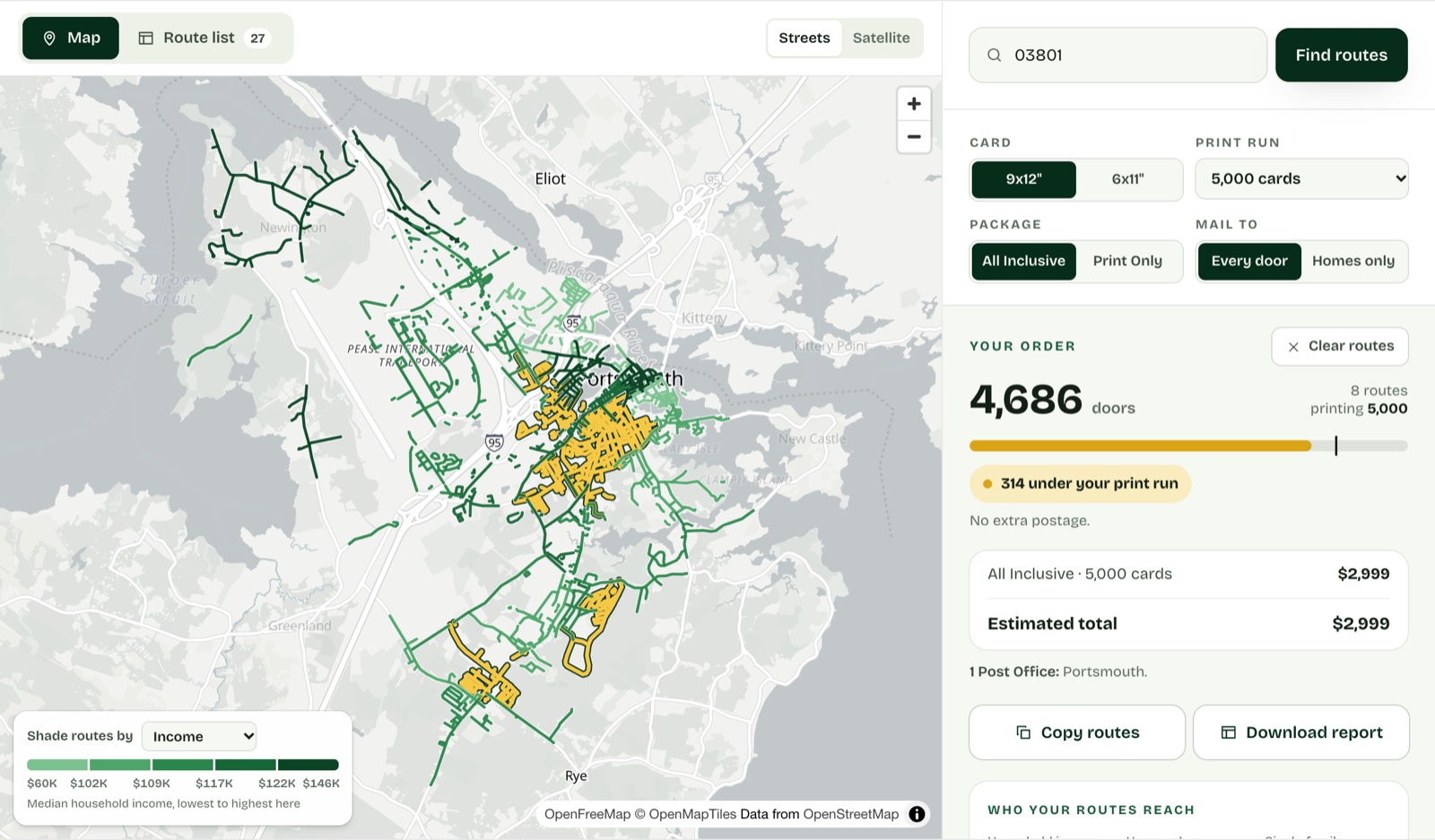
That's why I built our free EDDM route planner. It shades every carrier route by U.S. Census data (median household income, home values, single-family share, owner-occupied share) so you can skip the apartment-heavy routes before you print a thing. And there's a "Homes only" switch, because EDDM lets you mail every residential address on a route instead of every address, businesses included.
So for "homeowners," "higher-income neighborhoods," or "single-family homes," you usually don't need a list. You need to pick EDDM routes on purpose. My rule of thumb for homeowner businesses like roofing and HVAC: favor routes that are 70% or more single-family homes. That's my rule, not a USPS number.
What EDDM can't do is skip single houses. It's the whole route or nothing. If you need house-by-house precision, that's the list.
You'll see one more term thrown around, so let me clear it up. Saturation mail is the USPS name for mail that goes to all or nearly all of the addresses on each route it covers. EDDM is one kind of saturation mail, the kind with no names and "Postal Customer" on it.
There's also addressed saturation mail: you buy a list that covers basically every address on a route, put names on it, sort it in delivery order, and mail it under a permit. Notice 123 lists that at $0.308 a flat with no entry discount (October 4, 2026). Honestly, that's mail house territory. The 90 percent and 75 percent coverage thresholds you'll read about apply to that addressed version, not to EDDM.
Targeted mail is the opposite end. Only the addresses on your list, wherever they are.
Look. If you're a small business and every-door mail fits you, there's one more option that beats both. A shared postcard. A local operator mails one big 9x12 with about 16 non-competing businesses on it, and you buy one spot. A $500 spot to 5,000 homes is 10 cents a home. A $250 spot on a 6x11 community card to 2,500 homes is the same 10 cents.
Bruce, one of our members, spent 35 years in printing, mostly for real estate agents. He used to sell them their own targeted postcard mailings. He prices his realtor spot per 1,000 cards, which works out to about 20 cents a home, and he tells them this: "it's only going to cost you 20 cents compared to actually, you know, having her spending 90 cents." His realtor spot is dead simple: a dark box, "find out the value of your home," and a QR code. He says one of his agents landed a million-dollar listing, then a $1.3 million listing, then a $4.3 million one. If you're an agent, my full guide to real estate postcards covers when your own farm mailing still makes sense.
The trade-off is space. Your ad is a box on a big card, not the whole card, and you mail when the operator mails. You can find operators in a lot of towns on the Our Local Spotlight map, and here's the full rundown on shared postcard advertising before you buy a spot.
And if you'd rather have the whole card to yourself, our EDDM mailing page for business owners handles design, printing, postage, and the Post Office drop.
Write one sentence about your best customer. "Homeowners within 10 miles" or "people with a pool."
Ask whether you could see that customer on a map. If it's a neighborhood type (homes, income, owners), go EDDM and choose routes with the route planner. If it's a trait you can't see from the street, get a list quote.
Do the per-door math with the postage table above. Then add the list, the permit or mail house fee, and printing.
Figure your break-even. Divide the full cost of the mailing by what one new customer is worth to you. That's how many customers it takes to pay for itself.
Track it. Put a code, a QR, or a unique phone line on the card so you know what worked, then mail again. One drop is a coin flip. A few drops is a test.
Here's how that sentence usually shakes out for common businesses:
Business
Usually
Why
HVAC, plumbing, roofing
EDDM, homeowner routes
Every house has the system; skip apartment-heavy routes
Restaurants, pizza, coffee
EDDM, every door
Everybody nearby eats, renters included
Dentists, chiropractors
EDDM
Nearly every household is a possible patient
Landscaping, pest control
EDDM, single-family routes
You want yards, which a route map can show
Real estate agents
EDDM farm or a shared spot
The farm is a neighborhood, not a name list
Pool service
Mailing list
"Has a pool" doesn't show up on a route map
Commercial cleaning, B2B
Mailing list
You want businesses, not homes
Any business, repeat sales
Your own customer list
Warmest list you'll ever have
That's it. It is that simple. Don't let anybody (including me) talk you into a channel before you've written that one sentence about your customer.
Per piece, yes. EDDM Retail postage is $0.26 for a flat up to 3.3 ounces, while the same 9x12 flat mailed to a list runs $0.504 to about $1.30 depending on how it sorts (USPS Notice 123, October 4, 2026). A list also adds the list cost and a permit or mail house fee. A list can still pay off if it cuts out a lot of homes that would never buy.
Not by person, but by route. You pick carrier routes, and our free route planner shades each one by Census data like median income, home value, single-family share, and owner-occupied share. You can also mail only the residential addresses on a route. You can't skip individual houses.
To mail at commercial prices yourself with a permit imprint, yes. USPS charges a $390 permit imprint application fee and a $390 annual mailing fee (Notice 123, October 4, 2026). Most people who mail to a list use a mail house that already has a permit and charges for its service. EDDM Retail needs no permit.
USPS Marketing Mail needs at least 200 pieces or 50 pounds per mailing, and presorted First-Class Mail needs at least 500 pieces. Below that, you're paying single-piece prices, like a $0.65 postcard stamp. EDDM Retail needs 200 pieces per mailing (not per route).
No. EDDM pieces are addressed to "Postal Customer" with the EDDM Retail indicia, and the carrier delivers them to every address (or every residential address) on the route. If you need names or a personal offer, that's a job for a mailing list.
It can make sense. A common setup is EDDM to the neighborhoods around your business to find new customers, plus a mailing to your own past-customer list to bring people back. Track each one with its own code so you can see which one brings in customers.
As always, I'm rooting for you. Peace.
Ready to run your own card?
Get the course, scripts, tools, and weekly coaching inside the 9x12 Method community.

 Mitchell Tebo