 Mitchell Tebo
A thousand bucks a month doesn't sound like a lot until you try to find it. It's a car payment. It's groceries for a family. It's the difference between "we're fine" and checking your bank app before you buy gas. So if you're searching how to make an extra $1,000 a month, I'm not going to hand you 27 ideas that include selling your plasma and diving for coins in fountains. (Yes, one of the big ranking lists actually has fountain diving on it.)
Here's what I'm going to do instead. I'm going to work backward from the number. What $1,000 "extra" really means after taxes, how many hours it costs on the usual paths, and why in my business it comes down to selling a few more ad slots than you need to cover the printing. Real math, real sources, real people.

First, how much do side hustles actually pay?
Before we plan anything, let's look at reality. Bankrate surveyed 2,616 U.S. adults in June 2025 (699 of them had a side hustle) and published the results on July 9, 2025. Here's what Bankrate's side hustle survey found:
Look at that gap between the median and the average. The average is $885 because a small group of people earns a lot and pulls it up. The typical person, the one right in the middle, makes $200 a month. So $1,000 a month puts you at five times the typical side hustle.
I'm not saying that to scare you off. I'm saying it because every list on page one makes $1,000 sound like a weekend project. For most people doing the usual stuff, it isn't. Like I said in a video about this exact survey, "You would literally make more money picking up a second shift at a gas station."
That's not the end of the story though. It just means you have to pick the right kind of side hustle. Not more effort. A different setup.
Is $1,000 a month gross or what you keep?
This is the part nobody on page one talks about. Not one of the top-ranking articles I read mentions taxes. Not once.
If you earn side money as a freelancer, an independent contractor on a gig app (the kind who gets a 1099, not a W-2), or a small business owner, you're self-employed for that income. A second regular job is different: it's W-2 pay, so there's no self-employment tax, and taxes come out of each paycheck like your main job. And the IRS wants its piece in two ways.
Self-employment tax
On a regular paycheck, your employer covers half of your Social Security and Medicare taxes. When you work for yourself, you pay both halves. According to IRS Topic 554:
- The rate is 15.3% (12.4% for Social Security plus 2.9% for Medicare).
- It's figured on 92.35% of your net self-employment earnings.
- You owe it once your net self-employment earnings hit $400 for the year.
- You can deduct half of it when you figure your adjusted gross income.
Let me break it down on $1,000 of profit:
So to keep $1,000 after self-employment tax alone, you need about $1,165 in profit ($1,000 divided by 0.8587). And then regular income tax comes on top of that at whatever bracket you're in, plus state tax where you live. I can't tell you your exact number because it depends on your whole tax picture. A tax pro can, and it's worth the one-time call.
Quarterly payments
Here's the other thing that bites people. The IRS says that if you're in business for yourself, you generally need to make estimated tax payments, and people generally have to pay if they expect to owe $1,000 or more when they file. The due dates are April 15, June 15, September 15, and January 15 of the next year.
Got a day job? The same IRS page says employees can avoid paying estimated tax by asking their employer to withhold more, with a new Form W-4. For a lot of people with a side hustle, that's the easiest way to cover it.
Okay. Now that we know the real target, let's see what it costs on each path.
How many hours to make $1,000 a month?
If your side hustle pays by the hour (driving, delivery, tutoring, cleaning, freelancing), the math is simple and brutal. Hours times rate. A month has about 4.33 weeks. Here's what $1,000 in gross pay takes at a few example rates:
| If you earn | Hours per month | Hours per week |
|---|---|---|
| $15 an hour | 67 | About 15 |
| $20 an hour | 50 | About 11.5 |
| $25 an hour | 40 | About 9 |
| $35 an hour | 29 | About 7 |
These are example rates, not promises. Plug in whatever you'd really earn after the app's cut, gas, and supplies. And if it's self-employed income (gig apps, freelancing), you're aiming closer to $1,165 to keep a thousand after self-employment tax, so add about 16% more hours.
At $20 an hour, that's 11 or 12 hours every single week, forever. Miss a week because your kid's sick, and you missed the goal. That's the real problem with hourly side hustles. The income stops the second you stop.
Hourly work isn't bad. It's honest money, and it's the fastest way to get some cash this month. If you need $1,000 in the next 30 days, pick up shifts. But if you want $1,000 every month without giving up every evening, you need something where one sale is worth more than one hour.
How to make an extra $1,000 a month: the three paths
When you strip away all the listicle stuff, there are really only three paths to an extra thousand a month.
- Trade more hours. A second job, gig apps, freelance hours. Fast to start, capped by your calendar. See the table above.
- Sell stuff. Reselling, Etsy, an online store. You usually buy inventory or pay for ads before you sell anything. I sorted a bunch of these by who pays first in my post on low cost business ideas.
- Sell something with a bigger ticket. A service or product where one sale is worth hundreds of dollars, so a handful of sales covers the month.
Number three is where it gets fun. You still put in hours. But when one sale is worth $250 or $500, each yes pays like a whole day of gig work, so the hours you do put in are worth a lot more.
Don't ask "how do I find 50 more hours?" Ask "what could I sell where one yes pays like a full day of work?"
That's the question that changed things for me. I tried drop shipping. I looked at affiliate marketing. I tried day trading. I was part of that statistic. And then I found a boring little business where one customer pays $500 up front.
The postcard math: why $1,000 is a couple of slots
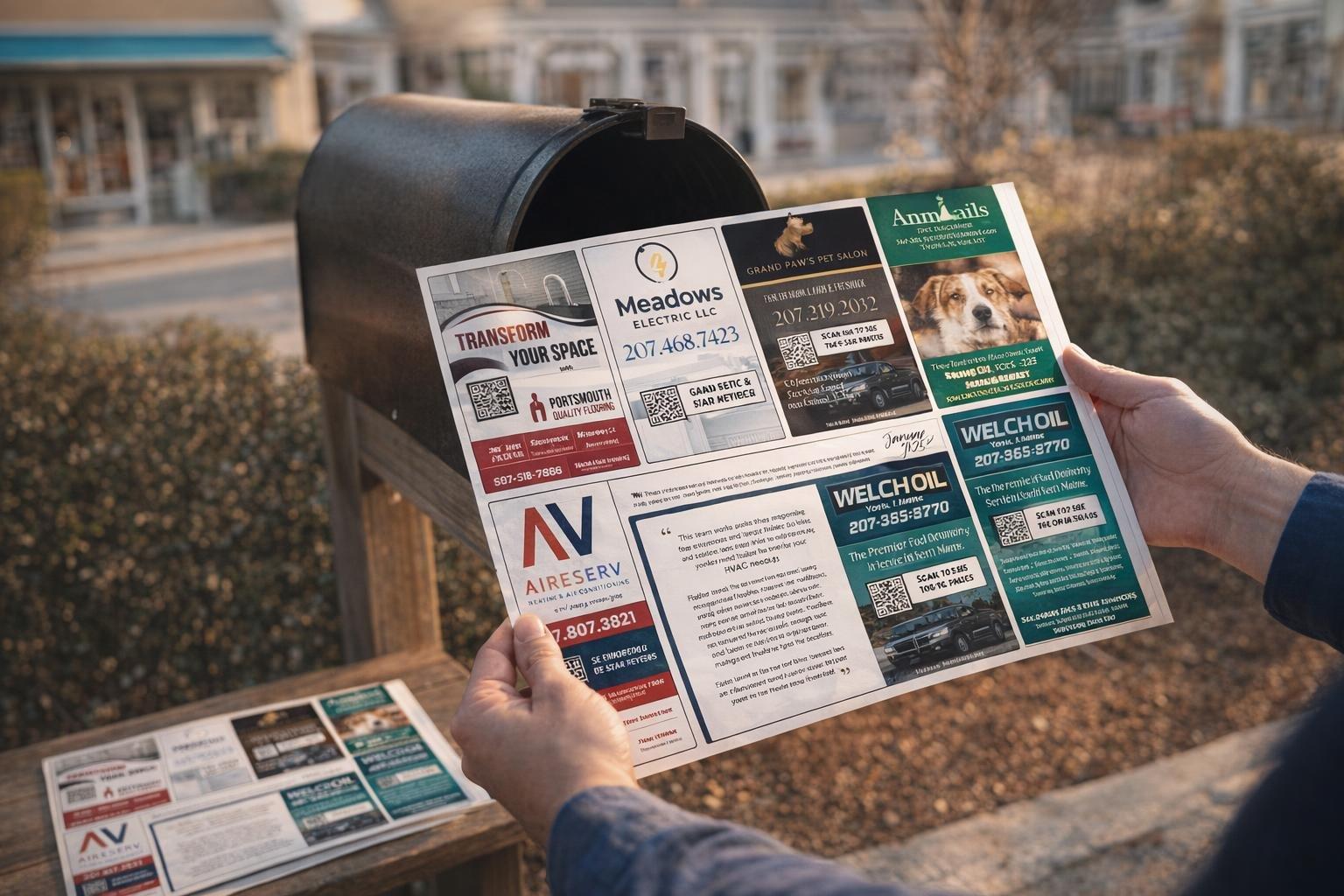
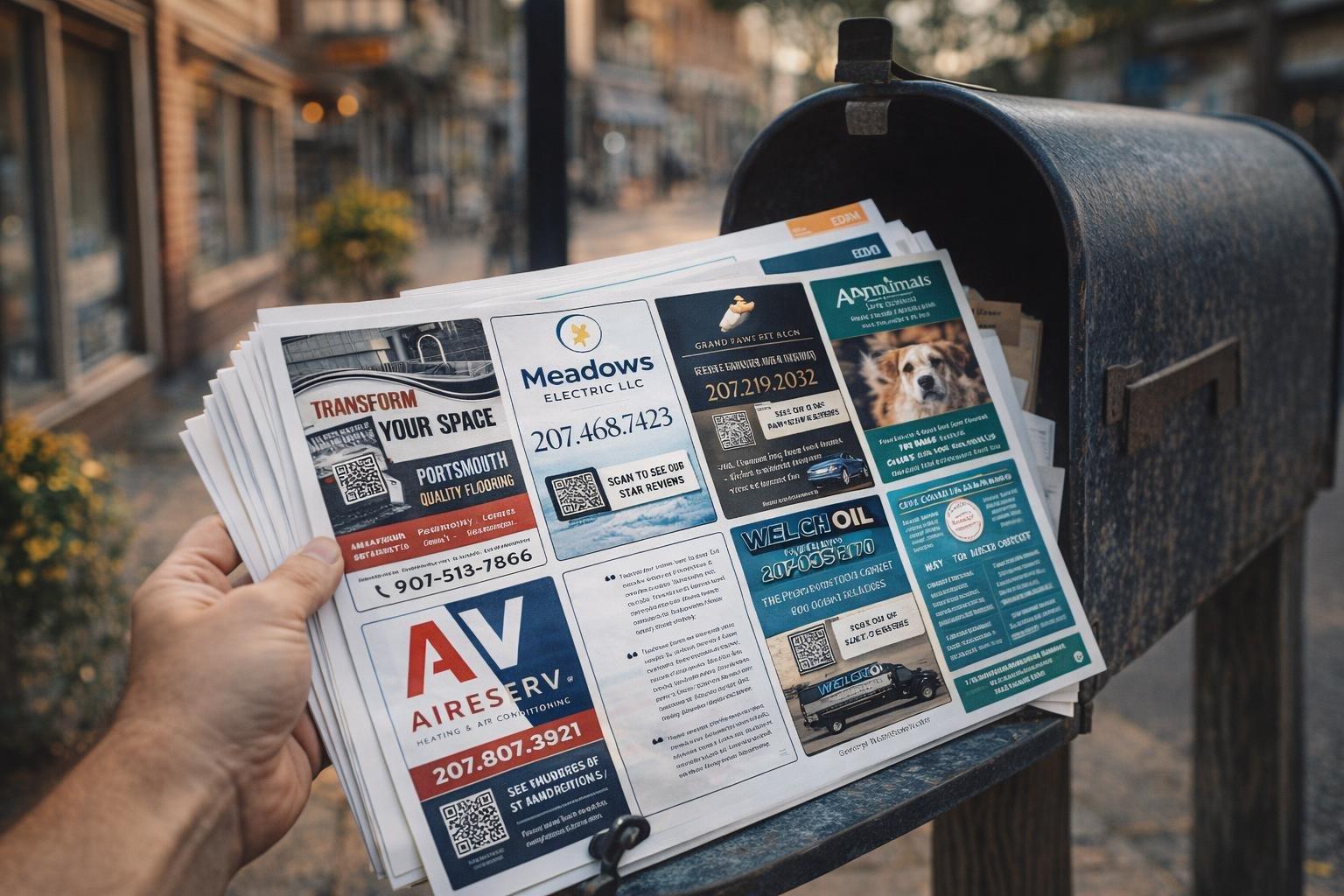
Okay so here's how my business works, quick version. You sell ad slots on a big shared postcard to local businesses, one business per industry. Once the card is sold, it gets printed and mailed to every home on the routes you pick through the Post Office's Every Door Direct Mail program. The businesses pay you before you print anything, so you're never out of pocket.
There are two card sizes most people in our community run.
| Metric | 9x12 card | Community card (6x11) |
|---|---|---|
| Slots | 16 | 16 |
| Price per slot | $500 | $250 |
| Revenue when full | $8,000 | $4,000 |
| All Inclusive print and mail | $2,999 to 5,000 homes | $1,449 to 2,500 homes |
| Profit when full | $5,001 | $2,551 |
Now here's the part I love. Think of every card in two halves.
- On a 9x12, the first 6 slots ($3,000) pay the $2,999 printing and mailing bill. Every slot after that is $500 in your pocket. Slots 7, 8, and 9 are $1,500 of profit, which clears the roughly $1,165 you need to keep a thousand after self-employment tax.
- On a community card, the first 6 slots ($1,500) cover the $1,449 bill. Every slot after that is $250. Slots 7 through 11 are $1,250 of profit, which also clears it.
Of course you want to sell the whole card. A full 9x12 is $5,001 and a full community card is $2,551. Here's what that means for a "$1,000 a month" goal (profit before tax):
Read that first line again. One community card every two months averages about $1,275 a month in profit, which is above the $1,165 you need to keep a thousand after self-employment tax. That's the slow, chill version. You don't need to quit anything. Income tax still applies on top, same as any business income.