Low cost business ideas sorted by who pays first: what each costs before your first dollar, the real catch, the tax bill, and the one where customers fund you.
When I started, I had like $1,000 to my name and no idea where the next dollar was coming from. So I get it. If you're searching for low cost business ideas, you're not looking for a fun list. You're looking for something you can start without betting the little bit of money you have. Here's the thing nobody tells you: the startup cost is the wrong number to look at first. The number that matters is who pays first. You, or the customer.
Every list that ranks for this stuff sorts ideas by a guessed dollar figure. One of the big ones even quotes a "whopping average startup cost of $3,000" with no source behind it. "Start for $25!" Then you find out the $25 version assumes you already own a car, a camera, and a ladder. So I'm doing it differently. I'm sorting these by how the money actually moves, telling you what you buy before you earn a dollar, and being straight about the catch on each one.
Watch: Simple $10K/Month Local Side Hustle AI Can’t Touch (Start With $0) · Summary and transcript
Look. A business that costs $200 to start can still sink you if you're buying inventory every week and waiting a month to sell it. A business that costs $0 can still be a bad fit if it eats 40 hours a week for $12 an hour. So before you pick anything, run it through these three questions:
What do I have to buy before my first dollar comes in? Tools, inventory, software, ads, a license.
Who pays first? Do you spend and then hope people buy? Do you do the work and then send a bill? Or does the customer pay before you spend anything?
What's left after taxes? Side business money isn't take-home pay until the IRS gets its piece. More on that below.
The SBA's startup cost checklist is a good gut check here. It lists licenses and permits, insurance, equipment and supplies, inventory, advertising, printed marketing materials, and a website. Most "start for $25" lists quietly skip half of that.
And here's a number that should make you careful with your money. According to the Bureau of Labor Statistics, 78.9% of new private-sector business locations with employees that opened in the year ending March 2025 were still open a year later. Of the group that opened in the year ending March 2015, only 34.6% were still around ten years later. When a cheap business doesn't work out, you lose a few weekends. When an expensive one doesn't, you can lose your savings.
These are the ones with inventory, equipment, or upfront spending. Not bad businesses. Just more risk than the "$50 to start" headlines suggest.
Reselling and thrift flipping. You buy before you sell. Every item that sits unsold is your money sitting in a bin in your garage.
Handmade products and Etsy shops. Materials, listing fees, and shipping supplies come first. And you're competing with everyone on the internet, not just your town.
Dropshipping and print on demand. No inventory, which is great. But you usually end up paying for ads before anyone buys, and that's where the money goes.
Lawn care and pressure washing. Real local demand, and the customer pays after the job like any service. But you need the equipment and a way to haul it before job one. If you already own a mower and a truck, this moves to the low-risk side. If you don't, it's not really low cost. Like I said in one of my videos, those have startup costs and they're seasonal. (I compared a bunch of these in my post on boring business ideas.)
Service businesses. These really are cheap to start, because you're selling your time instead of stuff.
House cleaning. Supplies and a way to get there.
Dog walking and pet sitting. Leashes, bags, and a lot of trust building. Ask your city about a license and look into insurance before you hold someone's house key.
Tutoring. Your knowledge plus a laptop.
Virtual assistant, bookkeeping, or freelance writing. A computer and internet, and you're open.
Window cleaning and handyman work. Basic tools, a ladder, and some guts.
The catch with this whole bucket: your income stops when you stop. You're trading hours for dollars. That's fine for getting started, and honestly it's a great way to learn how to find customers. It just has a ceiling, because there are only so many hours in your week.
This is the bucket I care about, and the one nobody else's list separates out. These are businesses where you collect the money first and spend it second. Usually it's some form of local advertising, because businesses are used to paying for ad space before the ad runs.
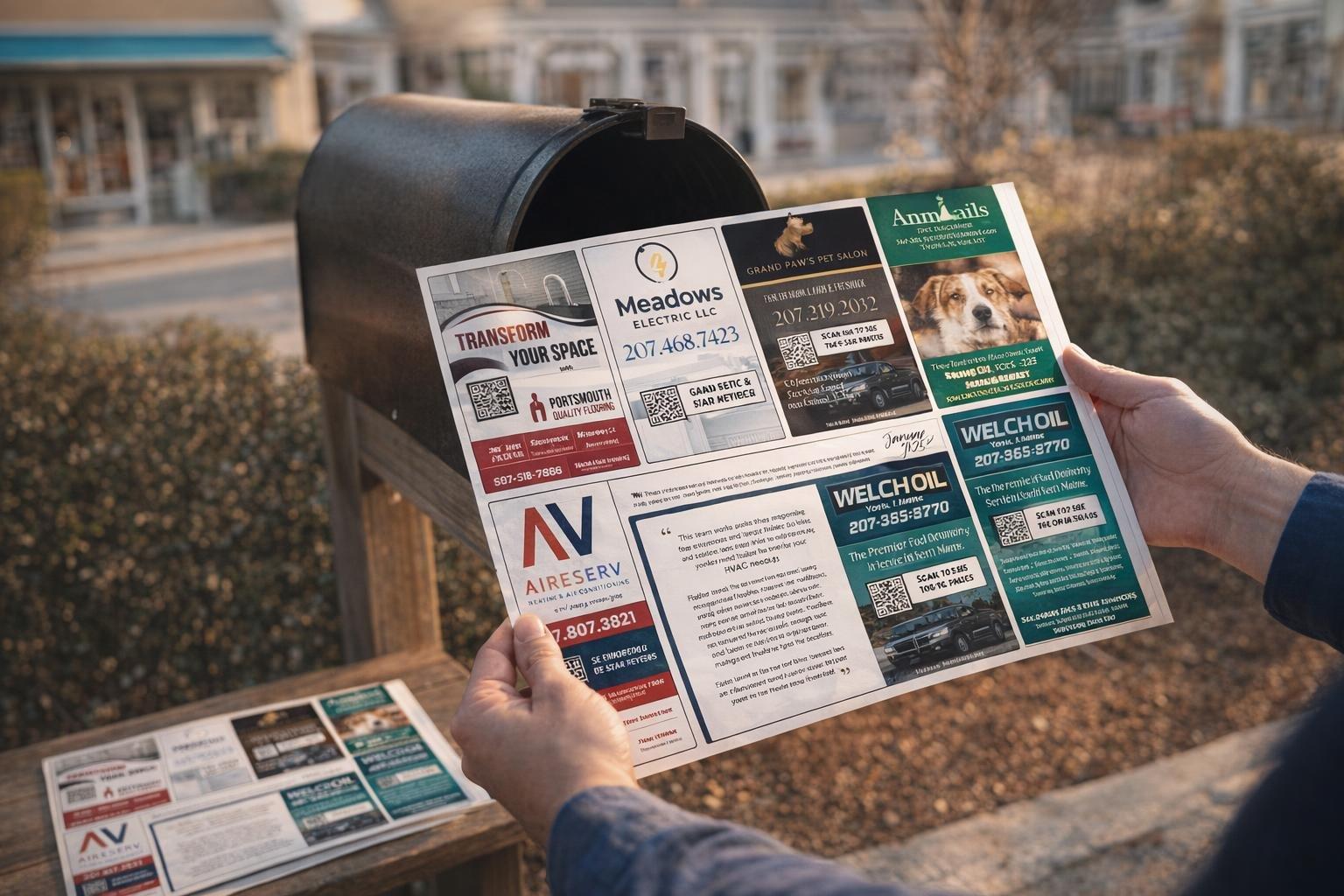
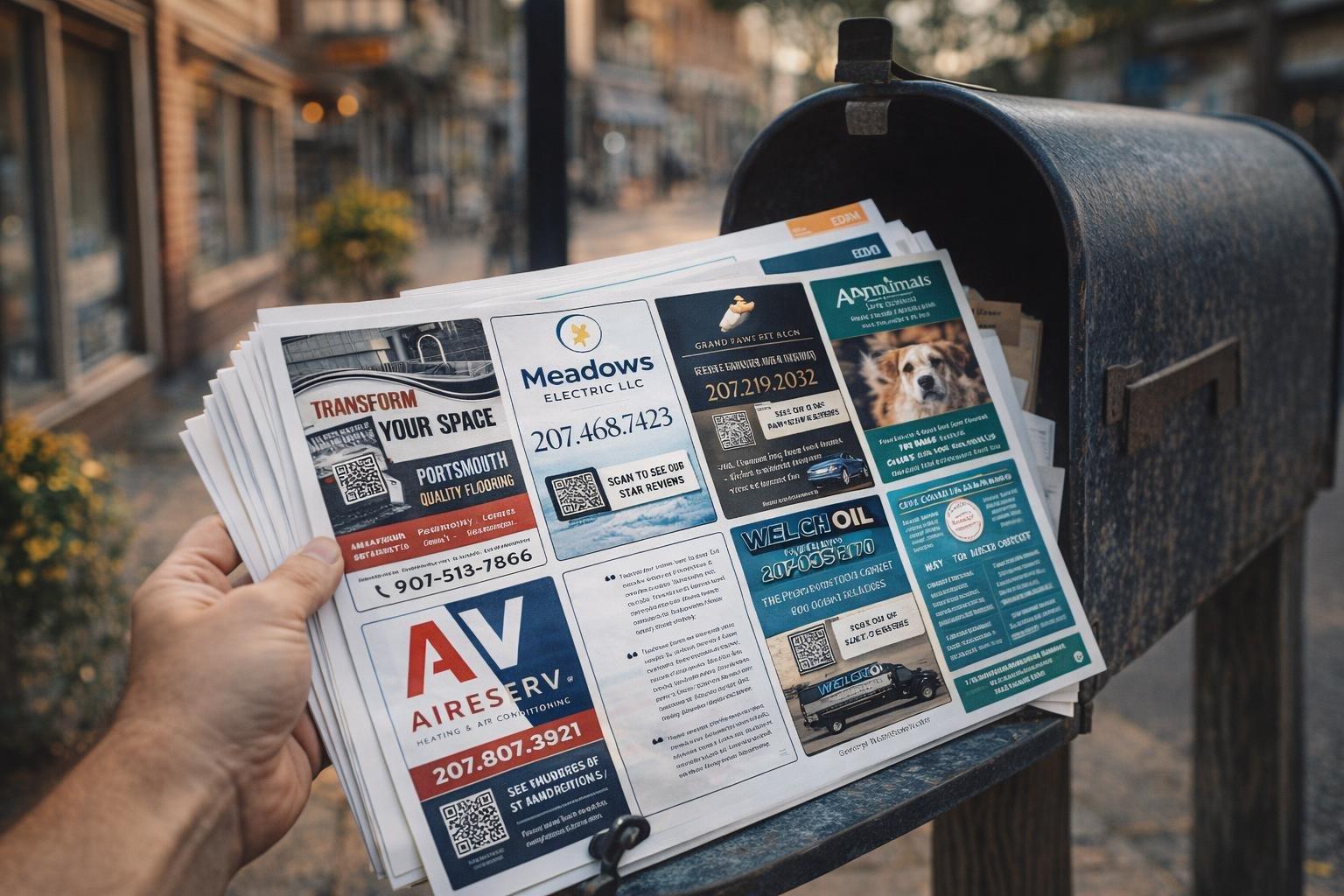
Shared postcard advertising. You sell ad spots on one big postcard to local businesses and mail it to every home in a neighborhood. This is the one I run. Full breakdown below.
A local newsletter with sponsors. A free email or print newsletter for your town, paid for by local businesses. Building the readers is the slow part. Here's how to start a local newsletter from zero.
Door hanger distribution. Businesses pay you to hang their ads on doors. Low cost, and you can ask for payment before you walk, but you're still selling hours. I ran the real numbers on starting a door hanger business if you want to see what you'd earn per hour.
Coupon books. Same idea. Sell the space, collect the money, then print. The catch is the books only work if people actually keep them, so the offers have to be good.
Boring businesses make people wealthy. Mail isn't sexy. That's why it works.
Okay so here's the one I actually know, because I do it every month. It's called the 9x12 Method. You sell ad spots on a giant 9x12 inch postcard to local businesses (one per industry, so no competitors on the same card), then mail it to 5,000 homes through USPS Every Door Direct Mail.
The beauty of this is the order things happen in. You collect from every advertiser first. Then you send the card to print. The plan is that you never pay for printing out of your own pocket: the card only goes to print once the spots are paid for. Here's the math with our real prices:
16
Ad spots per card
$500
Price per spot
$8,000
Collected before printing
$2,999
Print, postage, and mailing
$5,001
Profit per card
$0
Money out of your pocket first
That $2,999 is our All Inclusive print and fulfillment package for 5,000 homes, with postage included. If you'd rather start smaller, there's the community card: a 6x11 card with about 16 spots at $250 each, mailed to 2,500 homes. That's $4,000 collected, $1,449 All Inclusive, and $2,551 profit.
And these aren't just numbers on a slide. Travis builds vehicles in a factory and had zero sales background. He walked into 10 local businesses in one day and 8 of them said yes. Hunter's first sale was a plumber who handed him a check on the spot. Rachel posted once in a local Facebook Group and a roofer bought 12 monthly mailings, paying $3,000 up front. That's what "the customer pays first" looks like in real life.
I'm also not going to round anything up for you. Leland shared his whole first-card breakdown with us: $7,150 collected, $200 on Facebook ads, $150 in discounts, $1,000 in free spots he gave away, and $3,000 for print and postage. He walked away with $3,850. Not the full $5,001, but real money, from a card where the advertisers paid the print bill. Your first card is the hardest one. Everything after gets easier.
If you want the exact order of operations, I wrote a full walkthrough on how to start a postcard business with no money. Full transparency: I do teach all of this inside the 9x12 Method community, with the scripts and templates. You don't need it to get started. Everything in that walkthrough is free.
Whatever you pick, don't spend a month researching it. Test it. Here's how I'd test any of these business ideas under $1,000, without blowing your $1,000 (or your $100).
Pick one idea from the list above. Just one. Bucket 2 or 3 if you're nervous about money.
List everything you'd have to buy before your first sale. If the list costs more than you can afford to lose, pick a different idea or find a way to rent or borrow the gear.
Call your city or county clerk and ask what license or permit you need, then check your state's business filing page for fees.
Make 20 real offers to real people in 7 days. Calls, walk-ins, Facebook Group posts, emails. Not "building a website." Offers.
Collect your first payment. In Bucket 3, collect it before you spend anything.
Set aside money for taxes from every payment, starting with the first one.
Look at what happened. If people said yes, do more of it. If nobody did, change the offer or the idea, not your whole life.
That's it. A week of real offers will teach you more than a month of reading lists like this one. (Yes, I'm aware of the irony.)
This is the part every list skips, and it's the part that bites people in April.
15.3%
Self-employment tax rate
12.4%
Social Security portion
2.9%
Medicare portion
$400
Net earnings that trigger it
Up to $5,000
Startup costs you can deduct in year 1
Per the IRS, self-employment tax is 15.3% (12.4% for Social Security and 2.9% for Medicare), and you owe it once your net self-employment earnings hit $400 for the year. That's on top of regular income tax. So if you clear a few thousand dollars on the side, a real chunk of it belongs to the government. I worked out what that does to a goal like an extra $1,000 a month in a separate post.
The good news: the IRS Schedule C instructions let you elect to deduct up to $5,000 of startup costs in the year your business begins. That limit shrinks once your total startup costs go past $50,000, which is not a problem anyone on this page has. The rest gets spread out over 180 months.
What about an LLC? You don't need one to make your first sale in most cases. A lot of people start as a sole proprietor and form the LLC once they know the business is real. I covered the LLC, sales tax, and insurance questions for postcard businesses in their own post.
Honestly? Pick the one that matches what you've got more of: time, money, or nerve.
More time than money, and you like doing the work yourself: a Bucket 2 service business. Cleaning, tutoring, pet care, VA work. Fast to start, steady, with a ceiling.
Some gear already in the garage: lawn care or pressure washing. Your startup cost is mostly paid already.
Little money, and you're willing to talk to business owners: a Bucket 3 business, where the customer pays before you spend. That's where the postcard business lives.
I'll say what I say about every side hustle: it needs to cost less than a vacation, not feel like you're gambling on your future. Low cost means low risk, and low risk means you get to keep trying until something works. If what's really keeping you up is the economy, I ran the usual "safe" businesses through real recession data in my post on recession proof business ideas. And look, I'm nothing special. So if you're nothing special too, then you're special for this business.
Businesses where the customer pays before you spend anything, like selling local ad space, cost nothing out of pocket. With a shared postcard, you collect from the advertisers first, then pay for printing out of that money. Service businesses like tutoring or VA work are close behind, since you mostly need things you already own.
Most service businesses (cleaning, pet sitting, tutoring, freelance work) and any of the "customer pays first" ideas fit under $1,000. The bigger question is what you'd buy before your first sale and whether you could afford to lose it. Keep some of the $1,000 back for licenses and taxes.
The ones where you aren't trading every hour for a dollar. On a 9x12 shared postcard, 16 spots at $500 bring in $8,000, and $2,999 covers printing, postage, and mailing, which leaves $5,001. Real first cards often come in lower, like Leland's $3,850, so plan for that.
Yes. Once your net self-employment earnings reach $400 in a year, you owe self-employment tax of 15.3%, plus regular income tax. Set money aside from every payment so tax time isn't a surprise.
Service businesses can pay the day you finish your first job, as soon as you land one. With a postcard business, the target for a beginner's first 9x12 card is about 30 days to fill, and about two weeks for a community card. Advertisers pay as they sign up, so money starts coming in before the card is full.
One where the skill is just talking to people and you can learn as you go. Travis had zero sales background and builds vehicles in a factory, and he still closed 8 of 10 local businesses he walked into on a single day selling postcard ad spots. Service work like cleaning or pet sitting is also easy to start, since most people already know how to do it.
As always, I'm rooting for you.
Ready to run your own card?
Get the course, scripts, tools, and weekly coaching inside the 9x12 Method community.

 Mitchell Tebo