How to start a billboard business: the federal 660-foot rule, permits, land leases, sourced build costs, and who buys the ads, plus a $0-upfront alternative.
You drive past them every day. A roofer, a personal injury lawyer, a car dealer, all thirty feet up on a steel pole, and somebody is collecting rent on every one of those faces. So it's a fair thought: could I own a few of those? This is the honest version of how to start a billboard business: the federal rule that decides where a sign can even go, the permits, the land lease, what a structure really costs (with a source, not a guess), and who actually buys the ads.
Full transparency before we start. I don't own billboards. I run and teach a different way to sell local ad space: one big shared postcard that 16 local businesses split. So I have a bias, and I'll flag it. But I also dug through the actual federal law and a billboard company's annual report for this, because almost every guide ranking for this topic just makes numbers up.
Strip it down and a billboard business is three things stacked on top of each other:
A real estate business. You need a spot where lots of cars pass, the zoning allows a sign, and a landowner will lease it to you for years.
A construction and permit business. You need government approval and a structure that can stand up to wind for decades.
An ad sales business. You need local businesses to rent the face, month after month, forever.
Most people fall in love with the third part. That's the part that looks like money. But you don't get to touch it until the first two are done, and the first two are where the time and capital go.
Here's the clearest picture I found of how the big players run it. Lamar Advertising, one of the largest billboard companies in the country, has to publish real numbers every year in its FY2025 Form 10-K:
About 159,300
Billboard displays
About 71,500
Leased sites
About 17%
Lease cost share of billboard revenue
About 79%
Revenue from local advertisers
Two of those numbers matter a lot for you, and we'll come back to both. About 17 cents of every billboard dollar goes to rent the dirt under the sign. And about 79% of the money comes from local advertisers. Not national brands. Local businesses.
This is the part nobody explains. Along Interstates and federal-aid primary highways, billboards are controlled by the Highway Beautification Act, signed October 22, 1965. It's federal law, but states do the enforcing, and they have a big reason to: under 23 U.S.C. 131, a state that doesn't control outdoor advertising loses 10% of certain federal highway funds. So states take it seriously.
Here's what the law says in plain English:
Within 660 feet of the highway's edge, a billboard advertising some other business (an "off-premise" sign) is only allowed in areas zoned commercial or industrial. Unzoned commercial or industrial areas can also qualify by agreement between the state and the federal government.
States set the size, lighting, and spacing rules for signs in those areas. That's why the rules change when you cross a state line.
Out in rural areas, distance doesn't save you. Signs past 660 feet that are visible from the highway and meant to be read from it are controlled too.
Existing legal signs are protected. If a lawfully built sign has to come down under the Act, the law requires just compensation to its owner.
Signs a business puts on its own property (the "on-premise" sign over the door) and "for sale" signs on the property are separate exceptions. A billboard business doesn't live off those.
Then local rules stack on top. Lamar's own 10-K says some local governments prohibit construction of new billboards entirely, and some only allow a new one to replace an existing structure.
Here's the thing. In a lot of towns, the best billboard spots aren't for sale at any price, because the law stopped new ones years ago.
If you still want to do it, here's the order that keeps you from losing money on step one.
Find stretches of road with heavy traffic, commercial or industrial zoning, and room for a sign. Your state DOT's outdoor advertising office and the local planning department are where the rules live.
Confirm a sign is legal on that exact spot. State spacing rules, local bans, and moratoriums all decide this. Get it in writing.
Negotiate a land lease with the owner, contingent on getting the permit. Have a real estate attorney read it.
Apply for the state permit and any local building permit. Expect engineering drawings for the structure.
Get quotes and build the structure. Static or digital, wood or steel, one face or two.
Sell the faces to local businesses, usually for a set number of weeks or months at a time.
Keep it running: lights, vinyl changes, insurance, repairs, lease payments, and permit renewals, every year.
Notice how far down "sell an ad" sits. Steps 3 through 5 all cost you money before step 6 brings any in, and steps 1 and 2 cost you weeks.
Okay so, the money. This is where I got frustrated, because most of the guides ranking for this give confident ranges with no source at all. I'm only going to give you numbers I can point to. Let me break it down.
The structure. The best number I found is a reader survey from Billboard Insider, an industry publication, published February 27, 2025. It says one in three of its readers spend between $80,000 and $100,000 to build a standard 14 by 48 foot steel static monopole, and one in three spend more than $50,000 on a smaller 12 by 25 foot steel monopole. About as many readers spend more than that as spend less, and on the smaller sign, 6 in 10 spend more than $40,000. It's a survey of readers, with no sample size given, so treat it as a ballpark, not a quote. But it gives you the scale: one sign is a five or six figure check before it earns a dollar.
The land. You either buy a lot or lease one. Most big operators lease. Lamar's 10-K says its leases run anywhere from month-to-month to over ten years, and about 73% of them expire or come up for renewal within five years. That's a lot of renegotiating, and a landowner who knows your sign is making money will ask for more.
The rest. Permits, engineering, insurance, electricity if it's lit, vinyl printing and install for every new ad, and repairs. Those vary so much by state and town that I'm not going to put a number on them. Get local quotes.
$80,000 to $100,000
14x48 steel monopole (1 in 3 readers)
$50,000+
12x25 steel monopole (1 in 3 readers)
Usually none
Advertisers paying before you build
That last line is the one that matters most. With a billboard, you build first and hope the faces rent.
It can be. The industry is real money. According to OAAA data reported by OOH Today, U.S. out-of-home advertising hit a record $9.46 billion in 2025, up 3.6%, with digital at 36.3% of it. A sign on a good road with a long lease can rent for decades.
But "is a billboard business profitable" really means "how long until my sign pays me back?" Look. Nobody can tell you that without three numbers from your town: your build cost, your lease, and what your faces actually rent for. Here's how to run it yourself once you have quotes:
Yearly ad income = rent per face per period × number of periods sold × number of faces. If you sell in 4-week periods, there are 13 of those in a year, so a face that sits empty for 2 of them only earns 11.
Payback in years = what it cost to build ÷ (yearly ad income minus yearly costs).
That's it. If that last number scares you, believe it. Does that make sense?
What I can tell you for sure:
The money goes out first. Land, permits, and steel all get paid before your first advertiser does.
Empty faces still cost rent. The lease is due whether the sign is sold or not.
The good spots are often taken. If new signs are banned in your town, the only way in may be buying an existing sign, which is its own expensive deal.
Static or digital? Digital is where the growth is: digital was 36.3% of out-of-home revenue in 2025. But they're rare at the local level. Lamar runs about 5,500 digital displays out of roughly 159,300 billboards. For someone starting out, digital means a bigger build check, power, and screens to maintain, on top of everything above.
Remember that 79%? Local advertisers. And in the OAAA's 2025 numbers, Legal Services was the top spending category for out-of-home, and a category called Fuel Suppliers, Plumbing and HVAC Services made the top ten, up 54% from the year before.
So who's on the billboards in your town? Roofers. HVAC companies. Lawyers. Dentists. Car dealers. Realtors. The exact same businesses that buy a spot on a shared postcard.
Here's what got me. A billboard business and a postcard business sell to the same buyers. The difference is what you have to own first.
On one of our member interviews, it came up perfectly: a billboard depends on "somebody driving by and in the moment looking up." And honestly, most people aren't writing your number down at highway speed. A billboard builds recognition. A card sits on the kitchen counter with the number on it. Neither one is wrong. They do different jobs.
Here's the bias I promised to flag. If what pulls you toward billboards is selling ad space to local businesses, you can do that this month without a lease, a permit, or a crane. It's the same advertising business, just on paper in the mailbox instead of steel by the road.
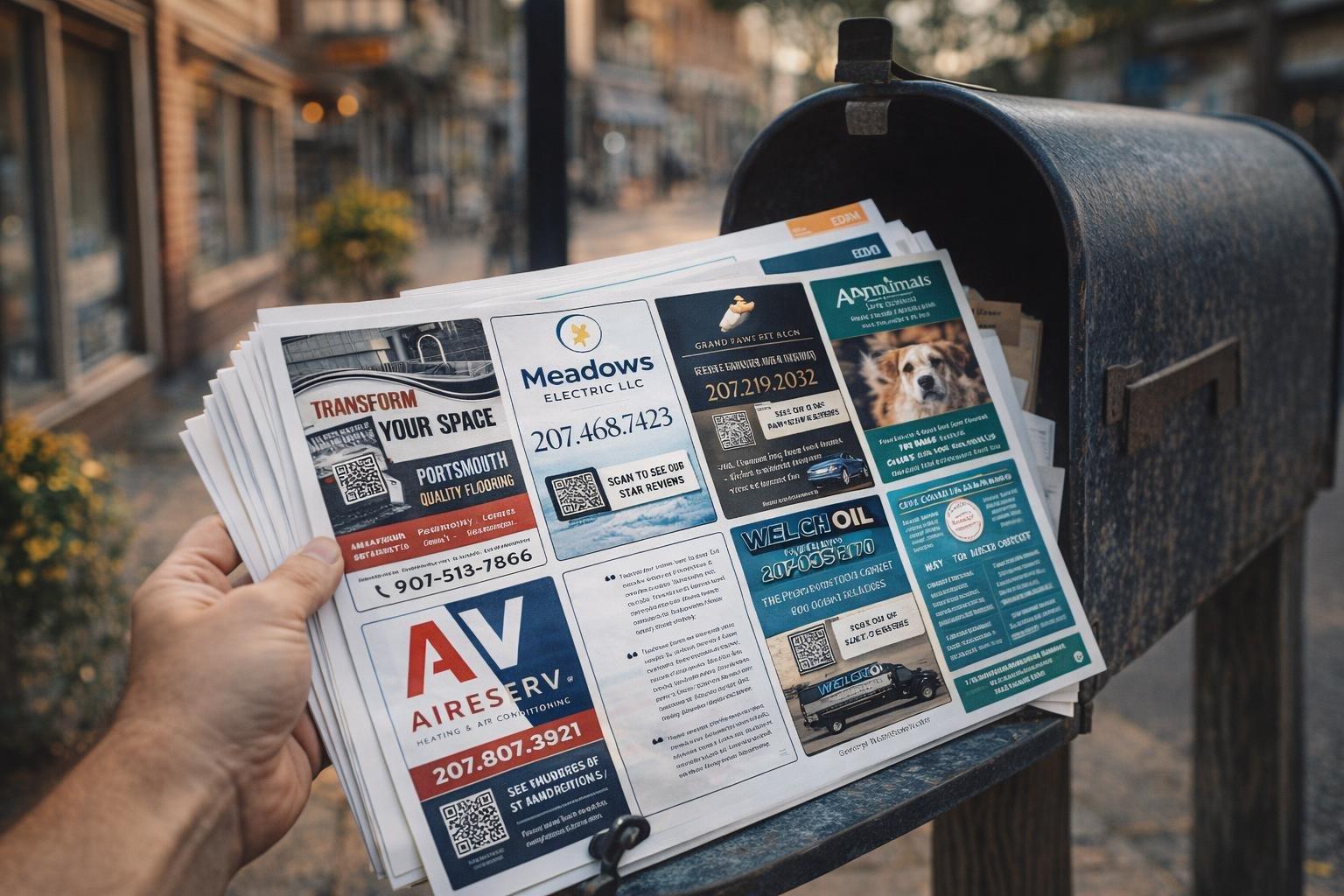
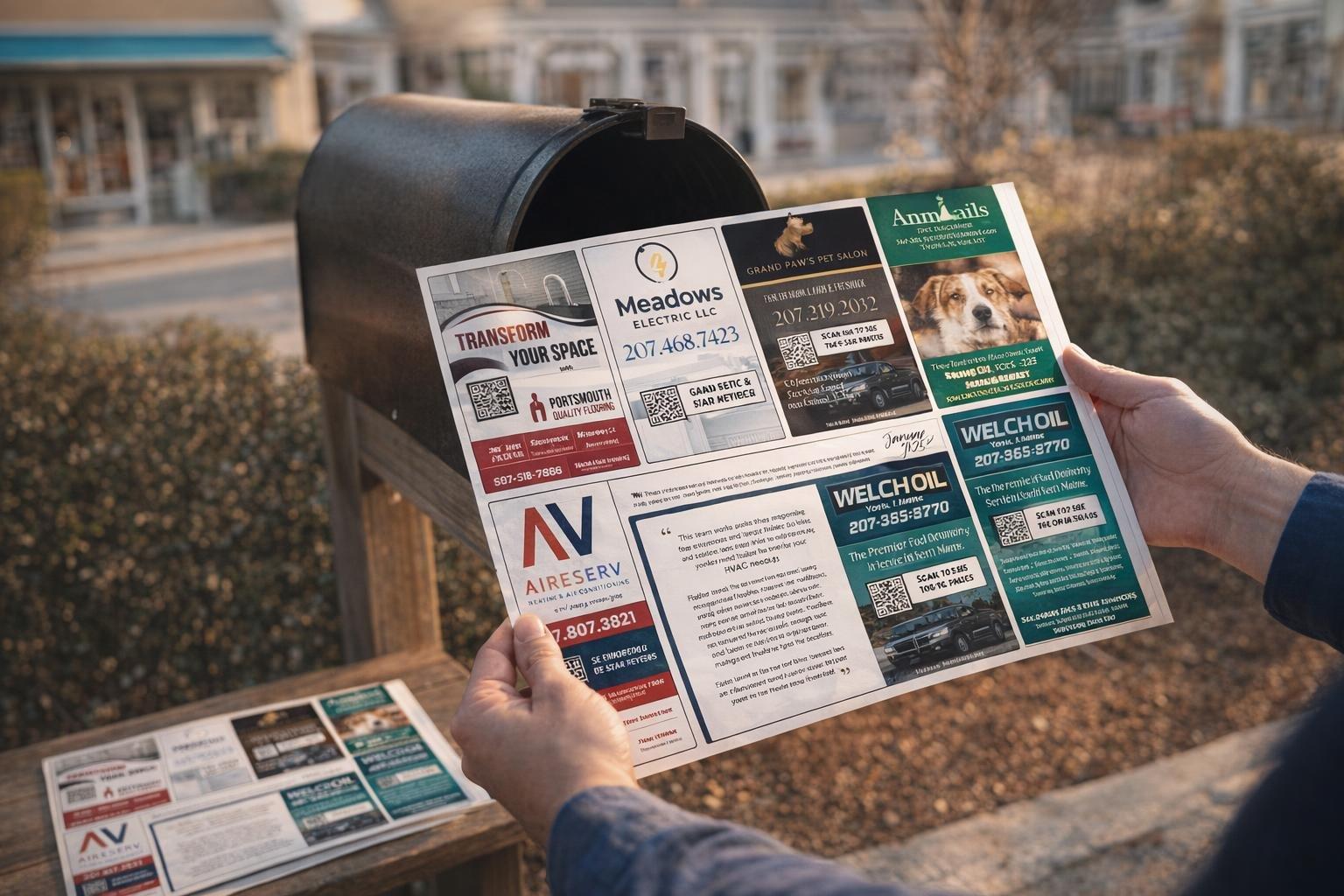
A 9x12 shared postcard is one big card with about 16 ad spots. You sell the spots first, collect the money, and only then pay to print and mail it to 5,000 homes with USPS Every Door Direct Mail. Here's the math with our real prices:
16
Spots per card
$500
Price per spot
$8,000
Revenue per card
$2,999 All Inclusive
Print, postage, mailing (5,000 homes)
$5,001
Profit per card
$0
Money needed upfront
The $2,999 is our 9x12 Method Printing All Inclusive package: print, pack, postage, and drop-off to USPS. And because advertisers pay before you print, you never front the money. That's how people start it with no money. Want something smaller to start? A community card runs 16 spots at $250 and mails to 2,500 homes for $1,449 All Inclusive.
Let me put the two side by side, because this is really the whole decision:
Billboard: you pay for land, permits, and a structure first. Then you sell the faces.
Shared card: you sell the spots first. Then you pay to print with their money.
It's not glamorous. It's boring but profitable. And if one card goes badly, you're out some time, not a six figure structure.
If you've looked at other ways to own a local ad channel, like how to start a local magazine, you'll see the same pattern. Models where you build first carry the most risk. Models where the advertiser pays first carry the least.
Here's my favorite part, and it works whether you ever build a sign or not. Every local business on a billboard is a business that already spends real money on advertising. That makes them one of the best prospect lists in your town.
Michael, one of our members, saw a company on a billboard, called them on a Wednesday, and got told to send an email. They opened it, called him back, and bought a spot on his card for two months. That's it. One billboard, one call, one sale.
Here's the line that came up on one of our community calls for exactly this situation:
"I noticed you're doing a lot of billboard advertising. That's kind of expensive. How's it working out for you?"
Then you offer the card as a way to reach the same people, right in their mailbox. You're not telling them the billboard is bad. You're giving them a second touch for a lot less.
The simple version:
Drive your main roads and write down every local business on a billboard.
Add them to the free 9x12 Method CRM so you don't lose track of who you called.
Reach out the same week, by phone or email, with a mockup of their ad on a real card.
If you want the rest of the playbook, here's how to find advertisers for a card from scratch, and a bunch of other local advertising channels that point you to businesses with a budget.
Full transparency. I teach all of this inside the 9x12 Method community, with the scripts, the card templates, and coaching calls. You don't need it to get started. Everything above works without it. But if you want people in your corner, it's there.
There's no honest single number, because land, permits, and structure costs change a lot by state and town. The best sourced figure I found is a February 2025 Billboard Insider reader survey: one in three readers spend $80,000 to $100,000 to build a 14 by 48 foot steel monopole. Add the land lease, permits, engineering, insurance, and lighting on top.
Maybe. Near Interstates and federal-aid primary highways, an off-premise billboard within 660 feet of the road generally has to be in a commercial or industrial zone, and it has to meet your state's size, spacing, and lighting rules. Many towns add their own limits, and some ban new billboards completely. Call your state DOT's outdoor advertising office and your local planning department before you do anything else.
Yes, in almost every case. Along controlled highways you need a state outdoor advertising permit, and most towns also require zoning approval and a building permit for the structure. States enforce this because federal law cuts 10% of certain highway funds from any state that doesn't control outdoor advertising.
It depends on the location and the deal, so I won't guess at a monthly number. The one hard data point is from a large billboard company's 2025 annual report: its land lease costs came to about 17% of its billboard revenue, and its leases ran from month-to-month to over ten years.
It can be, and the industry hit a record $9.46 billion in U.S. out-of-home ad revenue in 2025 according to OAAA data. But your profit depends on three numbers only you can get: what it costs to build, what the lease costs, and what your faces actually rent for. Until you have local quotes for all three, any payback period is a guess.
A shared postcard. You sell about 16 ad spots to local businesses, collect the money first, then print and mail one card to 5,000 homes. With our All Inclusive printing at $2,999, a full 9x12 card at $500 a spot is $8,000 in and $5,001 profit, with $0 upfront. Billboard advertisers make great prospects for it, since they already pay for advertising.
Whatever you decide to build, go in with real numbers, not someone's guess. As always, I'm rooting for you.
Ready to run your own card?
Get the course, scripts, tools, and weekly coaching inside the 9x12 Method community.
 Mitchell Tebo