Community Postcards: The World’s Fastest Cash Side Hustle
Mitchell TeboOctober 6, 202512:33
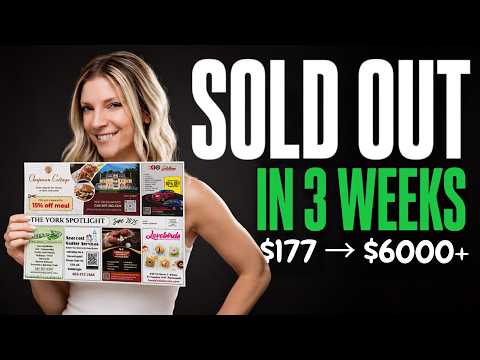
Mitchell explains the community card, a smaller shared mailer to about 2,500 homes that sells faster than a 9x12, and walks through selling one step by step.
Key takeaways
- Mailing about 2,500 homes instead of 5,000 cuts printing and postage sharply, which is what lets the community card charge less per slot.
- A lower slot price is "yes money" owners approve without asking a spouse or partner, and some buy just to block a competitor.
- Community card ads use a simple coupon-style template with a logo, contact info and one offer, so design takes far less time.
- Home services, auto businesses, dentists and chiropractors buy readily, while realtors are usually a tough fit because they lack a clear offer.
- Collect payment before designing or holding any spot, then send a handwritten thank you or small gift after mailing to earn renewals.
Read the full guide
 Getting Started
What Is a Community Card? The Complete Guide
A community card is a 6x11 postcard with 16 local business ads mailed to 2,500 homes. How the format works, what it costs, and why it beats coupon packs.
13 min readVideo
 Getting Started
How to Start a Community Card Business in 2026
How to start a community card business: the 6x11 postcard with 16 ad slots at $250 each. Step-by-step guide to $2,551 profit per card, zero upfront cost.
17 min readVideo
Read the full transcript
Auto-generated from the video, lightly formatted. Expect a few typos.
You may already know that this is a 9x12 postcard. And you might already know that you can make around $5,000 in profit by selling all 16 ad slots on this card to local businesses in your town. You may already know you charge $500 per slot, which gives you $8,000 in revenue. After paying $3,000 or $4,000 for printing, postage, and fulfillment to send it to 5,000 doors, you end up with around $5,000 in profit in your pocket at the end of the month. You may already know that and it's pretty amazing, right?
That's why the 9x12 is the backbone of this entire business model. But here's the thing. What if you're just starting out? You don't have a ton of contacts. You don't have a ton of sales experience.
and the idea of convincing 16 businesses to fork over $500 is just seems out of reach, feels a little intimidating. Or maybe you've already run a 9x12 postcard, but now you're in between campaigns and you want a way to keep cash flowing in without having to wait another few weeks to fill your next card up. That's where the community card comes in. The community card is like the little brother of the 9x12. It looks very similar, but it's smaller, it costs less, and in this way, it's much faster.
For many people, it's the easiest way to make your first $1,000 in profit in this business. Far easier than the 9 by12. And honestly, it could be the fastest way to build confidence, momentum, and a pipeline of advertisers that you can then upsell later. So, let's break it all down. If we put the two cards side by side, the 9x12 is obviously larger.
The community card is typically 6 1/2 in x 12 in. So, it's the same length, but just a bit shorter in height. Now, the size difference doesn't really matter much to the average customer. Most homeowners aren't looking through their mailbox, sitting there measuring postcards with a ruler, but what really matters is the mailing on your end. The 9x12 postcard usually goes to 5,000 homes, whereas the community card usually goes to about 2500 homes.
And since every door direct mail postage is about 24 cents per card, regardless of the size of the card you're sending out, cutting your mailing list in half means massive cost savings for you. So, instead of printing a huge card and mailing 5,000 copies, you're printing a smaller card and mailing half as many. And that's what makes this model special. Now, let's be clear. I'm not saying you're going to make more money on a community card than you would on a 9x12.
That would be nice, but unrealistic. The truth is, $500 ad slots on a 9x12 take a lot of work. Many of you probably already know that they're worth it and sometimes a few let me think about it conversations before you close the deal. The community card, on the other hand, changes that equation. It's not about maximum profit per card.
It's about speed. It gives you a way to make quicker sales, stack smaller wins, and keep momentum going, and more important, gain confidence if you're new. So, here's how the numbers break down. On a community card, you'll usually charge around $200 per slot, or you could say $199. So, let's say you sell 16 slots at $200 each.
That's $3,200 in revenue. Printing and fulfillment for 2500 homes will probably run you about $1,500 to $1,800. And that's with postage included. So that leaves you around $1,500 in profit in your pocket at the end of the day. So yes, clearly there's less profit per card.
But here's the question. Would you rather grind for 4 weeks filling up your 9x12 postcard or fill a community card in 5 days and already have cash in hand and have already made some connections? Some operators even run three, four, or even five community cards every month across different towns. So that's $4 to $7,000 profit while also building a giant database of businesses that trust them. So let's talk psychology for a second.
Why is it so much easier to close a $200 ad than it is to close a $500 ad? Think about it from the business owner's perspective. At $500, they have to ask themselves, "Will this make me my money back? How many customers am I going to need? How many coffees am I going to have to sell?
Is this really worth it?" They may even need to talk to their spouse if they're a really small business or their business partner, their office manager. It feels like an actual decision. Whereas at $200, or more realistically $199, they barely need to think. It's pennies to them.
They spend that much money on computer paper for the office. They spend that much on a couple of boosted Facebook posts that disappear within a couple of days. 200 bucks is yes money. It's money that they can part with without losing sleep. Especially in this economy where every penny counts, that's important.
That's why community cards sell so much faster. And here's another secret. Sometimes businesses don't even justify it as marketing. They simply justify it as defense. Let's say you're talking to an HVAC company.
They might think if I don't take this spot, then my competitor will. And I really don't want them to steal that neighborhood from me. So even if they don't expect a huge ROI, they'll still pay the 200 bucks just to block somebody else from joining it. Again, it's yes money. That's why you'll often hear business owners say yes faster than you'd expect often times.
Now, let's talk about design. As you know, on a 9x12, you usually do more custom layouts, custom designs. Each advertiser might want like a specific look, a specific branding, a certain design style. It can take a little more time. Whereas on a community card, the design is templated.
Each business gets a simple coupon style box with their logo, their contact info, and a straightforward offer. That's it. It's uniform, it's clean, and it's very easy to produce, which is different from the 9x12 ads. And because it's plug-and-play, you're not spending days trying to make each ad look perfect. In this case, businesses don't expect a polished, award-winning ad for 200 bucks.
They just want the exposure of $2,500. And the coupon style format works beautifully. And by the way, if you'd like a head start on this design, comment the word template down below. I'll send you an exact Canva template for the community card that you can download, edit, and use for your own campaign. Literally, just plug in your client's logos, swap the text, swap the contact info, and you're done.
Again, just comment template down below, and I'll send that over to you for free. Now, let's talk about industries. As you may know, if you've already done a 9x12, higher ticket home services are still the best. HVAC, painters, landscapers, window cleaners, roofers, these guys love local exposure. Car related businesses also work really well, like car dealers, car washes, auto repairs, oil change stops, and also dentists, chiropractors, health businesses love it, too.
Restaurants can work, but honestly, they're a hit or miss. And realtors, although they're great on a 9x12 card, they're usually tough on community cards because they really don't have like a discount or offer that they can provide, and they are more focused on highass branding. So, I recommend sticking with high ticket service businesses, and you'll fill cards in no time. So, now let's go step by step. How do you actually run a community card?
Hint, it's very similar to the 9x12 postcard. Step one is prospecting. You can do that on Facebook Messenger, emails, phone calls, or literally walking doortodoor with a sample. Just walking into the local shops. You can send a short message simply saying something like, "Hey, I'm running a a local community postcard featuring locally respected businesses.
It's going to be mailed to 2500 homes right here in town. Would you like me to hold you a spot?" And that's all you say. And honestly, because it's such a low price point, you may even experiment with just adding the price in at the end, like saying it's just 200 bucks. Sure, we're commoditizing ourselves, but remember, this is a small goal for the bigger picture, which is building a 9x12 campaign and making connections with local businesses that allows us to upsell other services.
But anyways, no long pitch, no overexlaining, just keep it super simple. Step number two is collecting payment. You can use Stripe, PayPal, Square, or whatever you're most comfortable with, even Venmo. Those are all free and simple to set up. And I have a Stripe tutorial somewhere on my YouTube channel that you'll be able to find.
Some businesses even prefer to pay you with a check, which is great because then you don't have to pay stupid transaction fees. Now, take the $200 upfront. Always. Do not chase money. Don't design anything until they pay.
Don't put them on the card. Don't hold their spot until they pay. Don't waste your time with lolly gaggers. You'll see that there are some people out there who really love to just waste your time, and that's common in any business. But the small businesses who are serious are willing to pay instantly.
Step number three is collecting their logo and coupon. Again, keep it simple. Just say, "What do you want to offer? 10% free consultation, first service, discount." Then you just drop it into the template.
Again, comment template, and I'll just send it over to you. So, you don't have to design it yourself. Now, step four is sending the card to print and fulfillment. So, we at the 9x12 method can handle this for you from printing all the way through fulfillment all the way to the post office all the way to the mailboxes. Just email me at 9 by12 method@gmail.
com for up-to-date pricing. And then step number five, if you don't go with our all-inclusive service is mailing. And the US Postal Service every direct mail system makes it easy. You just choose the postcard routes. You drop the cards off at the post office and they handle the rest.
And again, if you don't want to touch the cards and lug them over to the post office at all, we offer that fulfillment service so we can get them to the post office and totally fulfilled for you after we print them. And finally, step six is retention. After the card mails, send the businesses that joined you a handwritten thank you card or even just a small tiny little gift. That little gesture just completely sets you apart and keeps them coming back for more. People love working with people that they love and you'd be shocked how well something that small actually works.
Now, let's talk about objections, cuz it's not all sunshine and rainbows. What if a business says something like, "I've tried mail before and it didn't work. It was way too expensive." You should say, "Well, I'm sorry to hear that. I totally understand."
The difference here is that instead of spending thousands of dollars on a solo mailer, like it sounds like you did before, you're getting exposure in the same exact amount of homes for just a tiny fraction of that cost. So, it's much easier to get the ROI when you're paying just a slight fraction of that cost, but going to the same amount of homes. Or what if they say, "I don't like giving discounts." Well, you are the business owner. You could say, "No problem.
You don't have to. A lot of businesses just put their name, their logo, and a simple call to action." Of course, you're the business owner. You get to decide that. Sometimes just being seen by 2500 local households every month is enough.
And what if they say, "I'm not sure if it's worth it." You can say, "Listen, for the price of a couple dinners out, you're in 2500 mailboxes in town every month. If one customer comes in, it pays for itself and more. And that's not even considering the repeat business that could create and the referrals if you provide great service, which I'm sure you do. That's why so many small businesses love to hop on this card.
Okay, and here's the real secret. Community cards aren't just about the first $1,500 in profit. They're about creating momentum. When you get your first card filled, your confidence goes through the roof. Now you know you can do this.
You've gotten 16 people to hand over their cash. Now you've got real advertisers who have actually paid you cold, hard cash. Now you've got proof for yourself and to show other businesses. Mentally, that makes it 10 times easier to go out and pitch for the next card. And eventually, you'll probably transition those advertisers into your actual 9x12 postcard campaigns because that's where the real big profits come in.
Or you can just stick to doing the community cards altogether and just do multiple of them per month. The choice is yours. You get to decide once you succeed with it. So, here's the real takeaway I'm trying to give to you. The 9 by1 12 postcard is your premium product and it delivers bigger profits to you and it gives you more prestige whereas the community card is your fasttrack product or your downell.
It delivers smaller profits per card but it fills faster, builds momentum, creates relationships and sets you up for bigger upsells. Both work and some smart operators figure out ways to offer both of them either as upsells or as downells like I talked about. If you want to learn exactly how to do this step by step, I actually just added a full community card module inside the 9 by12 postcard sales mastery course, which is already in our school community. So, if you're already one of the 2700 members in that community, you've already got access to that to that module. Just go to that course.
It's no extra cost. That means now you have both options side by side to build your business and you get to choose. And if you're not already in the community, click the link in the description to join us. And once again, if you'd like me to send you that exact Canva template that I use for community cards that you can just save and then use for yourself, just comment the word template down below and I'll send it right over to you so you can start selling slots immediately without worrying about design. And please like this video if you're considering doing a community card or even if you just feel like you learned something from this.
That way I know that I should actually put more effort and create a more in-depth tutorial video going through step by step how to create a community card. And now, click this video here to see my 1-hour training on exactly how to sell out your first 9x12 postcard and make $5,000 in your first month in profit if you do plan on stepping it up at some point. As always, I'm rooting for you. Peace.
New videos every week on YouTube.
Subscribe on YouTube