9x12 Method vs Community Card — My New Favorite (Simplest Business Ever)
Mitchell TeboMarch 19, 202611:30
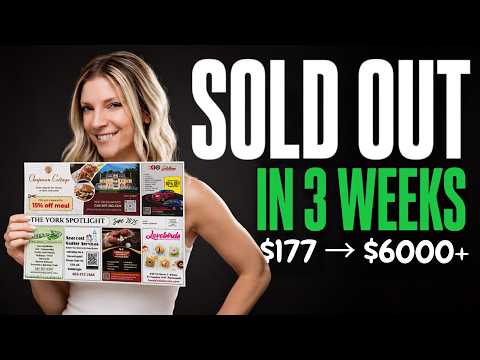
Mitchell compares the 9x12 postcard with the 6x11 community card and explains why he now recommends beginners start with a community card before upgrading.
Key takeaways
- A 9x12 card sells 16 slots at $500 to reach 5,000 homes, while a community card sells 16 slots at $250 to reach 2,500 homes.
- Beginners often sell two community cards in the time one 9x12 takes, so their monthly profit ends up very similar.
- The lower ask feels like a small test to business owners, so new operators have more conversations and build sales skills faster.
- Every community card grows a list of advertisers and near-advertisers that becomes the warm list for your first $500 9x12 slots.
- Mitchell's plan: fill a community card in about two weeks, refine pricing and categories over a few cards, then invite advertisers to a 9x12.
Read the full guide
 Getting Started
9x12 Postcard vs Community Card: Which Should You Run?
9x12 postcard vs community card — full side-by-side comparison of size, cost, profit, sales difficulty, and which one to start with as a new operator.
12 min readVideo
 Getting Started
Community Card Pricing: How Much to Charge Per Slot
How much should you charge per slot on a community card? Breakdown of $250 pricing, profit math, and when to charge more for your 6x11 postcard mailer.
14 min read
Read the full transcript
Auto-generated from the video, lightly formatted. Expect a few typos.
$5,100 per month to sell a 9x12 postcard or $2,600 every 2 weeks [music] to sell a community card. Which would you rather earn? On paper, those sound like almost the same thing, plus or minus a couple hundred dollars, but they are oh so very different. And I've officially decided that I have a favorite, especially for beginners to the postcard side hustle game. This video is for those of you who have been working on your 9x12 postcard side hustle and have been [music] struggling to make that first sale, or maybe you've not even started at all and you're still stuck in planning mode.
Or maybe this is the first video you've seen about it. If so, welcome. And you're in luck because I've officially decided which card you should start selling first, >> and just a hint, it is not what you'd expect. And I'm going to break down exactly why, what advantages this sets up for you, and how you should think about transitioning to the other card when the time is right. And if you do not know what the 9x12 method is, welcome to the channel.
The 9x12 method is a shared direct mail business model where you take a big 9x12 inch postcard, you sell advertising slots on that card to local businesses for $500 each, then you print and mail that one card to 5,000 doors in town. All of the businesses split the cost of the mailing and you keep the [music] spread as your profit. It's basically like running a mini billboard in people's mailboxes without needing a big agency or crazy overhead. And it is one of the cleanest ways that I know to turn sales conversations into real local income. Now, let's lay out the two options clearly so we're all on the same page.
Option one, the traditional 9x12 postcard. This is the big premium feeling card that you mail to 5,000 homes in a specific area. You go out and sell ad slots to local businesses, and I recommend you charge $500 for a slot. When you fill all 16 slots, that's $8,000 collected up front, and total fulfillment, like printing on nice cardstock and mailing it to 5,000 [music] homes, is going to cost you around $2,900, which means you are left with roughly $5,100 in profit from a single sold out 9x12 postcard. And most people, especially when they're new to this, take about a month to sell out a card like this, give or [music] take.
Sometimes it's a bit faster, sometimes a bit slower, but roughly a 30-day push to fill it and get it into the mailboxes. And option two is community card. This is a 6-in by 11-in card that typically goes to 2,500 homes instead of 5,000. You still sell ad slots to local businesses, but this time you're charging less for each [music] slot. I recommend $250 per slot on the community card.
Again, with 16 advertisers, that's $4,000 collected upfront. Total fulfillment to print and mail 2,500 of these 6x11 cards is around $1,400, which means when you sell out a community card, you're left with around $2,600 in profit. So, the cost to fulfill the card is cheaper, meaning you can charge less per slot, which means quicker and easier sales. People typically sell out their first community card in roughly 2 weeks, around that 14-day mark. >> So, yes, the profit per card is lower than the 9x12, but it tends to fill much faster and get you that first real win much sooner.
Now, before I go way deeper into which one I think you should start with and [music] why, this is a good moment to tell you that if you know you actually want to do this in your town, we have an amazing community wrapped around all of this. There's over 2,800 members inside working on the 9x12 method and selling out the community cards. And we have a combined course that walks you through both models step-by-step, plus the scripts, templates, [music] and we have live group calls. You'll see real wins from members in there like these. [music] Michelle sold seven slots in 48 hours despite her busy day job running an event venue.
>> That's literally $3,500 in 2 days. And Michael sold 10 slots in a single day despite working a full-time job just from emailing and calling local businesses. That's literally $5,000 in a single day. That's ridiculous, but you see what I'm getting at. And as you can see from this screenshot, there's hundreds more wins exactly like those ones.
So, if you want to plug into that >> the link to join is in the description of this video. Now, let's talk about what those numbers really mean. Because on paper it's easy to hear $5,100 in profit from a 9 by 12 and $2,600 profit from a community card and think, well, obviously I should start with the bigger one. The 9 by 12 sounds way better. That's only half the story.
If you only ever ran one campaign a month forever, then yeah, [music] the 9 by 12 would win. $5,100 is more than $2,600. But in practice, what I see with beginners is that they can comfortably sell and mail two community cards in the amount of time it would have taken them to sell out [music] one 9 by 12 card. So, two community cards at $2,600 profit is $5,200, which basically matches the 5,100 you would have made from one 9 by 12 postcard. So, when you zoom out to a monthly income view, the raw earning potential can end up very similar.
And that's why the real question is not which postcard makes more money on paper, the real question is which starting point gives you the highest [music] chance of actually getting those wins, building your skills, and creating momentum if you are starting from zero. To be fair, let me talk about what is so great about the 9 by 12 so you understand why I still love it and why my channel is named after it. When the 9 by 12 lands in someone's mailbox, it dominates the other mail. It feels like a real community advertising campaign. Businesses see the size and they instantly understand that it has presence in the mailbox.
That perception makes it much easier for you to confidently charge $500 for a slot. You can create [music] premium positions and charge more for the ones that stand out. And because the card is larger and it reaches 5,000 homes instead of [music] 2,500, it's very easy for a business owner to picture the value that they're getting. Once you get a couple of 9 by 12 campaigns under your belt, you can build a really nice recurring revenue engine where your month [music] might be as simple as filling your regular advertisers in and then just reaching out to a few new ones, then just sending the artwork to print and banking around $5,100 in profit every time the card goes out. The catch that I keep seeing though is that when you are brand new and you [music] don't have any proof yet, asking a business owner for $500 on something they have never seen you do before can feel very intimidating.
And because it feels intimidating, a lot of people simply do not have enough of those conversations. They They procrastinate. [music] They spend weeks tweaking their pitch, redesigning their card, rethinking the neighborhood that they're going to send it to, and they never really get into sales mode all together. >> So, now if we compare it with the community card experience, this is where my opinion has shifted hard. [music] With the community card, your ask is only $250 instead of $500.
For a lot of business owners, that lives in a much easier budget bucket. It feels like a small test instead of a [music] huge decision, which means they say yes way faster. It is way easier to close sales on this thing. And because the card is smaller and the investment is way lighter, you can sell it more casually through Facebook messages, quick phone calls, short emails, and walk-ins without feeling like you have to deliver some massive formal presentation. Don't get me wrong, the 9 by 12 is still simple, [music] but this just takes it to the next level.
And that means you're more likely to actually take more swings at bat. You're going to talk to more people, you're going to hear some objections still, and you're going to build your sales muscles way faster. And that speed is everything in the beginning. Your first community card is something you can very realistically sell out and mail within about 2 weeks. So, you get your first win very quickly.
You put about $2,600 profit in your pocket, [music] which will get you in a nice financial place. You get to hold a physical card that you can hold in your hand and show to your next prospects. >> And most importantly, you start building a list of advertisers and almost advertisers [music] that you can go back to for future campaigns. Every time you run a community card, you're growing that advertiser list in the background. This is your ecosystem.
These are people who have already trusted you enough to spend money with you or who are very close to saying yes. And that list becomes the pool you will pull [music] from when it's time to launch your first premium 9 by 12 postcard at $500 a slot. And this is why the heart of my official recommendation has changed. [music] It's not that the 9 by 12 stopped working at all. It's just that I've seen how starting with the community card sets you up for success with the 9 by 12 method instead of you trying to jump straight into the hardest version on day one.
The community card gets you into momentum quickly. It teaches you [music] sales without as much fear because the ask is way smaller. Gives you real proof and stories to share. It builds the warm list that turns your future 9x12 into a natural upgrade instead of a cold pitch. Honestly, [music] I wish I started out with community cards when I first started.
Would have been a way smoother process. So, if I were starting from scratch today, >> here's exactly how I'd approach it. Phase one, start with the community card. Pick a solid specific neighborhood. Use a simple layout and focus on filling 16 [music] slots at $250 each.
Your only job in this phase is to talk to enough businesses to fill that card and get it into the mail roughly two weeks later. Not to make it look like the fanciest design on earth. It's very simple. Just get it real, printed and delivered. [music] While you're doing that, you keep track of everyone you talked to, at least in a basic spreadsheet, but I recommend the 9x12 method CRM.
So, you are building that asset, that ecosystem. Now, once you've mailed that first card and ideally a second and maybe a third card, you start to refine. You may raise your price a little if the market is responding really well. You double down on categories that got good results and you [music] trim out the ones that didn't. You collect testimonials from your advertisers and simple quotes around [music] their experience and you keep all of those organized somewhere.
And this is also the phase where being inside of the school community and going through the combined community card and 9x12 method course makes a huge [music] difference because you can see what's working for other people in this transition. You can plug in the proven scripts and not reinvent the wheel alone. And then, phase three is where you upgrade. Once you have that core group of advertisers who like you and have seen you deliver, you go back to them and say something like, "Hey, we're putting together a bigger 9x12 inch postcard that's going to 5,000 homes in this area. The ad space is larger.
It has more presence in [music] the mailbox. The ad designs are more custom and we're only taking one business per category. And the investment this time is $500. Would you like a shot at that spot?" And at that point, the 9x12 isn't not scary at all.
It's just the next logical step for people who already know you pull through. And over time, you end up with the best of both worlds. Community cards that reliably generate [music] around $2,600 profit in a couple of weeks and build your base. I recommend using this as a down sell. And 9 by 12 cards that drop about $5,100 when you sell it out.
And when [music] you stack the two together, this is where the income starts to get really fun and consistent because you're keeping that ecosystem tight. [music] So, if this breakdown is helping you see the picture more clearly and helping you decide, tap the like button for me cuz it genuinely helps me grow the channel so I can keep making deep dives like this. And as a thank you, here's a carton of strawberry milk with chocolate milk pouring out of it onto some fruity pebbles. Pretty cool, huh? I also plan to make your job in launching your first community card a whole lot easier actually.
So, if you want my Canva template for the community card so that you don't have to design the card from scratch, just comment the word template and I will send it to you. You can literally plug in your advertisers, change a few colors, change the contact info, and be ready to go. So, both the 9 by 12 postcard and the 6 by 11-in community card are powerful and they both work. But after seeing enough people actually try this in the real world, my official recommendation is [music] that you start with the community card first so that you can get faster wins, easier sales, and real proof under your belt. Then use that momentum and those relationships to upgrade into [music] the bigger 9 by 12 campaigns when you're ready.
Plus, these things are like made of gold, look. If you want my help doing this [music] step by step with other people who are on the same path, the link is in the description to join our community and accelerate your process a whole lot. It's not totally mandatory for success, but it'll save you a ridiculous amount of time. And as they say, [music] time is money, baby. Now, if I've convinced you to start with the community card, you probably should learn exactly how the step-by-step process works.
So, watch this video next. It's where I go in depth on exactly how to build, price, and sell out your first community card from start to finish. Okay, love you.
New videos every week on YouTube.
Subscribe on YouTube